 HYGO News
 Trump Signs Four Education EOs: Restores School Discipline, Eliminates Disparate Impact Theory, AI Workforce Training, Harvard Foreign Gifts
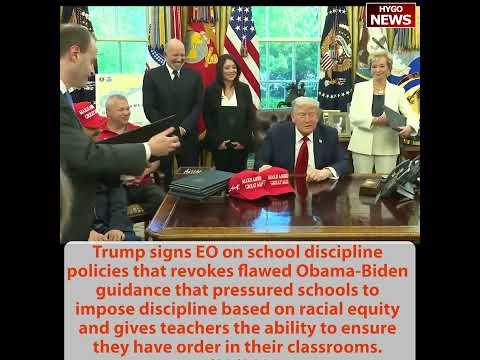
Trump Signs Four Education EOs: Restores School Discipline, Eliminates Disparate Impact Theory, AI Workforce Training, Harvard Foreign Gifts
President Trump signed four executive orders on education and workforce policy in April 2025. The first revoked Obama-Biden school discipline guidance that “made it almost impossible for schools to enforce adequate disciplinary policies” — an adviser explained it “gives teachers the authority now to have discipline in their classroom.” The second eliminated disparate impact theory from federal regulation, described as “a theory that underlies a lot of the modern DEI and CRT-driven diversity culture.” The third created AI education and workforce development opportunities for American youth. The fourth targeted universities like Harvard for failing to disclose large foreign gifts, charging departments with “enforcing the laws on the books.” Trump reacted: “Trillions of dollars being invested in AI. A very smart person said AI is the wave of the future.”
School Discipline Restored
An adviser presented the first executive order with a clear explanation of the problem it addressed.
“Under the Biden administration — first Obama and then Biden — the Department of Justice issued guidance that made it almost impossible for schools to enforce adequate disciplinary policies,” the adviser said.
He described the consequence: “This created issues in the classroom for teachers and students alike. Basically they focused on CRT and sort of diversity ideology instead of actually just enforcing the rules in classrooms to ensure a safe learning environment.”
He explained the fix: “This executive order revokes that prior guidance and puts us back in a place where hopefully the Department of Education can focus on education and teachers can focus on teaching in a safe environment.”
Trump asked for confirmation of the impact, and the adviser affirmed: “Yeah, absolutely, because it gives teachers the authority now to have discipline in their classroom and discipline the person who is being disruptive.”
Trump noted: “We took that away.”
The Obama-era school discipline guidance had been one of the most consequential and controversial education policies of the past decade. It pressured schools to ensure that disciplinary actions — suspensions, expulsions, and other consequences — were proportional to each racial group’s share of the student population. If Black students were suspended at higher rates than white students, the school was presumed to be discriminating, regardless of whether the individual disciplinary decisions were justified.
The practical effect was that teachers lost the ability to maintain classroom order. A disruptive student could not be disciplined if doing so would worsen the school’s racial disparity statistics. Teachers reported being unable to remove violent or chronically disruptive students from classrooms because administrators feared federal investigations. The students who suffered most were the well-behaved students in the same classrooms — disproportionately minority students in underserved schools — who lost instructional time to chaos that teachers were powerless to address.
Disparate Impact Theory Eliminated
The second executive order targeted the legal theory that had underpinned much of the DEI regime.
“This is a theory that underlies a lot of the modern DEI and CRT-driven diversity culture,” the adviser explained.
He described the change: “The basic idea here is instructing your departments and agencies to no longer rely on disparate impact theory as they’re regulating, as they’re issuing guidance, as they’re making rules.”
He stated the replacement philosophy: “We want to focus on results. We want to focus on actual fairness. We want to focus on merit — not things like disparate impact theory and the whole sort of diversity, equity, and inclusion cult.”
Trump’s reaction: “Let’s get rid of that, huh?”
Disparate impact theory held that any policy or practice that produced different outcomes for different racial groups was presumptively discriminatory, regardless of whether the policy itself was racially neutral. A hiring test that all applicants took equally could be challenged as discriminatory if one racial group passed at a lower rate than another — even if the test was directly relevant to job performance.
The theory had been weaponized across federal regulation. Lending standards that required credit scores were challenged because they produced different approval rates by race. Zoning regulations were challenged because they affected neighborhoods of different racial compositions differently. Criminal background checks for employment were challenged because they affected racial groups at different rates.
The executive order’s instruction to federal agencies to stop relying on disparate impact theory represented a fundamental shift from equity (equal outcomes) to equality (equal treatment). Under the new framework, the question was not whether a policy produced equal results across racial groups but whether it treated every individual equally regardless of race.
AI Education and Workforce Development
The third executive order addressed the future of the American workforce.
“This next executive order relates to artificial intelligence education,” the adviser said. “The basic idea is to ensure that we properly train the workforce of the future by ensuring that schoolchildren, young Americans are adequately trained in AI tools so that they can be competitive in the economy years from now as AI becomes a bigger and bigger deal.”
Trump assessed the landscape: “AI is where it seems to be at. We have literally trillions of dollars being invested in AI.”
He cited expert opinion: “And somebody today, a very smart person, said that AI is the wave of the future. I don’t know if that’s right or not, but certainly very smart people are investing in it heavily.”
The AI education EO complemented the workforce development order Trump had signed earlier that week targeting one million apprenticeships. Together, the two orders addressed both the immediate need (skilled tradespeople for reshored manufacturing) and the long-term need (AI-literate workers for the technology economy).
The scale of AI investment Trump referenced — “literally trillions of dollars” — was not an exaggeration. Microsoft, Google, Amazon, and other technology companies had committed unprecedented capital to AI infrastructure, including data centers, semiconductor fabrication, and research facilities. Ensuring that American workers could use, manage, and advance AI technologies was essential to capturing the economic benefits of that investment.
Harvard and Foreign Gifts
The fourth executive order targeted universities that had failed to disclose foreign funding.
“There are currently laws on the books requiring certain disclosures of universities when they accept large foreign gifts,” the adviser explained. “We believe that certain universities, including for example Harvard, have routinely violated this law, and this law has not been effectively enforced.”
He described the remedy: “So this executive order charges your departments and agencies with enforcing the laws on the books with respect to foreign gifts from American universities.”
The foreign gift disclosure issue had been a growing concern in national security circles for years. Universities — particularly elite institutions like Harvard — had accepted billions of dollars from foreign governments and foreign-controlled entities, including from China, Saudi Arabia, Qatar, and Russia. Federal law required disclosure of foreign gifts exceeding $250,000, but compliance was spotty and enforcement was virtually nonexistent.
The national security implications were significant. Foreign governments that funded American universities could influence research priorities, gain access to sensitive technology, and shape academic discourse in ways that served their strategic interests. Chinese funding of American university research programs was particularly concerning given the ongoing technology competition between the two countries.
The Common Thread
The four executive orders shared a common theme: restoring institutions to their intended purposes. Schools should educate, not impose racial ideology. Regulations should ensure fairness, not engineer racial outcomes. Workforce training should prepare Americans for the economy that exists, not the one that ideologues imagine. Universities should serve American interests, not foreign donors.
Each order reversed a specific distortion that the progressive capture of institutions had introduced. The school discipline guidance had turned classrooms into laboratories for racial equity theory. Disparate impact theory had turned neutral policies into presumptive discrimination. Educational institutions had become vehicles for foreign influence rather than engines of American competitiveness.
Key Takeaways
- School discipline EO revokes Obama-Biden guidance: “It gives teachers the authority to have discipline in their classroom and discipline disruptive students.”
- Disparate impact theory eliminated from federal regulation: “We want to focus on merit, not the diversity, equity, and inclusion cult.”
- AI education EO ensures young Americans are “trained in AI tools so they can be competitive as AI becomes a bigger deal.” Trump: “Trillions being invested.”
- Harvard targeted: universities must disclose large foreign gifts under existing law that “has not been effectively enforced.”
- Four EOs in one session — all restoring institutions to their core purposes rather than progressive ideology.