 HYGO News
 Liberation Day: Trump Signs Reciprocal Tariff EO -- 'Chronic Trade Deficits Are a National Emergency'
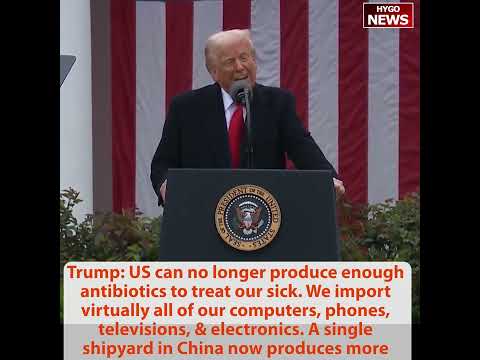
Liberation Day: Trump Signs Reciprocal Tariff EO — “Chronic Trade Deficits Are a National Emergency”
President Trump signed the executive order implementing reciprocal tariffs from the Rose Garden on April 2, 2025 — “Liberation Day” — declaring that “chronic trade deficits are no longer merely an economic problem. They’re a national emergency that threatens our security and our very way of life.” He cataloged America’s strategic vulnerabilities: “We can no longer produce enough antibiotics to treat our sick. We import virtually all of our computers, phones, televisions, and electronics. A single shipyard in China now produces more ships every year than all the American shipyards combined.” Trump then cited economic progress: energy costs down, groceries down, gasoline “way under $3,” and 10,000 new manufacturing jobs created in weeks.
”A National Emergency”
Trump’s Rose Garden speech was not a trade policy announcement. It was a national security declaration.
“The United States can no longer produce enough antibiotics to treat our sick,” Trump said. “We have a tremendous problem. We have to go to foreign countries to treat our sick. If anything ever happened from a war standpoint, we wouldn’t be able to do it.”
The antibiotic dependency was one of the most alarming facts in the president’s catalog. The United States — the country that had pioneered modern antibiotics with the mass production of penicillin during World War II — had offshored pharmaceutical manufacturing to such an extent that it could not produce enough basic antibiotics for its own population. In a wartime scenario where supply chains were disrupted, Americans would die not from enemy weapons but from untreatable infections.
Trump moved to electronics: “We import virtually all of our computers, phones, televisions, and electronics. We used to dominate the field, and now we import it all from different countries.”
Then shipbuilding: “A single shipyard in China now produces more ships every year than all of the American shipyards combined. Think of that. And it was a business that we used to dominate. We used to dominate it totally.”
The shipyard comparison was perhaps the most strategically significant statistic in the speech. Naval power had been the foundation of American global influence since World War II. The ability to build ships — warships, cargo vessels, support craft — was essential to maintaining that power. If a single Chinese shipyard outproduced every American shipyard combined, the United States could not sustain a naval competition with China over the long term. The trade deficit was not just costing jobs; it was eroding the industrial base on which military power depended.
Trump drew the conclusion: “In short, chronic trade deficits are no longer merely an economic problem. They’re a national emergency that threatens our security and our very way of life. It’s a very great threat to our country.”
The Executive Order
“And for these reasons, starting tomorrow, the United States will implement reciprocal tariffs on other nations,” Trump announced. “It’s been a long time since we even thought of that.”
The executive order declared chronic trade deficits a national emergency under the International Emergency Economic Powers Act (IEEPA). This legal framework gave the president broad authority to regulate international commerce in response to declared emergencies — authority that did not require congressional approval.
The reciprocal tariff structure meant that each country would face tariffs proportional to the barriers it imposed on American exports. Countries that charged high tariffs on American goods would face high tariffs on their goods entering the United States. Countries with more open markets would face lower rates. The system created an automatic incentive for every country to reduce its own barriers: the fastest way to lower American tariffs on your goods was to lower your tariffs on American goods.
The Rose Garden setting for the first outdoor event of the administration underscored the significance. The cabinet was present. The press corps was assembled. The cherry blossoms were in bloom. Liberation Day was being staged as a historic event — and the executive order being signed would affect every trading nation on Earth.
The Strategic Vulnerabilities
Trump’s catalog of American dependencies — antibiotics, electronics, shipbuilding — was not a random list. Each item represented a category of production that had once been dominated by American industry and had been systematically offshored over decades of free-trade orthodoxy.
Antibiotics represented pharmaceutical dependency. If China or India decided to restrict pharmaceutical exports during a conflict, Americans would face drug shortages within weeks. The COVID-19 pandemic had already demonstrated the vulnerability of medical supply chains; the antibiotic dependency was orders of magnitude more dangerous.
Electronics represented technological dependency. The devices that ran American businesses, military operations, and daily life were manufactured almost entirely overseas. A disruption in semiconductor supply chains — whether from a Chinese invasion of Taiwan, a natural disaster, or deliberate export restrictions — could paralyze the American economy.
Shipbuilding represented industrial dependency. The ability to build large vessels was a proxy for broad-based heavy manufacturing capability. A country that could not build ships could not build the machinery, components, and systems that constituted an advanced industrial base. The Chinese shipyard comparison was a canary in the coal mine for America’s entire manufacturing sector.
Economic Progress
Trump closed with the evidence that his first two-plus months in office had already begun to reverse the trajectory.
“Energy costs now are down,” he said. “Groceries are down. Gasoline is way under $3, and people are beginning to be able to buy things and live again. We brought prices way down.”
On jobs: “We created 10,000 already, in a few weeks, new manufacturing jobs. And that took place in one month. Numbers that they haven’t seen in a long time.”
He cited his first-term record: “We had virtually no inflation under my term. We had virtually no inflation for four years.”
The economic data served as evidence that the administration’s approach was working before Liberation Day — and that the reciprocal tariffs would accelerate rather than disrupt the positive trajectory. Critics who warned that tariffs would cause inflation had to contend with the fact that prices were already falling and manufacturing jobs were already growing under the administration’s existing tariff regime.
The Historic Context
Liberation Day represented the most significant restructuring of American trade policy since the passage of NAFTA in 1994 — or arguably since the Smoot-Hawley Tariff Act of 1930. But unlike Smoot-Hawley, which imposed blanket protectionist tariffs during a depression, the reciprocal tariff framework was designed to be dynamic: rates adjusted based on each country’s behavior, creating incentives for negotiation and mutual reduction of barriers.
The national emergency declaration elevated the tariffs from a trade policy to a security measure. Trade deficits were not merely about economic efficiency or comparative advantage; they were about the survival of the industrial base that produced antibiotics, electronics, and warships. A country that could not make its own medicines, build its own devices, or construct its own fleet was a country that had outsourced its sovereignty.
Trump’s promise that the tariffs would be “far more generous than those countries were to us” — repeated throughout the week leading up to Liberation Day — suggested that the rates, while significant, would be lower than what other countries charged the United States. The reciprocal framework meant America was asking for nothing more than equal treatment — a position that was difficult to argue against in principle.
Key Takeaways
- Trump signed the Liberation Day EO declaring chronic trade deficits “a national emergency that threatens our security and our very way of life.”
- He cataloged strategic vulnerabilities: America can’t produce enough antibiotics, imports virtually all electronics, and a single Chinese shipyard outproduces all U.S. shipyards combined.
- Reciprocal tariffs would be implemented starting the next day, with rates proportional to each country’s barriers against American exports.
- Economic progress cited: energy costs down, groceries down, gasoline “way under $3,” and 10,000 new manufacturing jobs created in weeks.
- Trump: “We used to dominate” pharmaceuticals, electronics, and shipbuilding — “and now we import it all from different countries.”