 HYGO News
 Trump Signs EO Cracking Down on Ticket Scalping with Kid Rock in Oval Office; Le Pen Ban 'Sounds Like This Country'
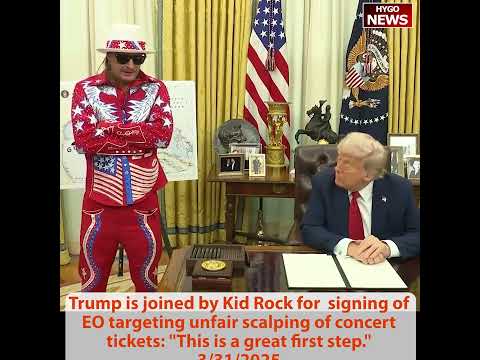
Trump Signs EO Cracking Down on Ticket Scalping with Kid Rock in Oval Office; Le Pen Ban “Sounds Like This Country”
President Trump signed an executive order in April 2025 targeting ticket scalping in the live entertainment industry, with Kid Rock standing beside him in the Oval Office. The order directed the FTC and DOJ to “rigorously enforce laws on the books” against bots and algorithms that “buy up huge blocks of tickets and then jack up the price.” Kid Rock called it “a great first step” and described how fans buying a $100 ticket end up paying $170 at checkout, while bots relist tickets at “four or five hundred percent markup — and the artists don’t see any of that money.” Separately, Trump reacted to Marine Le Pen’s conviction and five-year ban from running for office: “That’s a big deal. That sounds very much like this country.”
The Executive Order: FTC and DOJ Enforcement
A White House official introduced the order by explaining the problem it was designed to solve.
“This is an executive order that deals with the ticket reselling business,” the official said. “For fans of live entertainment and for entertainers as well, the ticket reselling industry has become a huge issue.”
He described the mechanism: “These people use bots and computer algorithms to buy up huge blocks of tickets and then jack up the price, so that fans of live entertainers like Mr. Rock don’t have access to concerts the way that they should. And when they do, it’s at exorbitantly high prices.”
The official outlined the order’s directives: “It charges the FTC and the Department of Justice with rigorously enforcing laws on the books, in collaboration with state attorneys general that have power over consumer protection, and other people who have the power to really crack down on this issue, so that entertainers and fans won’t be subject to these abusive and oftentimes illegal practices.”
The executive order directed multiple agencies to act. The FTC would enforce the Better Online Ticket Sales (BOTS) Act, which had been on the books since 2016 but inconsistently enforced. The DOJ and FTC would jointly ensure competition laws were applied to the entertainment industry. The Treasury Department and DOJ would verify that scalpers complied with tax laws — a provision targeting the underground economy of ticket reselling that generated billions in unreported income. And within 180 days, Treasury, DOJ, and FTC would deliver a report recommending additional regulations or legislation.
Kid Rock: “A Great First Step”
Kid Rock provided the perspective of someone who had lived the problem for decades.
“First of all, thank you, Mr. President, because this has happened at lightning speed,” Kid Rock said. “I know you put — I want to make sure Alina Habba gets her credit too, because I know she worked very hard on this. But thank you for making this happen so quick.”
He described the consumer experience: “Anyone who’s bought a concert ticket in the last decade, maybe 20 years, no matter what your politics are, knows it is a conundrum. You buy a ticket for 100 bucks, by the time you check out it’s 170. You don’t know what you’re being charged for.”
Then the bot problem: “But more importantly, these bots — they come in to get all the good tickets to your favorite shows you want to go to, and then they’re relisted immediately for sometimes a four or five hundred percent markup. And the artists don’t see any of that money.”
Kid Rock called the order “a great first step” and suggested future legislation: “I would love down the road if there would be some legislation that we could actually put a cap on the resale of tickets. And I’m a capitalist and a deregulation guy, but they’ve tried this in some places in Europe and it seems to be the only thing that lets us as artists be able to get the tickets into the hands of the fans at the prices we set.”
He offered a surprisingly self-deprecating assessment of his own economics: “I’ll be the first one to say — and I know the president doesn’t like what I say — but I’m a little overpaid right now. It’s kind of ridiculous. I would rather be a hero to the working-class people and have them be able to come attend my shows and give them a fair ticket price. I can’t control that right now, so hopefully this is a step to really be able to make that happen.”
The admission that he was “a little overpaid” was disarming and authentic. Kid Rock was not a typical celebrity advocate; he was acknowledging that the system was broken in a way that benefited him financially while hurting the fans he cared about. His advocacy for ticket price caps — despite being “a capitalist and a deregulation guy” — reflected a genuine recognition that the free market had failed in this specific sector because bots and algorithms had corrupted the price discovery process.
Marine Le Pen: “That Sounds Like This Country”
When a reporter asked about the conviction of Marine Le Pen — the French far-right leader who had been banned from running for office for five years — Trump drew an immediate parallel to his own experience.
“That’s a big deal,” Trump said. “That’s a very big deal. I know all about it, and a lot of people thought she wasn’t going to be convicted of anything.”
He noted the nature of the penalty: “I don’t know if it means conviction, but she was banned from running for five years, and she’s the leading candidate.”
Then the comparison: “That sounds like this country. That sounds very much like this country.”
The parallel Trump was drawing was to the multiple prosecutions he had faced between his first and second terms — indictments that he and his supporters believed were designed to prevent him from running for president. Le Pen’s situation was different in specifics but similar in structure: a populist political leader who was the frontrunner in her country’s next election had been judicially barred from competing. Whether the legal basis was legitimate or the prosecution was politically motivated, the effect was the same: the courts were removing a candidate from the democratic process.
The “sounds like this country” observation resonated because Trump had survived what Le Pen had not. He had been indicted, prosecuted, and yet had won the presidency. Le Pen had been convicted and banned. The comparison implied that American democracy, for all its flaws, had ultimately allowed the voters to overrule the prosecutors — a correction that France’s system had not yet made.
The Broader Consumer Protection Agenda
The ticket scalping executive order was an unusual entry in the Trump policy catalog. It was not about tariffs, border security, or geopolitical strategy. It was about concert tickets. But its populist appeal was precisely the point.
Every American who had tried to buy concert tickets in the past decade had experienced the frustration Kid Rock described: tickets that sold out in seconds, reappeared on secondary markets at four or five times the face value, and came with mysterious fees that inflated the final price well beyond what was advertised. The system was designed to extract maximum revenue from fans while enriching intermediaries — bots, scalpers, and platforms — who added no value.
By signing the executive order with Kid Rock at his side, Trump was demonstrating that the populist agenda extended beyond trade policy and immigration. The same administration that was imposing tariffs to protect factory workers was cracking down on ticket scalpers to protect concertgoers. The common thread was the same: ordinary Americans were being exploited by systems rigged for the benefit of insiders, and Trump was using executive power to rebalance the equation.
Key Takeaways
- Trump signed an EO directing FTC and DOJ to crack down on ticket scalping bots, enforce the BOTS Act, ensure price transparency, and verify scalpers’ tax compliance.
- Kid Rock described the problem: “$100 ticket becomes $170 at checkout; bots relist at 400-500% markup; artists don’t see any of that money.”
- Kid Rock called it “a great first step” and advocated future legislation capping resale prices, despite being “a capitalist and deregulation guy.”
- Trump reacted to Marine Le Pen’s conviction and five-year ban: “That’s a big deal. She’s the leading candidate. That sounds very much like this country.”
- Treasury, DOJ, and FTC will deliver a 180-day report recommending additional regulations or legislation for the live entertainment industry.