 HYGO News
 Trump Signs 'Farthest-Reaching' Election Integrity EO: Citizenship Proof Required; Treasury Payment Modernization
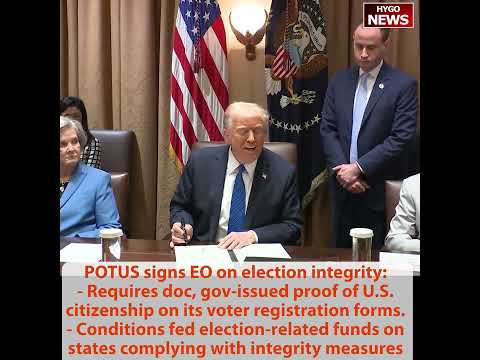
Trump Signs “Farthest-Reaching” Election Integrity EO: Citizenship Proof Required; Treasury Payment Modernization
President Trump signed two executive orders in March 2025: one on election integrity that a White House official called “the farthest-reaching executive action taken in the history of the Republic to secure our elections,” and one directing Treasury to modernize its payment systems. The election order required government-issued proof of citizenship on voter registration forms for the first time, cut federal funding to non-compliant states, directed DHS data sharing to identify illegal immigrants on voter rolls, mandated paper ballot records, and revoked Biden’s Executive Order 14019. Trump also signed a Treasury modernization order after learning that paper checks were “14 times more likely to become the subject of fraud."
"Farthest-Reaching in the History of the Republic”
The White House official who introduced the election integrity executive order made an extraordinary claim about its scope.
“We believe that this executive order is the farthest-reaching executive action taken in the history of the Republic to secure our elections,” the official said.
He outlined the central mechanism: “This is going to cut down on illegal immigrants on the voter rolls, ensure that the Department of Homeland Security and the data that they have available is being fully utilized to ensure that illegal immigrants aren’t voting.”
Then the historic first: “This will include a citizenship question on the federal voting form for the first time.”
The citizenship question had been one of the most contentious political battles of Trump’s first term, when the administration attempted to add a citizenship question to the Census and was blocked by the Supreme Court. Adding a citizenship question to voter registration forms was a different legal mechanism — registration forms were not the Census — but the principle was the same: the federal government was requiring individuals to affirm their citizenship status as a condition of participating in elections.
Funding Conditioned on Compliance
The executive order created financial incentives for states to secure their elections.
“This executive order instructs the EAC to cut federal funding to states that don’t take reasonable steps to secure their election,” the official said.
The Election Assistance Commission (EAC) distributed federal election-related funds to states. By conditioning those funds on compliance with security standards, the administration was creating a mechanism to incentivize states that had resisted election integrity measures. States that refused to verify citizenship, maintained inaccurate voter rolls, or failed to secure their voting systems would lose federal funding.
The approach mirrored the administration’s strategy in other areas: rather than mandating compliance through legislation (which required congressional action), the executive order used the leverage of federal funding to encourage state-level action.
DOJ Prosecution of Election Crimes
The order directed aggressive enforcement against election law violations.
“This calls on the Department of Justice to vigorously prosecute election crimes, particularly in states that we don’t believe are in compliance with federal law around election integrity,” the official said.
The directive to “vigorously prosecute” represented a significant escalation. Previous administrations had treated election fraud as a low-priority issue, with the DOJ’s Public Integrity Section handling a small number of cases annually. The Trump administration was signaling that election crimes would receive the same prosecutorial intensity as other federal offenses.
The targeting of “states that we don’t believe are in compliance” was particularly pointed. Certain states — typically those with Democratic leadership — had adopted election procedures that the administration considered inadequate: same-day registration without verification, ballot harvesting, extended counting periods, and mail-in voting without identity verification. The DOJ would now scrutinize these practices for potential violations of federal election law.
Revoking Biden’s Executive Order 14019
The order included the revocation of one of the Biden administration’s most controversial election-related actions.
Biden’s Executive Order 14019, signed in March 2021, had directed federal agencies to promote voter registration and participation. Critics had called it the “government voter turnout” order, arguing that it turned federal agencies into Democratic registration machines by targeting populations disproportionately likely to vote Democratic.
The White House official characterized the order in blunt terms: “Revoking President Biden’s Executive Order 14019, which essentially weaponized government to corrupt and pollute our election process.”
The revocation meant that federal agencies would no longer be directed to promote voter registration. The distinction between promoting voting and promoting partisan voting had been at the heart of the controversy — supporters of EO 14019 had argued it was nonpartisan civic engagement, while opponents had argued the targeting and implementation were designed to benefit one party.
Paper Ballots and Voting System Standards
The executive order addressed the technical infrastructure of elections.
Among its provisions: “Directs the updating of the Voluntary Voting System Guidelines 2.0 and security standards for voting equipment — which includes requiring a voter-verifiable paper ballot record and not using ballots in which the counted vote is contained within a barcode or QR code.”
The paper ballot requirement addressed one of the most common concerns about electronic voting: that purely electronic systems could be manipulated without leaving a verifiable record. By requiring paper ballot records, the order ensured that every electronic vote could be audited against a physical document.
The prohibition on barcode or QR code ballots was more specific. Some voting systems encoded votes in barcodes that were read by machines but could not be verified by human voters — meaning voters could not confirm that their printed ballot accurately reflected their choices. The order required that the counted vote be in a format that voters could read and verify.
”We’re Going to Straighten It Out”
Trump offered his personal remarks after the signing.
“Election fraud — you’ve heard the term,” he said. “We’ll end it, hopefully. At least we’ll go a long way toward ending it.”
He previewed future actions: “There are other steps that we will be taking in the coming weeks, and we think we’ll be able to end up getting fair elections.”
Trump acknowledged the paradox of his position: “Some people think I shouldn’t be complaining because we won in a landslide. But we’ve got to straighten out our elections. This country is so sick because of the elections — the fake elections and the bad elections — and we’re going to straighten it out one way or the other.”
He expressed the personal significance: “And it’s an honor to sign this one. To sign all of them, but to sign this one is a great honor.”
Treasury Payment Modernization
The second executive order addressed government payments.
The official explained the rationale: “Historically, checks issued by the Treasury are, I believe, 14 times more likely to become the subject of fraud than electronic transfer payments.”
The order: “This is an executive order that’s going to push the Treasury Department to modernize its payment system to ensure that where possible they’re using electronic methods of payment as opposed to paper checks, in order to reduce waste, fraud, and abuse.”
Trump described it simply: “It’s basically modernization of equipment and methods, and it’s something that really — I think — is going to be a great Secretary of the Treasury wanted, Scott.”
He placed it in context: “We could let somebody else, whoever’s next, whoever that may be, do it. But it’s something that should have been done 25, 30 years ago.”
The 14x fraud multiplier for paper checks versus electronic payments was a straightforward case for modernization. Every paper check the Treasury issued was an opportunity for interception, alteration, forgery, or misdirection. Electronic payments were traceable, verifiable, and far more difficult to defraud. That the federal government was still issuing paper checks in 2025 was itself evidence of the institutional inertia the administration was combating.
Key Takeaways
- Trump signed an election integrity EO described as “the farthest-reaching executive action in the history of the Republic” to secure elections.
- Key provisions: citizenship proof on voter registration for the first time, federal funding cut for non-compliant states, DOJ directed to “vigorously prosecute” election crimes.
- Paper ballot records required; barcode/QR code ballots prohibited. Biden’s EO 14019 (federal agency voter registration) revoked.
- A second EO pushed Treasury to modernize payments from paper checks to electronic transfers, since checks are “14 times more likely to become the subject of fraud.”
- Trump: “This country is so sick because of fake elections. We’re going to straighten it out one way or the other.”