 HYGO News
 Trump Signs HBCU Initiative and Accreditation Overhaul EOs: 'Merit, Not How Woke Universities Have Gotten'; 'Let's Go Brandon' Moment
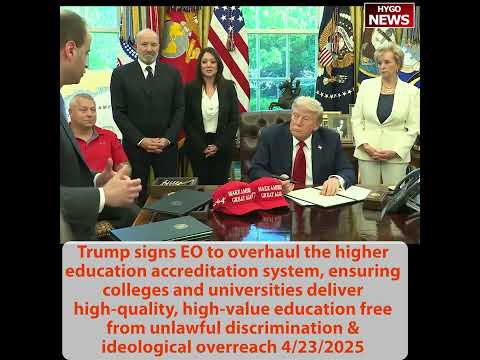
Trump Signs HBCU Initiative and Accreditation Overhaul EOs: “Merit, Not How Woke Universities Have Gotten”; “Let’s Go Brandon” Moment
President Trump signed executive orders establishing a White House Initiative on Historically Black Colleges and Universities and overhauling the university accreditation system in April 2025. On HBCUs, an adviser explained: “We’re setting up a White House initiative making sure every aspect of your administration is working to ensure HBCUs are able to do their job effectively.” On accreditation, the adviser stated: “Many third-party accreditors have relied on woke ideology instead of accrediting based on merit and performance. The basic idea is to force accreditation to be focused on actual results, not how woke these universities have gotten.” Trump questioned admissions standards: “They’re allowing people into school that can’t do math, and yet kids who are number one in their class can’t get into the best schools. What is that all about?” A veteran in the room produced a “Let’s Go Brandon” photo of Biden for Trump to sign.
HBCU White House Initiative
An adviser presented the HBCU executive order by connecting it to Trump’s first-term record.
“During your first administration, you made promoting Historically Black Colleges and Universities — HBCUs — a major priority,” the adviser said.
He explained the new action: “This executive order takes existing law on HBCUs and brings it into effect. We’re going to be setting up a White House initiative on HBCUs.”
He described the mission: “The basic idea here is making sure that every aspect of your administration is working to ensure that HBCUs are able to do their job as effectively and as efficiently as possible.”
The HBCU initiative represented a continuation of Trump’s first-term outreach to the Black community through institutional support. During his first term, Trump had signed the FUTURE Act, providing permanent funding for HBCUs and other minority-serving institutions. He had also moved the White House HBCU Initiative from the Department of Education to the Executive Office of the President, elevating its profile and its access to administration resources.
The second-term executive order formalized and expanded this support. By ensuring that “every aspect” of the administration worked to support HBCUs, the order created an obligation across all federal agencies — from the Department of Defense (which funded HBCU research) to the Department of Health and Human Services (which funded HBCU medical programs) — to actively support these institutions.
HBCUs occupied a unique and important place in American higher education. Despite representing a small fraction of four-year colleges, they produced a disproportionate share of Black professionals in STEM fields, medicine, law, and other professions. Supporting HBCUs was one of the most effective mechanisms for expanding educational opportunity and economic mobility for Black Americans — and it was a policy that received bipartisan support.
Accreditation Overhaul: “Merit, Not Woke”
The accreditation executive order addressed a problem that had corrupted American higher education from within.
“University accreditation is currently a process controlled by a number of third-party organizations — that’s by statute, by law,” the adviser explained.
He identified the corruption: “Many of those third-party accreditors have relied on sort of woke ideology to accredit universities instead of accrediting based on merit and performance.”
He described the fix: “This executive order affects a number of changes to the university accreditation process, also applies to law schools and other graduate programs.”
He stated the principle: “But the basic idea is to force accreditation to be focused on the merit and the actual results that these universities are providing, as opposed to how woke these universities have gotten.”
He outlined specific reforms: “So we’re setting up new accreditation pathways, we’re charging the Department of Education to really look holistically at this accreditation mess and hopefully make it much better.”
The accreditation system was one of higher education’s least understood and most powerful mechanisms. Accreditation determined whether a university’s degrees were recognized, whether its students could receive federal financial aid, and whether its credits transferred to other institutions. Losing accreditation was an existential threat to any university.
The problem was that accreditors had increasingly used their power to impose ideological requirements. Universities seeking or maintaining accreditation were evaluated not just on educational quality but on their commitment to diversity, equity, and inclusion metrics. This effectively made DEI compliance a condition of operating as a university — without any legislation or democratic accountability.
”They Can’t Do Math”
Trump asked pointed questions about admissions standards that revealed the absurdity of the current system.
“Will we look into the past, people that they’ve taken?” Trump asked. “For instance, I hear all about certain great schools, and then we read where they’re going to teach people basic math — math that we can all do very easily, but they can’t do there.”
He pressed the point: “Going to the top school and they’re going to come out with a program of teaching basic math to somebody that got into a Harvard or a Princeton or Yale. Is that part of this?”
The adviser confirmed: “When universities are not performing appropriately, whether that’s in admissions or in their actual instructional activities, that’s certainly something that accreditors should be considering, and right now we believe they’re not doing a good enough job.”
Trump stated the injustice: “They’re allowing people into school that can’t do math, and yet kids who’ve worked really hard and are number one in their class at a high school someplace in New Jersey or in Mississippi — they can’t get into the best schools. What is that all about?”
Secretary McMahon connected it to the broader philosophy: “I think that gets to your policy, sir, of meritocracy — that we should be looking at those who have real merit to get in, and we have to look harder at those universities that aren’t enforcing that.”
Trump’s observation cut to the heart of what had gone wrong with elite university admissions. Institutions that admitted students based on race rather than qualification were then forced to provide remedial instruction in basic subjects — teaching college students math that high school students should have mastered. Meanwhile, students who had earned their way through academic achievement were denied admission because they belonged to the wrong demographic group.
The accreditation overhaul aimed to break this cycle by requiring accreditors to evaluate universities on outcomes — graduation rates, employment rates, student debt levels, and actual learning — rather than on ideological compliance.
The “Let’s Go Brandon” Moment
The signing ceremony produced an unscripted moment that instantly went viral.
Trump noticed something one of the veterans had brought: “Who’s that picture on there?”
The veteran answered: “That is Joe Biden — and it says ‘Let’s Go Brandon.’”
An aide interjected: “I told him he wasn’t allowed to ask you to sign it.”
Trump laughed: “That’s very good.”
The exchange — a veteran asking the president to sign a “Let’s Go Brandon” photo of his predecessor — captured the irreverent humor that characterized Trump’s interactions with military personnel. The “Let’s Go Brandon” phrase, which had become a cultural phenomenon as a coded criticism of Biden, was being deployed by a veteran in the Oval Office itself.
Trump’s amused reaction — and the aide’s admission that the veteran had been told not to ask — made the moment human and relatable. The Oval Office was not always about policy and protocol; sometimes it was about a veteran with a sense of humor and a president who appreciated it.
Key Takeaways
- Trump signed an EO establishing a White House HBCU Initiative, ensuring “every aspect of the administration works to support HBCUs effectively.”
- Accreditation overhaul: “Force accreditation to focus on merit and actual results, not how woke universities have gotten.” New pathways established.
- Trump questioned elite admissions: “They allow people who can’t do math into Harvard, while kids who are #1 in their class can’t get in. What is that about?”
- Secretary McMahon: “It gets to the president’s policy of meritocracy — looking at those who have real merit.”
- A veteran produced a “Let’s Go Brandon” Biden photo for Trump to sign, drawing laughs in the Oval Office.