 HYGO News
 Trump enters US-Saudi Forum, Saudi Arabia's $600B invest in US; Bessent touts Trump's trade, tax cut
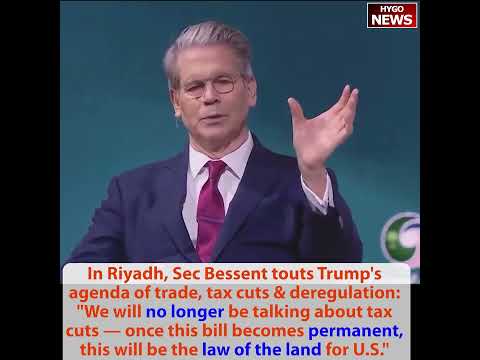
Trump enters US-Saudi Forum, Saudi Arabia’s $600B invest in US; Bessent touts Trump’s trade, tax cut
President Trump entered the U.S.-Saudi Investment Forum at King Abdulaziz International Conference Center in Riyadh, commemorating Saudi Arabia’s $600 billion commitment to invest in the United States. Treasury Secretary Scott Bessent delivered substantive remarks on the Trump economic agenda’s three parts: trade, tax cuts, and deregulation. Bessent noted tariffs, non-tariff trade barriers, currency manipulation, and subsidies of labor and capital are coming down quickly — making him “optimistic that on trade we could actually see more frictionless trade globally.” Bessent acknowledged tax bill progression “moving better than I would have expected, as a newcomer to Washington” — expecting passage by summer 2025 making the 2017 Tax Cuts and Jobs Act permanent with additional capital-friendly features including 100% expensing. Bessent: “We will no longer be talking about tax cuts — once this bill becomes permanent, this will be the law of the land for the U.S.” Announcer introduction: “Please welcome his royal highness, Prince Mohammed bin Salman, bin Abdul Aziz al Saud, Crown Prince and Prime Minister, and the 45th and 47th President of the United States of America, Mr. Donald Trump.” Bessent on tax cuts: “We will make the 2017 Tax Cuts and Jobs Act permanent. We will add more features that are very friendly to capital. We’re going to bring back 100% expensing. If you build a factory in the U.S., you can expense it immediately.”
Forum Opening
“Please welcome his royal highness, Prince Mohammed bin Salman, bin Abdul Aziz al Saud, Crown Prince and Prime Minister, and the 45th and 47th President of the United States of America, Mr. Donald Trump.”
The formal introduction — both heads of state announced together. The “45th and 47th” framework for Trump emphasizing his unique non-consecutive distinction.
The King Abdulaziz International Conference Center — major Saudi convention venue in Riyadh — hosted the forum.
$600 Billion Commitment
“Saudi Arabia’s $600 billion commitment to invest in the United States.”
The scale — $600 billion — among the largest foreign investment commitments in U.S. history. The sources:
- Saudi Public Investment Fund (sovereign wealth)
- Private Saudi investment
- Partnership structures
- Joint ventures
- Strategic partnerships
Target sectors:
- Technology
- Energy (renewable and traditional)
- Defense
- Real estate
- Infrastructure
- Financial services
Three-Part Economic Agenda
“The Trump economic agenda really consists of three parts.”
Bessent’s framework for the Saudi-American business audience:
- Trade
- Tax cuts
- Deregulation
Each part requires detailed explanation to sophisticated international investors.
Trade Part
“Thus far, we have seen trade, which has gotten most of the publicity.”
Trade has received significant attention because:
- Tariff announcements dramatic
- Currency manipulation addressed
- Non-tariff barriers targeted
- Bilateral negotiations visible
- Market impact immediate
“President Trump wants to reorder the U.S. engagement with other countries.”
The reordering framework — fundamental reset of U.S. trade relationships.
“I will tell you that the tariffs, the non-tariff trade barriers, currency manipulation, subsidies of labor and capital are coming down quickly.”
Bessent’s observation — global reductions in trade distortions. Other countries responding to U.S. pressure.
“So I am optimistic that on trade we could actually see more frictionless trade globally.”
The paradox — aggressive U.S. trade policy producing more frictionless global trade. Countries reducing their barriers to maintain U.S. market access. The tariff threat driving liberalization.
Tax Cuts Part
“The second part of the agenda, which is moving better than I would have expected, as a newcomer to Washington.”
Bessent’s personal framework — his experience in Washington brief (as new Treasury Secretary). He acknowledged uncertainty about legislative process.
“I would say that it was my highest level of anxiety, the tax bill.”
Bessent’s honest admission — tax legislation was his biggest worry.
“The 2017 Tax Cuts and Jobs Act was not passed until December, just before Christmas of President Trump’s first year.”
The historical parallel — TCJA took nearly a year in Trump’s first term.
“I believe that we will have it passed this summer.”
Bessent’s expectation — faster passage in second term. OBBB in fact signed July 4, 2025.
TCJA Permanent
“We will make the 2017 Tax Cuts and Jobs Act permanent.”
The core provision — TCJA individual tax cuts (originally expiring 2025) made permanent. Prevents massive middle-class tax increase.
“We will add more features that are very friendly to capital.”
Additional provisions beyond TCJA extension:
- 100% expensing
- No tax on tips
- No tax on overtime
- No tax on Social Security
- Auto loan interest deduction
- Various business provisions
100% Expensing
“We’re going to bring back 100% expensing.”
100% bonus depreciation — capital investment immediate deduction:
- Build a factory
- Expense entire cost in year one
- Major tax savings
- Encourages investment
- Drives capital formation
“If you build a factory in the U.S., you can expense it immediately.”
The simple explanation — tax code rewards American manufacturing investment.
“If the equipment for that factory can be expensed in the first year, and we think that that will be very powerful.”
Equipment expensing:
- Machinery
- Technology
- Specialized tools
- Production equipment
- All immediately deductible
Growth Engine
“That was the most powerful aspect of driving growth and jobs during President Trump’s first term.”
Bessent’s observation — 100% expensing drove first-term growth more than other tax provisions. The immediate write-off creates incentive for immediate capital deployment.
“I believe that permanent, so we will no longer be talking about tax cuts.”
Making provisions permanent ends the uncertainty cycle:
- No more temporary extensions
- No more sunset anxiety
- Predictable framework
- Long-term investment certainty
“Once this bill becomes permanent, this will be the law of the land for the U.S., and there will be great certainty on the tax side.”
The certainty value — businesses can plan investments based on permanent rules rather than temporary provisions.
Deregulation Part
“And then the third side is deregulation.”
Bessent’s third pillar. Specifics:
- Agency rulemakings pared back
- Executive orders removing regulations
- Congressional Review Act rescissions
- Agency leadership appointments
- Regulatory philosophy change
The deregulation framework produces:
- Lower compliance costs
- Faster project approvals
- Reduced litigation
- Innovation enabling
- International competitiveness
Kingdom and U.S. Parallel
“When I look at the Kingdom, when I look at the U.S., the one thing I see is great optimism and a can-do attitude.”
Bessent’s framework — both economies share optimism and can-do attitude:
- Saudi Vision 2030 transformation
- American renewal under Trump
- Both economies growing
- Both countries ambitious
- Natural partnership
Saudi Royal Court Departure
“POTUS Trump departs the Royal Court following an official state visit with Crown Prince Mohammed bin Salman.”
The ceremonial departure from the Royal Court to the investment forum venue. Protocol and security logistics.
“President Trump now heads to the King Abdulaziz International Conference Center for the Saudi-U.S. Investment Forum.”
The movement from government-to-government engagement (Royal Court) to business-to-business engagement (Investment Forum). Comprehensive bilateral framework.
Significance
The $600 billion Saudi commitment represents historic bilateral investment framework. Combined with Trump’s tax and regulatory framework, creates comprehensive investment environment:
- Saudi capital committed to U.S.
- Tax certainty for investment
- 100% expensing accelerating deployment
- Reduced trade barriers
- Deregulation removing obstacles
Bessent’s emphasis on three-part agenda (trade, tax, deregulation) provides framework for international investors to understand American economic policy.
The frictionless global trade prediction — counterintuitive for tariff-focused administration — reflects Bessent’s observation that bilateral pressure produces multilateral liberalization. Countries reducing barriers to maintain U.S. market access.
The tax cut permanence framework ends the recurring temporary extension cycle. Businesses can plan investments based on permanent rules rather than temporary provisions expiring.
100% expensing specifically — restored for manufacturers — provides immediate tax benefit for American industrial investment. The provision that drove first-term growth now permanent.
Key Takeaways
- Trump and MBS joint introduction: “Please welcome his royal highness, Prince Mohammed bin Salman, bin Abdul Aziz al Saud, Crown Prince and Prime Minister, and the 45th and 47th President of the United States of America, Mr. Donald Trump.”
- Bessent on trade: “The tariffs, the non-tariff trade barriers, currency manipulation, subsidies of labor and capital are coming down quickly. So I am optimistic that on trade we could actually see more frictionless trade globally.”
- Bessent on tax anxiety: “The second part of the agenda, which is moving better than I would have expected, as a newcomer to Washington, I would say that it was my highest level of anxiety, the tax bill.”
- Bessent on tax permanence: “We will make the 2017 Tax Cuts and Jobs Act permanent. We will add more features that are very friendly to capital. We’re going to bring back 100% expensing. If you build a factory in the U.S., you can expense it immediately.”
- Bessent on law of the land: “Once this bill becomes permanent, this will be the law of the land for the U.S., and there will be great certainty on the tax side. And then the third side is deregulation.”