 HYGO News
 Trump: end mail-in voting, it's a FRAUD; FLOTUS letter well-received by Putin; no need ceasefire
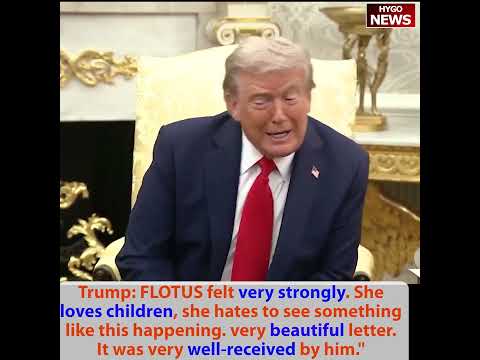
Trump: end mail-in voting, it’s a FRAUD; FLOTUS letter well-received by Putin; no need ceasefire
Trump covered three significant items during the Zelensky meeting setup. A firm commitment to end mail-in voting as “fraud” citing the Jimmy Carter Commission. First Lady Melania Trump’s beautiful letter to Putin about the war’s children, which was “very well received.” And a surprising Trump assertion that ceasefires are not necessary for peace deals — citing his six resolved conflicts this year that were all completed without ceasefires. Trump on mail-in voting: “We’re going to end mail-in voting. It’s a fraud. Even Jimmy Carter with this commission, they set it up. He said, the one thing about mail-in voting, you will never have an honor selection if you have mail-in.” On Melania: “The First Lady felt very strongly … She loves children, and she hates to see something like this happening … It was a very beautiful letter. It was very well received by him.” On ceasefires: “I don’t think you need a ceasefire … If you look at the six deals that I settled this year, they were all at war. I didn’t do any ceasefires … I like the concept of a ceasefire for one reason: because you’d stop killing people immediately.” And on both populations: “I love the Ukrainian people, but I love all people. I love the Russian people. I love ‘em all. I want to get the war stopped."
"Paper Ballots” and “Mail-In Voting”
Trump’s opening on election integrity. “Very important, paper ballots, and I think maybe even more important, the mail-in voting. We’re going to end mail-in voting. It’s a fraud.”
Two specific positions. Paper ballots as preferred. Mail-in voting to be ended. “A fraud” — not merely susceptible to fraud but specifically fraudulent in design and operation.
The specific reform package Trump has advocated:
- Paper ballots (instead of electronic-only voting)
- Same-day voting (instead of extended early voting windows)
- Voter ID requirements
- Elimination of mail-in ballots (except narrow absentee categories)
- Ballot custody chain restrictions (preventing third-party ballot collection)
“We’re going to end mail-in voting.” That is specific commitment. Executive orders alone cannot end state-level mail-in voting. Federal legislation would be required for federal elections. Constitutional amendments might be required for some comprehensive reforms. But Trump is committing to pursue the elimination through all available mechanisms.
The Jimmy Carter Commission
“Even Jimmy Carter with this commission, they set it up. He said, the one thing about mail-in voting, you will never have an honor selection if you have mail-in.”
That references the 2005 bipartisan Commission on Federal Election Reform, chaired by former President Jimmy Carter (Democrat) and former Secretary of State James Baker (Republican). The Carter-Baker Commission specifically identified mail-in voting as the most vulnerable element of American election integrity.
The Commission’s specific finding on mail-in voting: “Absentee ballots remain the largest source of potential voter fraud.” The Commission recommended specific reforms including requiring in-person voting for most voters, with absentee voting limited to specific hardship cases.
Trump citing Carter — a Democrat former president — as authority on mail-in voting vulnerabilities. That is strategic. Democrats cannot dismiss Carter as partisan Republican source. The Carter Commission’s findings specifically support Trump’s current position.
“You will never have an honor selection if you have mail-in” is Whisper’s rendering of “honest election.” The Commission’s specific concern: honest elections are incompatible with widespread mail-in voting because the chain of custody and voter identification cannot be adequately verified with mail-in ballots.
”Time That the Republicans Get Tough”
“And it’s time that the Republicans get tough and stop it, because the Democrats want it. It’s the only way they can get elected, because with men and women’s sports and with transgender for everybody and open borders and all of the horrible things.”
That is Trump’s specific political attribution. Democrats support mail-in voting because Democrats cannot win elections on their substantive positions — including transgender athletes in women’s sports, transgender rights expansions, open borders, and related cultural positions.
“It’s the only way they can get elected.” That is a strong claim. Whether mail-in voting is specifically determinative of Democratic electoral success is the empirical question. But mail-in voting demographics do favor Democrats — specifically urban, elderly, and student populations that turn out more reliably via mail-in than via in-person.
”Now the New Thing Is, They Love Crime”
“And now the new thing is, they love crime. They’re fighting me on the fact that I’ve made Washington, D.C. safe. We’re not going to get mugged, beaten up, or killed, like all the people you’ve been watching get so badly hurt.”
“They love crime.” Trump’s polemical characterization. Democrats opposing DC federalization are, in Trump’s framing, supporting the criminal conditions that existed before. Whether Democrats “love” crime or have different views on enforcement approaches is the substantive question. Trump’s framing collapses policy difference into affirmative preference.
“Fighting me on the fact that I’ve made Washington, D.C. safe.” That is Trump’s operational claim. DC is safer under federalization. Democrats opposing federalization are therefore opposing safety. The empirical question — how much DC crime has actually reduced — matters for the framing.
“We’re not going to get mugged, beaten up, or killed, like all the people you’ve been watching get so badly hurt.” Specific visceral framing. DC residents were being mugged, beaten, killed. The federalization is reducing those specific outcomes. Viewers have seen specific instances of DC crime on television. The federalization responds to the visible suffering.
Melania Trump’s Letter
“The First Lady felt very strongly. She’s watched the same thing that you watch and that I watch. I see things that you don’t get to see, and it’s horrible.”
Melania Trump’s specific engagement. She has been watching the war coverage. She has processed the specific human cost.
“I see things that you don’t get to see, and it’s horrible.” Trump referencing his access to classified intelligence. The specific ground truth of the war — specific casualty reports, specific atrocity documentation, specific intelligence about war conduct — exceeds what public media conveys. Trump has access to that deeper picture. It is “horrible.”
“But when she’s got a great love of children, she has a wonderful son that she loves probably more than anybody, including me. I hate to say it, but she loves her son. She loves children, and she hates to see something like this happening.”
Melania’s love for her son Barron. That personal connection produces specific empathy for Ukrainian children who are experiencing the war’s effects — losing parents, becoming refugees, being displaced from homes. The universal mother’s experience produces specific emotional engagement with the war.
”It Was a Very Beautiful Letter”
“No, she felt it was a beautiful letter. It was very well received by him.”
The specific letter Melania wrote to Putin. Characterized as “beautiful” — suggesting it addressed Putin on personal and moral terms rather than diplomatic technical terms. An appeal to shared humanity and concern for children.
“Very well received by him” — Putin received the letter positively. Whether Putin’s positive reception translates to specific substantive movement on children’s issues (return of abducted Ukrainian children to Ukraine, humanitarian corridors for civilian safety, etc.) is the operational question.
That Melania is actively engaged in the diplomacy — writing a direct letter to Putin that Putin specifically received and acknowledged — is noteworthy. First ladies have historically sometimes engaged in diplomatic initiatives (Eleanor Roosevelt, Nancy Reagan on arms control, Michelle Obama on education and nutrition). Melania’s engagement on Ukraine children’s issues fits that tradition.
”She Would Love to See This End”
“She did ask me to say, you know, she would love to see this end. She would love to see it end. And she says it very openly, very proudly, and with great sorrow because so many people have been killed.”
Melania asking Trump to communicate publicly her desire for the war’s end. That is specific first-lady diplomatic engagement — not merely supportive of the administration’s positions but actively contributing to the public framing.
“Great sorrow because so many people have been killed.” That is specific emotional framing. Not abstract discussion of casualty numbers. Sorrow — a specifically personal grief response to the scale of death.
“She feels it in other wars, too.” Melania’s engagement extends beyond Ukraine-Russia. The various conflicts addressed by Trump’s peace-making (Cambodia-Thailand, India-Pakistan, DRC-Rwanda, etc.) all carry human costs that Melania has processed personally.
”I Don’t Think You Need a Ceasefire”
Trump’s surprising framing. “I don’t think you need a ceasefire. You know, if you look at the six deals that I settled this year, they were all at war. I didn’t do any ceasefires. And I know that it might be good to have, but I can also understand strategically why, well, you know, one country or the other wouldn’t want it.”
That is counterintuitive. Most diplomatic models assume ceasefires precede peace deals. Stop fighting. Then negotiate terms. Trump is asserting the opposite.
“If you look at the six deals that I settled this year, they were all at war. I didn’t do any ceasefires.”
Specific empirical claim. The six conflicts Trump resolved in 2025 — India-Pakistan, DRC-Rwanda, Armenia-Azerbaijan, Cambodia-Thailand, Israel-Iran, plus others — were all resolved while fighting continued during negotiations. No prior ceasefires. Peace deals completed despite ongoing military operations.
”They Rebuild and Rebuild”
“You have a ceasefire, and they rebuild and rebuild and rebuild, and, you know, maybe they don’t want that. But if you look at the six deals that we made peace, and, you know, long-term, long-running wars, I didn’t do any ceasefires.”
The strategic counter-argument. Ceasefires allow both sides to reconstitute forces, restock ammunition, reinforce positions. The pause in fighting can be tactically disadvantageous for the winning side.
Russia specifically: a ceasefire would allow Ukrainian forces to reorganize, receive more Western equipment, conduct maintenance. Russia would face a better-prepared Ukrainian military after the ceasefire. Russia therefore resists ceasefires that do not also lock in territorial gains.
Ukraine specifically: a ceasefire would allow Russian forces to consolidate territorial gains, convert occupied areas into more permanent Russian zones, normalize conditions that would then be difficult to reverse. Ukraine resists ceasefires that do not include Russian withdrawal commitments.
Both sides have reasons to resist ceasefires. Trump’s insight: requiring ceasefires as precondition for peace negotiations may be the wrong sequencing.
”I Like the Concept of a Ceasefire”
“Would I like, I like the concept, you know, I like the concept of a ceasefire for one reason, because you’d stop killing people immediately, as opposed to in two weeks or one week or whatever it takes.”
Trump’s specific ceasefire attraction. Immediate cessation of killing. Not in two weeks. Not in one week. Immediately. Lives saved today rather than after negotiation completion.
“But we can work a deal where we’re working on a peace deal while they’re fighting. They have to fight. I wish they could stop. I’d like them to stop. But strategically, that could be a disadvantage for one side or the other.”
Trump’s framework. Peace deal negotiations can proceed during active combat. Both sides continue fighting while terms are negotiated. The deal is completed. Fighting stops at the deal’s conclusion.
“All of these deals I made without even the mention of the words ceasefire.” Trump’s framing for his 2025 diplomatic record. The six deals completed during active combat. No preliminary ceasefires required.
”I Love the Ukrainian People”
Trump’s closing. “Well, I know Ukrainian people. I’ve known many over the years. They’re great people. They’re smart. They’re energetic. They love their country. I mean, they love their country, and we want to get this war ended.”
Specific respect for Ukrainians. Smart. Energetic. Loving their country. Those are specific characteristics that Trump attributes to Ukrainians from his personal experience over years of interactions with Ukrainian immigrants, businesspeople, and political figures.
“I love the Ukrainian people, but I love all people. I love the Russian people. I love them all. I want to get the war stopped.”
The specific universalization. Not Ukrainian lives at the expense of Russian lives. Not Russian lives at the expense of Ukrainian lives. All lives matter in the specific human moral sense. Trump’s motivation is ending the war — which benefits both populations — rather than favoring one population over the other.
That framing matters politically. Anti-Putin Democrats sometimes frame the war as good-versus-evil with Russians as evil. Trump rejects that framing. Russians are human beings. Russian soldiers dying matters morally. Russian civilian suffering matters morally. Ending the war benefits Russians as well as Ukrainians.
Three Distinct Policy Commitments
End mail-in voting (election integrity policy). Melania’s letter (first-lady diplomatic engagement). No ceasefire required (diplomatic methodology shift).
Each reflects specific Trump administration thinking. Election integrity as structural reform beyond any single election cycle. First-lady engagement in peace-making. Diplomatic innovation — peace deals without ceasefires.
Together, they illustrate the administration’s willingness to challenge conventional frameworks across multiple domains — voting rules, spousal diplomatic roles, war-ending methodology. Each represents specific departure from traditional approaches.
Key Takeaways
- Trump on mail-in voting: “We’re going to end mail-in voting. It’s a fraud. Even Jimmy Carter with this commission, they set it up. He said, the one thing about mail-in voting, you will never have an honor selection if you have mail-in.”
- Trump on the Democratic electoral strategy: “It’s the only way they can get elected, because with men and women’s sports and with transgender for everybody and open borders and all of the horrible things.”
- On Melania’s letter to Putin: “The First Lady felt very strongly … She loves children, and she hates to see something like this happening … It was a very beautiful letter. It was very well received by him.”
- On ceasefires: “I don’t think you need a ceasefire … If you look at the six deals that I settled this year, they were all at war. I didn’t do any ceasefires … I like the concept of a ceasefire for one reason, because you’d stop killing people immediately.”
- On both populations: “I love the Ukrainian people, but I love all people. I love the Russian people. I love them all. I want to get the war stopped.”