 HYGO News
 Trump-Elon Musk makeup: good person bad moment; Colbert has no talent; taking over DC Police
Trump-Elon Musk makeup: good person bad moment; Colbert has no talent; taking over DC Police
An unusually wide-ranging press engagement. On Elon Musk: “I think he’s a good person. I think he had a bad moment, really bad moment. But he’s a good person. I think, I believe that.” On Stephen Colbert and late-night TV generally: “Colbert has no talent … Fallon has no talent. Kimmel has no talent. They’re next. They’re going to be going.” On DC crime: “We’re considering it, yeah, because the crime is ridiculous … including bringing in the National Guard maybe very quickly too.” Rep. Adriano Espaillat at an ICE detention center claimed “most of which have not committed any crime whatsoever” — ignoring that illegal entry itself is a crime. And NEC Director Kevin Hassett summed up the EU deal economics: “Europe agreeing to open their markets to our products … they’re letting us charge a 15% tariff, which is going to raise maybe about $100 billion a year.”
Musk: “Good Person, Bad Moment”
The reporter’s question. “I’m wondering, do you miss having him around the White House or is that whole accurate?”
Trump’s response. “I don’t know, the polls accurate. I think he’s a good person. I think he had a bad moment, really bad moment. But he’s a good person. I think, I believe that.”
That is notable framing. Trump’s relationship with Elon Musk — who had been central to DOGE’s early work and then departed amid public friction over the One Big Beautiful Bill — had visibly fractured. Musk had attacked the bill and Trump. Trump had responded with characteristic sharpness.
“Good person. Bad moment.” That is rapprochement language. Trump is not reconciling fully. He is characterizing Musk’s anti-Trump moment as an anomaly rather than character. “But he’s a good person” — the “but” reasserts the underlying positive assessment despite the friction.
“I think, I believe that.” The repetition emphasizes Trump’s genuine conviction. Not reluctant concession. Actual belief.
For Musk, that framing is itself an invitation. Trump is leaving the door open to renewed engagement. Whether Musk walks through is the operational question. Given Musk’s ongoing federal regulatory exposure (Tesla, SpaceX, xAI, Neuralink), improved relations with the administration have concrete business value.
”Only One President”
“And yet there are immigrants there, most of which have not committed any crime whatsoever, and housed in this specific…”
Rep. Adriano Espaillat’s framing at an ICE detention center. “Most of which have not committed any crime whatsoever.”
The factual problem: illegal entry into the United States is a federal crime. Illegal reentry after deportation is a more serious crime. Being in the United States without legal authorization is, at minimum, a civil violation subject to removal. Characterizing detainees as having committed “no crime whatsoever” requires ignoring the legal basis for their detention.
That framing has been repeated across Democratic voices — AOC, Letitia James, Alex Padilla, multiple House members. The pattern: decouple immigration status from criminality in rhetoric while ignoring that immigration violations themselves are legal violations.
”Does Anybody Want to Be President?”
“Does anybody want to be president? Only one president.”
That appears to be Trump’s joking aside to White House interns. The role of president has specific obligations and burdens. Trump is inviting interns to imagine the weight of the job.
Earlier in the Vance interview segment, Trump had talked about the 5% mortality rate for U.S. presidents. That framing carries through. The presidency is not a light position. Candidates need to understand what they are pursuing.
”Colbert Has No Talent”
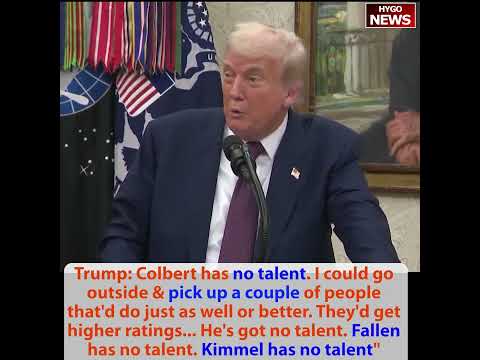
Trump’s assessment of late-night television. “Colbert has no talent. I mean, I could take anybody here, I could go outside on the beautiful streets and pick up a couple of people. They do just as well or better. They get higher ratings than he did. He’s got no talent.”
CBS had recently announced the end of The Late Show with Stephen Colbert, effectively canceling Colbert’s long-running late-night show. Trump’s assessment: Colbert’s departure reflects his lack of talent.
“Fallon has no talent. Kimmel has no talent. They’re next. They’re going to be going. I hear they’re going to be going.”
That is the forward projection. Jimmy Fallon (Tonight Show) and Jimmy Kimmel (Jimmy Kimmel Live!) will follow Colbert into cancellation. Trump claims to have heard — without specific attribution — that both are scheduled for departure.
The late-night television landscape has indeed been shifting. Cord-cutting has reduced traditional broadcast audiences. Social-media-first content has displaced appointment viewing. The economics of late-night network shows — their production costs versus declining ad revenues — have been under sustained pressure.
Whether Fallon and Kimmel’s specific departures materialize depends on network decisions. NBC and ABC have their own calculations. But Trump’s broader point — that late-night network TV is a dying format — is consistent with industry trends.
“I don’t know, but I would imagine because they get… Colbert has better ratings than Kimmel or Fallon. You know that.”
Trump confirming the comparative rating observation. Colbert had higher ratings than Kimmel or Fallon. If CBS canceled Colbert despite his rating advantage, lower-rated competitors at other networks face even greater vulnerability.
Howard Stern
The reporter pivoted. “Howard Stern is the name I haven’t heard.”
Trump’s response. “I used to do a show. I used to have fun. But I haven’t heard that name in a long time. What happened? He got terminated?”
That is characteristic Trump. He had been a frequent Howard Stern guest for decades, back when Stern’s shock-jock radio show dominated the morning commute. The two had a close personal relationship. That relationship ruptured when Stern moved toward political conservatism critique of Trump during the first term.
“Yeah, they’re going to separate ways because I think what’s an awesome salary wise is real low than what he’s getting down.”
Stern’s SiriusXM contract situation. Stern has been paid enormously for decades. His current contract, expiring soon, may not be renewed at previous levels.
”He Endorsed Hillary Clinton”
“You know when he went down? Whenever he went. You know when he went down? No. Before when he endorsed Hillary Clinton, he lost his audience. People said, give me a break. He went down when he endorsed Hillary Clinton.”
Trump’s theory of Stern’s audience loss. Stern’s 2016 Hillary Clinton endorsement alienated a substantial portion of his listener base. Stern’s audience had included significant numbers of working-class men, Trump-curious voters, and politically independent listeners. The Clinton endorsement, in Trump’s framing, drove those listeners away.
Whether that specific causal claim is accurate is contested. But Stern’s ratings have declined over the past decade. The combination of changing media landscape and Stern’s political repositioning both likely contribute.
DC Police Federalization
“Are you considering taking over the DC police? Is that an option on the table?”
Trump’s response. “We’re considering it, yeah, because the crime is ridiculous. I could show you a chart comparing DC to other locations and you’re not going to want to see what it looks like.”
“We’re considering it.” That is specific confirmation. Federalizing the DC Metropolitan Police is under active consideration. DC’s crime rate — which has been elevated over multiple years — combined with the recent DOGE staffer attack has pushed the consideration from theoretical to active.
“It was just up on television actually that we’re showing it. Now we want to have a great safe capital and we’re going to have it. And that includes cleanliness and includes other things. We have a capital that’s very unsafe.”
Broader agenda for DC. Safety. Cleanliness. Infrastructure. The capital’s physical state, in Trump’s framing, reflects poorly on America’s image. Visitors from around the world see DC. If DC is unsafe, dirty, and poorly maintained, that is American image damage.
”Beautiful Handsome Guy”
“You know we just almost lost a young man. Beautiful handsome guy that got the hell knocked out of him the night before last.”
That is the DOGE staffer reference Trump had made in the earlier segment. “Almost lost” — the attack was serious enough that the victim’s life was at risk. “Beautiful handsome guy” — Trump’s characteristic characterization, personalizing the victim.
“I’m going to call him now. We wanted to give him a little recovery time. We just put a call into him. They’re calling back a little while.”
Personal presidential engagement. Trump is calling the DOGE staffer victim. That level of personal involvement signals the seriousness with which the administration is treating the attack.
“But he went through a bad situation to put it mildly and there’s too much of it. We’re going to do something about it. So whether you call it federalized or what.”
“We’re going to do something about it.” Commitment to action. “Whether you call it federalized or what” — the specific mechanism is secondary to the outcome.
”Graffiti … Papers All Over … Roads in Bad Shape”
“And that also includes the graffiti that you see, the papers all over the place, the roads that are in bad shape, the medians that are falling down, the median in between roads that’s falling down. We’re going to beautify the city. We’re going to make it beautiful.”
Trump the developer applying his eye to DC. Graffiti. Litter. Road conditions. Infrastructure decay. All visible problems requiring specific intervention.
“What a shame. The rate of crime, the rate of muggings, killings and everything else. We’re not going to let it. And that includes bringing in the National Guard maybe very quickly too.”
“Bringing in the National Guard maybe very quickly too.” That is the escalation option. National Guard deployment to DC for public safety work. Federal military personnel providing force presence on DC streets.
National Guard deployment to DC has been used during specific high-threat moments (January 2021, various protests) but not generally as routine public-safety backup. The suggestion that it may be “very quickly” activated represents significant escalation from current norms.
Hassett on the EU Deal
NEC Director Hassett’s summary. “The president likes those deals. The Europeans like those deals. And they’re absolutely historically wonderful deals. Think about it. We’ve got Europe agreeing to open their markets to our products.”
That is the deal’s core achievement. European market access for American exports. For U.S. farmers, manufacturers, services providers, the European market of 450 million consumers is opening.
“So our farmers, our small businessmen can sell stuff in Europe like they never could before.”
“Like they never could before.” The historical framing. Previous bilateral trade agreements between the U.S. and EU had specific carve-outs, restrictions, and non-tariff barriers. The new deal opens categories that had been closed.
“And they’re letting us charge a 50% tariff, which is going to raise maybe about $100 billion a year.”
“50% tariff” is incorrect — the confirmed rate is 15%. Either Whisper error or Hassett misspoke. “Maybe about $100 billion a year” in revenue is the tariff revenue estimate — consistent with the broader $300-700 billion annualized tariff revenue figures the administration has cited.
Six Items, One Cycle
Musk rapprochement. Colbert and late-night TV commentary. DC police federalization under active consideration. Espaillat at ICE detention. EU deal revenue. Four different topical areas addressed in one press engagement.
That range reflects the administration’s operational tempo. Multiple fronts simultaneously. No single issue dominates. The president moves across economic, cultural, personnel, and security topics in the course of normal press availability.
For Democrats hoping to define Trump through any single narrative — “threat to democracy,” “racist,” “authoritarian” — the range of topics complicates the framing effort. Trump’s actual work is too broad to reduce to any single caricature.
Key Takeaways
- Trump on Elon Musk: “I think he’s a good person. I think he had a bad moment, really bad moment. But he’s a good person. I think, I believe that.”
- On late-night television: “Colbert has no talent … Fallon has no talent. Kimmel has no talent. They’re next. They’re going to be going.”
- On Howard Stern’s decline: “Before when he endorsed Hillary Clinton, he lost his audience. People said, give me a break.”
- DC Police federalization: “We’re considering it, yeah, because the crime is ridiculous … including bringing in the National Guard maybe very quickly too.”
- Rep. Adriano Espaillat claimed ICE detainees have “not committed any crime whatsoever” — despite illegal entry being a federal crime.
- NEC Director Hassett on EU deal: “Europe agreeing to open their markets to our products … going to raise maybe about $100 billion a year.”