 HYGO News
 Trump: Eggs Down 35%, Oil at $65; Alien Enemies Act 'This Is a Time of War'; Judge Rehire Order 'Absolutely Ridiculous'
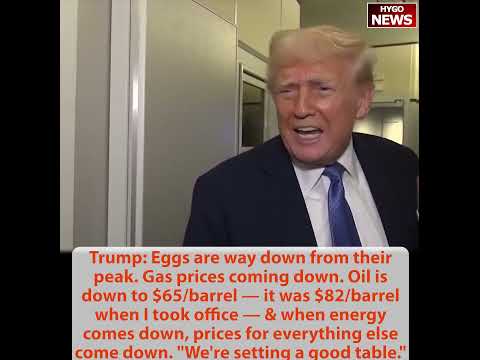
Trump: Eggs Down 35%, Oil at $65; Alien Enemies Act “This Is a Time of War”; Judge Rehire Order “Absolutely Ridiculous”
President Trump addressed reporters in March 2025 on three distinct fronts: defending his invocation of the Alien Enemies Act by declaring “this is a time of war” because of the border crisis, citing falling egg prices (down 35% from their peak), oil prices ($65 per barrel versus $82 when he took office), and gas prices as evidence of economic progress, and dismissing a Clinton-appointed judge’s order to rehire terminated federal workers as “absolutely ridiculous” — saying the judge was “putting himself in the position of the President of the United States, who was elected by close to 80 million votes."
"This Is a Time of War”
When a reporter noted that the Alien Enemies Act had only been invoked three previous times in American history, all during actual wartime, and asked whether Trump felt he was using it appropriately, the president did not hedge.
“This is a time of war,” Trump said, “because Biden allowed millions of people, many of them criminals, many of them at the highest level. They emptied jails out of the nation — emptied their jails into the United States. That’s an invasion.”
The Alien Enemies Act of 1798 had previously been invoked during the War of 1812, World War I, and World War II — conflicts involving declared or de facto hostilities with foreign nations. Trump’s argument was that the mass illegal immigration that had occurred during the Biden administration constituted a comparable threat. Foreign nations had, in his telling, deliberately exported their criminal populations to the United States, making the situation functionally equivalent to an invasion even if no formal declaration of war existed.
The legal argument was certain to be challenged, but the rhetorical framing was effective. By calling the border crisis a “time of war,” Trump was not merely defending a legal tool — he was redefining the scope of the threat. If millions of criminals had been deliberately sent into the country by foreign governments, then the tools designed for wartime were appropriate because the country was, in effect, already at war.
The reference to foreign nations emptying their jails echoed a theme Trump had developed throughout his political career: that countries like Venezuela, El Salvador, and others had intentionally released prisoners and sent them north, treating the United States as a dumping ground for their most dangerous populations. Whether the evidence supported the claim at the scale Trump suggested was debated, but individual cases of deported criminals with violent records in their home countries provided anecdotal support.
Eggs, Gas, and Oil: “Setting a Good Table”
Trump then pivoted to the economic indicators he found most favorable, focusing on the consumer prices that ordinary Americans experienced most directly.
“Eggs are down 35% over a short period of time,” Trump said. Egg prices had become a potent symbol during the inflation crisis, with viral social media posts documenting $8 and $10 cartons. The fact that prices had declined substantially from their peak gave Trump a concrete, relatable data point.
“And other things — fuel, gasoline, energy is down, way down,” Trump continued. “Oil is down to $65 a barrel. It was $82 a barrel” when he took office.
He then articulated the causal chain: “And when energy comes down, pricing is going to come down. Prices for groceries, etc. are going to come down.”
Trump summarized the trajectory with characteristic optimism: “So yeah, I think we’re setting a good table.”
The “setting a good table” metaphor was folksy and deliberate. Trump was framing the economic situation not as a completed project but as preparation — the table was being set for the meal of broad-based price relief that would follow from lower energy costs. The $17 per barrel decline in oil prices was the foundation; the cascading effects on transportation, manufacturing, and food production would follow.
The argument had sound economic logic behind it. Energy costs were embedded in virtually every product and service in the economy. When oil fell from $82 to $65 — a 21% decline — the reduced cost of diesel fuel affected shipping, the reduced cost of natural gas affected manufacturing, and the reduced cost of gasoline affected the disposable income of every driver in the country. Whether these gains would fully offset the inflationary pressures from tariffs was the question Trump’s critics raised, but the directional trend was undeniable.
”Absolutely Ridiculous”: The Judge and the Federal Workers
The sharpest exchange came when Trump was asked about a Clinton-appointed federal judge who had ordered the government to rehire terminated federal workers.
“I think it’s absolutely ridiculous,” Trump said. “Absolutely. It’s a judge that’s putting himself in the position of the President of the United States, who was elected by close to 80 million votes.”
Trump then elevated the dispute to a constitutional crisis: “You have that happening more and more. It’s a very dangerous thing for our country. And I would suspect that we’re going to have to get a decision from the Supreme Court.”
He attacked the premise of the order on practical grounds: “These are people, in many cases, they don’t show up for work. Nobody even knows if they exist. And a judge wants us to pay them even if they don’t know they exist.”
The “nobody even knows if they exist” line captured the administration’s broader argument about the federal workforce. The reduction-in-force efforts led by DOGE had, in the administration’s telling, uncovered phantom employees, no-show workers, and positions that existed on paper but served no discernible function. A judicial order to reinstate these workers was not just an infringement on executive authority — it was an order to reinstate waste.
Trump’s call for Supreme Court intervention reflected the administration’s escalating frustration with lower court judges issuing nationwide injunctions that blocked executive actions. Press Secretary Karoline Leavitt had recently revealed that the administration had faced 15 judicial injunctions in a single month — more than Biden had faced in three years. The rehire order was another data point in what the administration characterized as a coordinated judicial campaign to prevent the president from governing.
The constitutional question was genuine. The president’s power to hire and fire executive branch employees was a core executive function. When a single district court judge could order the president to retain workers the president had determined were unnecessary, the separation of powers was at stake. Whether the specific judge was Clinton-appointed or Obama-appointed was secondary to the structural issue, but Trump’s mention of the appointing president was designed to highlight what he viewed as the political motivation behind the ruling.
Three Fronts, One Message
The press gaggle covered three seemingly distinct topics — immigration enforcement, consumer prices, and judicial overreach — but Trump’s answers shared a common thread: the assertion that the executive branch had the authority and responsibility to act, and that obstacles to that authority were illegitimate.
The Alien Enemies Act was legitimate because the border constituted an invasion. Egg and gas prices were falling because the administration’s energy policies were working. The judicial rehire order was illegitimate because a district court judge could not overrule the president on executive branch personnel.
In each case, Trump was arguing that competent, decisive executive action produced results, and that the primary obstacles to progress were institutions — courts, bureaucracies, prior administrations — that either could not or would not act in the national interest.
Key Takeaways
- Trump defended invoking the Alien Enemies Act: “This is a time of war because Biden allowed millions of people, many of them criminals. They emptied their jails into the United States. That’s an invasion.”
- He cited falling prices: eggs down 35% from peak, oil at $65/barrel (down from $82), and said “when energy comes down, pricing is going to come down.”
- Trump called a Clinton-appointed judge’s order to rehire fired federal workers “absolutely ridiculous,” saying the judge was “putting himself in the position of the President.”
- He said the dispute would likely go to the Supreme Court and attacked the fired workers: “Nobody even knows if they exist. And a judge wants us to pay them.”
- Trump summarized the economic outlook: “I think we’re setting a good table.”