 HYGO News
 Trump: Largest Tax Cuts in History, USAID Eliminated, All DEI Officers 'Deleted,' DOGE Saved $55 Billion
Trump: Largest Tax Cuts in History, USAID Eliminated, All DEI Officers “Deleted,” DOGE Saved $55 Billion
In a sweeping February 2025 address, President Trump outlined the most ambitious domestic agenda of his second term: the largest tax cuts in American history, the effective elimination of USAID, the shuttering of the Consumer Financial Protection Bureau, the deletion of every federal DEI officer’s position, and over $55 billion in savings identified by DOGE in less than a month. Trump pledged no tax on tips, no tax on Social Security, no tax on overtime, 100% expensing for factory construction, and a corporate rate cut from 21% to 15% for companies that manufacture in America. He summarized the philosophy in a single sentence: “We will rapidly grow our economy by dramatically shrinking the federal government."
"The Largest Tax Cuts in American History”
Trump opened with a tax agenda that built on his first-term achievements and extended them dramatically.
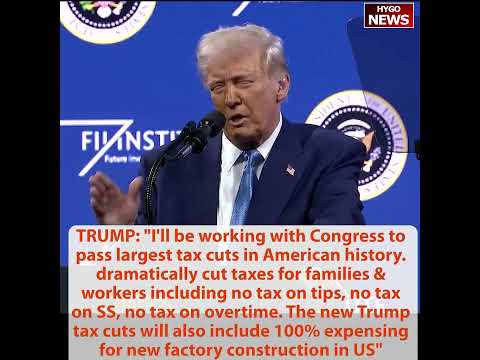
“I’ll be working with the Republican Congress to pass the largest tax cuts in American history,” Trump said. “And that includes, obviously, we have to extend the Trump tax cuts, which were, until now, the largest.”
He then listed the specific consumer-facing tax eliminations. “We’re going to dramatically cut taxes for families and for workers and for companies, including no tax on tips, and hopefully no tax on Social Security, and no tax on overtime,” Trump said.
He highlighted the overtime provision as what he called “a sleeper” in terms of its economic impact. “I think a lot of people are going to be spurred on to do a lot of extra work when they hear that,” Trump said. “A lot of companies really like it. A lot of people really like it.”
The three consumer tax provisions — no tax on tips, Social Security, and overtime — were signature campaign promises that targeted working-class Americans directly. Service workers, retirees, and hourly employees who worked extra shifts would all see immediate, tangible benefits. The political genius of the proposals was their simplicity: every American who received tips, collected Social Security, or worked overtime could calculate the personal impact instantly.
100% Expensing and the 15% Corporate Rate
On the business side, Trump announced two provisions designed to drive manufacturing investment.
“The new Trump tax cuts will also include 100% expensing for new factory construction in the United States and anything else that you’re going to buy with capital,” Trump said. “If you buy something that is going to be good for our country, we’re going to let you expense it one-year expense.”
He noted that this provision had existed during his first term and had been a major driver of investment. “I did that the first time. And everybody was saying, can you go back to that?” Trump said. The provision had partially expired under Biden, with the deduction reducing to approximately 40%. “We’re going to bring that right up to the top level,” Trump said. “I think that had a lot to do with the success that I had during my first term.”
Trump then announced the corporate rate target: “In my first term, I brought the business tax down from around 40% to 21%, which everybody said was an impossible thing to do. I cut it from 40% — it actually was, state and all, much higher than 40%. I got it down to 21%. And now I’m bringing it down to a goal of 15%.”
The critical qualifier: “But only if you make your product in America.” The 15% rate was not a universal corporate tax cut but an incentive specifically for domestic manufacturing. Companies that produced goods abroad would continue to pay the 21% rate. The differential was designed to make onshoring economically irresistible — a 6-percentage-point tax advantage for building in America versus building elsewhere.
USAID Eliminated, CFPB Shut Down
Trump then catalogued the agencies and programs his administration had already dismantled or curtailed.
“Over the past month, we have effectively eliminated the U.S. Agency for International Development, which was funding much of this lunacy,” Trump said. USAID had been a target of the administration since Secretary Rubio assumed control of the agency and began discovering programs that funded censorship operations, overseas DEI initiatives, and organizations with no clear connection to American national interests.
“We virtually shut down the out-of-control CFPB, escorting radical left bureaucrats out of the building and locking the doors behind them,” Trump continued. The Consumer Financial Protection Bureau, created under the Obama administration’s Dodd-Frank legislation, had been a frequent target of Republican criticism for what they characterized as regulatory overreach and ideological enforcement.
Trump then raised a question that suggested further investigations were coming. “What they were doing was so terrible, where they were spending their money was so terrible,” he said. “What we haven’t looked at yet, but will be, is: does the money come back to them? Because nobody can be stupid like that. And they’re not stupid. They’re smart, actually. And, you know, why are they doing that? Does money come back to them? So we’ll figure that out pretty easily, I think, and quickly.”
The implication — that officials who directed wasteful spending might have personally benefited from it — signaled potential corruption investigations beyond the waste-cutting mission.
”Every Single DEI Officer — Deleted”
Trump’s statement on DEI was his most definitive to date. “I’ve ended all of the so-called diversity, equity, and inclusion programs across the entire federal government and private sector,” he said. “And notified every single government DEI officer that their jobs have been deleted. They’re all deleted.”
The word “deleted” was characteristically Trumpian — more final than “eliminated” or “terminated,” suggesting the positions had not merely been vacated but erased from the organizational chart entirely. The extension to the “private sector” referenced executive orders that had pressured federal contractors and companies doing business with the government to end their own DEI programs.
DOGE: $55 Billion and “Just Getting Started”
Trump provided the latest DOGE savings figure. “In less than a single month, the Department of Government Efficiency has already saved over $55 billion,” he said. “And we’re just getting started.”
He put the number in perspective: “That’s nothing compared to the numbers that you’re talking about, right? We’re ending trillions of dollars in waste.”
Trump then connected the spending cuts to consumer-level economic benefits. “It’ll mean much lower inflation, lower interest rates, lower payments on mortgages, credit cards, car loans, and much higher stock markets,” he said. “I think the stock market’s going to be great.”
The transmission mechanism was straightforward: less government spending meant less demand-side pressure on prices (lower inflation), which would allow the Federal Reserve to reduce interest rates (lower borrowing costs), which would reduce monthly payments for every American with a mortgage, car loan, or credit card balance.
”Grow by Shrinking”
Trump concluded with what amounted to a thesis statement for his entire economic philosophy. “In other words, we will rapidly grow our economy by dramatically shrinking the federal government,” he said. “That we have to do.”
The paradox — growth through shrinkage — was the supply-side argument in its purest form. A smaller government meant fewer regulations, lower taxes, less wasteful spending, and more resources available for the private sector to invest, hire, and produce. The Trump administration was betting that the dynamism unleashed by removing government constraints would more than compensate for the reduction in government activity itself.
Key Takeaways
- Trump announced plans for “the largest tax cuts in American history,” including no tax on tips, Social Security, or overtime, plus 100% expensing for factory construction and a corporate rate cut to 15% for domestic manufacturers.
- He declared USAID “effectively eliminated” and the CFPB “virtually shut down,” with “radical left bureaucrats” escorted from the building and doors locked behind them.
- Trump said he had “notified every single government DEI officer that their jobs have been deleted” across the entire federal government.
- DOGE had saved over $55 billion in less than a month, with Trump projecting “trillions of dollars in waste” to be eliminated, leading to lower inflation, lower interest rates, and “much higher stock markets.”
- Trump summarized his philosophy: “We will rapidly grow our economy by dramatically shrinking the federal government.”