 HYGO News
 Trump: Don't Answer DOGE Email, 'You're Fired'; Ukraine War 'Could End Within Weeks'
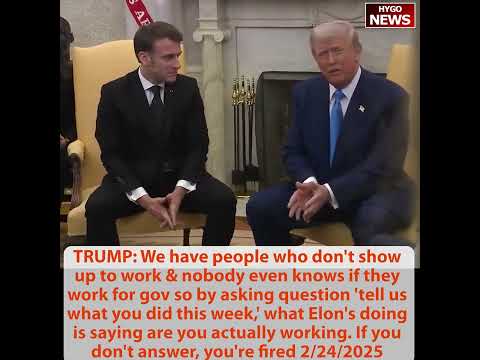
Trump: Don’t Answer DOGE Email, “You’re Fired”; Ukraine War “Could End Within Weeks”
During a February 2025 press availability alongside French President Macron, President Trump defended DOGE’s controversial email to federal employees asking them to report what they did the previous week, saying the purpose was to determine “are you actually working” and that non-respondents would be “sort of semi-fired or you’re fired, because a lot of people are not answering because they don’t even exist.” He acknowledged that agencies handling confidential matters like the State Department and FBI had instructed employees not to respond, but insisted the policy stood for everyone else. Trump also made his most specific prediction about the Ukraine war timeline: “I think the war could end soon — within weeks. If we’re smart."
"Tell Us What You Did This Week”
Reporters pressed Trump on the DOGE email that had generated controversy when some agencies told their employees to ignore it. The email, sent by Musk’s team, asked all federal employees to provide a summary of their work for the previous week, with the warning that failure to respond would be treated as a resignation.
Trump defended the email with an explanation that reframed the controversy. “I thought it was great, because we have people that don’t show up to work and nobody even knows if they work for the government,” he said.
He described the logic: “By asking the question, ‘Tell us what you did this week,’ what he’s doing is saying: are you actually working?”
Trump then revealed what the non-responses were uncovering. “If you don’t answer, like you’re sort of semi-fired or you’re fired, because a lot of people are not answering because they don’t even exist,” he said. “They’re trying to find — that’s how badly various parts of our government were run by, especially by this last group.”
The claim that non-respondents “don’t even exist” suggested that DOGE was discovering ghost employees — individuals on the payroll who were not real workers. Whether these represented outright fraud, bureaucratic errors, or positions that had been filled on paper but never occupied, the implication was that the federal payroll included a significant number of people who were being paid without performing any work.
“What they’re doing is they’re trying to find out who’s working for the government,” Trump said. “Are we paying other people that aren’t working? And you know, where’s all this — where’s the money gone?”
He added the latest savings figure: “We have found hundreds of billions of dollars of fraud so far. And we’ve just started.”
Confidential Agencies: “Not Combative”
A reporter pressed on the disconnect between Musk’s email and agencies that had told employees to ignore it. Trump acknowledged the carve-out while minimizing it.
“Only things such as perhaps Marco at State Department where they have very confidential things, or the FBI where they’re working on confidential things,” Trump said. “And they don’t mean that in any way combative with Elon. They’re just saying there are some people that you don’t want to really have them tell you what they’re working on last week.”
The exception was narrowly defined: agencies dealing with classified intelligence and law enforcement operations. “But other than that, I think everyone thought it was a pretty ingenious idea,” Trump said.
He restated the policy with finality: “We have to find out where these people are. Who are they? And we said, if you don’t respond, we assume you’re not around. And that holds. That stands. And you’re not getting paid anymore too.”
The distinction between confidential and non-confidential agencies was important for the legal framework. DOGE’s demand for work reports could not reasonably extend to covert operatives or agents conducting criminal investigations. But for the vast majority of the federal workforce — office workers, administrators, program managers, and support staff — the expectation that they could describe their work product was not unreasonable. Trump’s framing positioned the email not as surveillance but as basic accountability: can you describe what you did last week?
”Massively Popular”
Trump cited the Harvard-Harris poll to validate the DOGE approach. “We just had a poll come out, I guess the Harvard poll, saying that it’s massively popular what we’re doing,” he said.
The polling data was important because media coverage of the DOGE email had focused heavily on the controversy — the agencies that refused, the legal questions, the union objections. Trump’s citation of the polling reframed the narrative: while Washington insiders debated the process, the public overwhelmingly supported the objective. Americans who had to account for their own work performance found it entirely reasonable that government employees should do the same.
Ukraine: “Within Weeks”
Trump then delivered his most specific timeline prediction for the end of the Ukraine war.
“I think the war could end soon,” Trump said.
A reporter followed up: “How soon?”
“Within weeks,” Trump said. He turned to Macron: “Yeah, I think so. Right? Don’t you think so?”
Trump elaborated: “I think we could end it within weeks if we’re smart. If we’re not smart, it’ll keep going and we’ll keep losing young, beautiful people.”
He then raised the stakes. “And remember what I said: this could escalate into a Third World War. And we don’t want that either.”
The “within weeks” prediction was the most aggressive timeline any American official had offered. Previous statements had referenced “months” or general optimism. By saying “weeks,” Trump was either expressing genuine confidence based on the progress of negotiations — or deliberately creating expectations that would pressure all parties to move faster.
The qualifier “if we’re smart” left room for the possibility that the timeline could slip, attributing any delay to the parties’ failure to act wisely rather than to a flaw in Trump’s approach.
”A Decisive Break with the Past”
Trump concluded with a passage from what appeared to be his prepared opening statement for the Macron press conference, restating the philosophical foundation of his foreign policy.
“I’ve been elected by the American people to restore common sense to Washington and indeed to the world,” Trump said. “And I believe strongly that it’s in the best interest of the United States, the best interest of Europe, the best interest of Ukraine, and indeed the best interest of Russia to stop the killing now and bring the world to peace.”
He characterized his approach as a fundamental departure. “My administration is making a decisive break with the foreign policy values of the past administration and frankly, the past. I ran against a very foolish foreign policy establishment, and their recklessness has led to the death of many, many people.”
Trump concluded: “Under our administration, we’re forging a new path that promotes peace around the world.”
The statement placed the DOGE email controversy and the Ukraine negotiations within the same framework: a president who was willing to break with the establishment’s way of doing things, whether that meant demanding work accountability from federal employees or demanding peace from warring nations. In both cases, the establishment objected, the public supported, and Trump pressed forward.
Key Takeaways
- Trump defended the DOGE email demanding federal employees report their weekly work, saying non-respondents would be fired because “a lot of people are not answering because they don’t even exist.”
- He carved out exceptions for agencies handling “very confidential things” like the State Department and FBI but said the policy “holds and stands” for everyone else.
- Trump predicted the Ukraine war “could end within weeks — if we’re smart,” his most specific timeline to date, while warning of potential Third World War escalation.
- He cited the Harvard-Harris poll showing the DOGE mission was “massively popular” and reported “hundreds of billions of dollars of fraud” discovered so far.
- Trump confirmed the Fort Knox visit was still planned: “We’re actually going to Fort Knox to see if the gold is there. Because maybe somebody stole the gold.”