 HYGO News
 Trump: DOGE badly hurt last night; next week tariffs on pharmaceuticals; make dividend to people
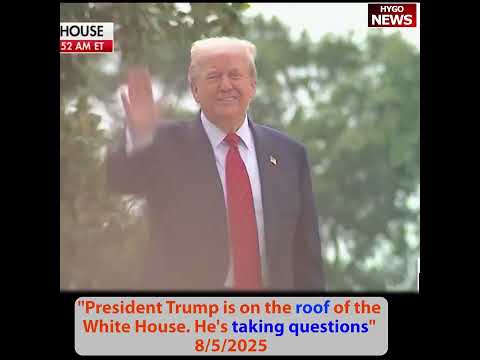
Trump: DOGE badly hurt last night; next week tariffs on pharmaceuticals; make dividend to people
Trump made four distinct announcements from the White House roof. On DC crime: “Somebody from DOGE was very badly hurt last night … a young man who was beat up by a bunch of thugs in DC, and either they’re going to straighten their act out … we’re going to have to federalize and run it the way it’s supposed to be run.” On a possible tariff-funded dividend: “There’s also a possibility that we’re taking in so much money that we may very well make a dividend to the people of America.” On Switzerland: “We have a $41 billion deficit with you, madam … You wanted 1% tariffs. You’re not going to pay 1%.” And pharmaceutical tariffs previewed: “Within the next week or so, we’re going to be announcing tariffs on pharmaceuticals … in one year, one and a half years maximum, it’s going to go to 150%. And then it’s going to go to 250% because we want pharmaceuticals made in our country.”
DOGE Staffer Attacked
Trump’s first item. “By the way, I have to say that somebody from Doge was very badly hurt last night. You saw that a young man who was beat up by a bunch of thugs in DC.”
A DOGE (Department of Government Efficiency) staffer was attacked in Washington, D.C. “Badly hurt.” Attacked by “a bunch of thugs.”
The incident is a specific data point in the ongoing DC crime narrative. Young federal workers — the kind of people DOGE employs — should be able to walk the streets of Washington safely. The fact that a DOGE staffer was assaulted badly enough for the president to mention publicly indicates crime in DC has reached a level that affects the administration’s own personnel.
“Either they’re going to straighten their act out in terms of government and in terms of protection, we’re going to have to federalize and run it the way it’s supposed to be run.”
“Federalize” is the threat. DC is a federal district, not a state. The federal government has ultimate authority over DC governance. The current arrangement — DC home rule under Mayor Muriel Bowser and an elected city council — can be modified by Congress or (in some scenarios) through executive action.
Trump is threatening that if DC’s current government does not address crime, the federal government will intervene more directly. That could mean:
- Federalizing the DC Metropolitan Police (putting it under federal command)
- Deploying National Guard to DC for public safety enforcement
- Restricting DC home rule through congressional legislation
- Other federal interventions in DC governance
“Run it the way it’s supposed to be run” is Trump’s framing of what federalization would produce — DC under federal management with specific outcomes on public safety.
”Dividend to the People”
“One of the questions asked to me this morning is, are you going to make a dividend to the people? And the purpose of what I’m doing is primarily to pay down debt, which will happen in very large quantity. But I think there’s also a possibility that we’re taking in so much money that we may very well make a dividend to the people of America.”
That is a specific policy possibility. Trump is adding “dividend to the people” to the menu of tariff-revenue uses. Previously he had discussed:
- Pay down federal debt (primary)
- Rebate to taxpayers (“a little rebate”)
- Infrastructure funding
- Tax cuts
Now a “dividend” — which implies direct payment to American citizens. That framing has been used by other policy frameworks (Alaska Permanent Fund Dividend, for example, which pays every Alaskan a portion of the state’s oil revenue annually).
“Taking in so much money” — the tariff revenue is coming in at a pace that, after debt paydown, leaves substantial surplus. That surplus could fund dividends.
For 2026 midterm politics, a dividend to every American would be transformative. A $1,000 or $2,000 per-person check, funded by tariff revenue, would be the kind of direct transfer that voters intuitively understand and value. Whether the math works at the required scale depends on actual tariff revenue levels.
Switzerland’s $41 Billion Deficit
Trump then pivoted to a specific Switzerland story. “I did something with Switzerland the other day. I spoke to their prime minister, the woman who was nice, but she didn’t want to listen. And they paid essentially no tariffs. And I said, we have a $41 billion deficit with you, madam. I didn’t know her.”
Switzerland’s head of government is President Karin Keller-Sutter (as of 2025). Switzerland’s trade with the U.S. is substantial — particularly in pharmaceuticals, financial services, and precision manufacturing. The $41 billion U.S. deficit with Switzerland reflects that trade asymmetry.
“You want to pay 1% tariffs. You wanted 1%. I said, you’re not going to pay 1%. We lose because I view deficit as loss.”
1% tariffs is extraordinarily low. Swiss goods entering the U.S. at 1% tariff while the U.S. carries a $41 billion bilateral deficit is the kind of asymmetry Trump’s tariff regime is designed to eliminate.
“I view deficit as loss.” That is Trump’s specific economic framework. Trade deficits are, in his view, losses for the deficit country. The orthodox economic position treats trade deficits as neutral capital-flow indicators. Trump treats them as dollar losses.
Whether the orthodox economic position or Trump’s position is more accurate for policy purposes is a contested economic question. But Trump’s framework drives specific tariff decisions. Countries with large bilateral deficits face higher tariffs. Switzerland, with its $41 billion deficit, is a clear target.
Pharmaceutical Tariffs
“Pharmaceuticals are a big issue with Switzerland. I think… Well, I’ll go into pharmaceuticals. They make a fortune with pharmaceuticals and they make our pharmaceuticals in China and Ireland and everything else.”
Switzerland is home to major pharmaceutical companies — Novartis, Roche, and others. Swiss pharma operations are significant. They manufacture globally — with substantial production in China, Ireland, and other low-tax or low-cost jurisdictions.
“And within the next week or so, we’re going to be announcing tariffs on specifically… This is a separate class than the 15% tariffs on everything. These are excluded classes, I call them. I like to call them excluded, like steel, aluminum, et cetera.”
Pharmaceutical tariffs are a separate category from the general 15% tariffs that apply to most imports. Categories with strategic or security implications — steel, aluminum, pharmaceuticals, semiconductors — get their own tariff schedules rather than the general baseline.
Semiconductor Tariffs Too
“We’re going to be announcing on semiconductors and chips, which is a separate category, because we want them made in the United States. And by the way, they’re being made in the United States. We have the biggest in the world, as you know, from Taiwan is coming over and spending $300 billion in Arizona, building the biggest plant in the world for chips, semiconductors.”
$300 billion Taiwan (TSMC) investment in Arizona. That is an updated figure from the earlier $165 billion. The TSMC Arizona investment has grown as additional fabs are planned.
“The biggest plant in the world for chips, semiconductors.” The ambition is that Arizona’s TSMC complex becomes the largest semiconductor manufacturing facility globally. That would surpass TSMC’s own Taiwan facilities.
”150% … Then 250%”
The pharmaceutical tariff schedule. “But on pharmaceuticals, we’ll be putting a initially small tariff on pharmaceuticals. But in one year, one and a half years maximum, it’s going to go to 150%. And then it’s going to go to 250% because we want pharmaceuticals made in our country.”
Initial tariff small. Then 150% in 12-18 months. Then 250% after that.
150% tariffs on imported pharmaceuticals would force pharmaceutical companies to either:
- Absorb the tariff cost (reducing profits significantly)
- Pass the cost to consumers (raising U.S. drug prices further)
- Move manufacturing to the U.S. (the policy objective)
The “one year, one and a half years” runway gives pharma companies specific time to announce U.S. manufacturing plans and begin construction. If they act quickly, they can complete U.S. facilities before the 150% rate fully activates. If they do not act, the 150% and then 250% rates will make imported pharmaceuticals commercially nonviable for the U.S. market.
”We Want Pharmaceuticals Made in Our Country”
That is the clear policy objective. U.S. pharmaceutical manufacturing. Not Swiss manufacturing. Not Chinese manufacturing. Not Irish manufacturing. American pharmaceutical capacity serving the American market.
The strategic rationale:
- National security (pharmaceuticals as strategic supply-chain resilience)
- Economic (U.S. jobs and tax revenue from pharma manufacturing)
- Pricing (domestic production competing with domestic markets can produce lower prices)
- Quality control (U.S. regulatory oversight of U.S. production is more robust than regulatory oversight of foreign production)
AstraZeneca’s earlier announcement of $50 billion in U.S. manufacturing investment was an early marker of the pharma-reshoring trend. The announcement was driven, per AstraZeneca’s statement, by “the election and … the tariffs are placed.” Additional pharmaceutical companies are likely to make similar announcements as the tariff rates approach activation.
The Ballroom Inspection
The press interaction. “Mr. President, what are you doing up there? What are you doing up there? What are you building? The whole building on the other side.”
Reporters on the ground asking questions to Trump on the roof. Trump is inspecting the ballroom construction site and related White House improvements. The informal visibility — the president accessible to reporters from ground level while he inspects the roof — captures Trump’s characteristic openness to press engagement.
“Are you considering more renovation, sir? Look Peter. Are you going to build up there?”
Reporter Peter [Doocy, likely] asking about additional renovation. Trump declines to confirm specific details.
The Three Announcements Together
DOGE staffer attacked (DC crime). Dividend to the people (tariff revenue allocation). Pharmaceutical tariffs escalating to 250% (manufacturing reshoring).
Each represents a specific administration priority. Public safety (including federalization threats for DC). Fiscal direction (tariff revenue options beyond debt paydown). Industrial policy (forcing pharmaceutical manufacturing to the U.S.).
The cumulative direction is consistent. Strong federal engagement. Populist revenue-distribution options. Aggressive industrial policy. Each item reinforces the broader administration narrative that the federal government is actively reshaping multiple dimensions of American life simultaneously.
Key Takeaways
- A DOGE staffer was badly beaten in DC: “A young man who was beat up by a bunch of thugs” — Trump threatened to “federalize and run it the way it’s supposed to be run” if DC doesn’t address crime.
- Possible tariff dividend: “We’re taking in so much money that we may very well make a dividend to the people of America” — in addition to primary debt paydown.
- Trump on Switzerland’s $41 billion U.S. deficit: “You wanted 1% tariffs. You’re not going to pay 1% … I view deficit as loss.”
- Pharmaceutical tariffs coming “within the next week or so” — escalating to 150% “in one year, one and a half years maximum” and then to 250%.
- Semiconductor tariffs announced as separate category: “Taiwan is coming over and spending $300 billion in Arizona, building the biggest plant in the world for chips.”