 HYGO News
 Trump: 'Become So Rich You Won't Know Where to Spend It'; WaPo 'Lost Credibility'; Big Week in Saudi Arabia
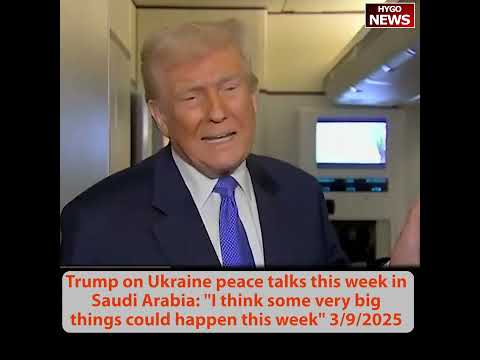
Trump: “Become So Rich You Won’t Know Where to Spend It”; WaPo “Lost Credibility”; Big Week in Saudi Arabia
President Trump delivered an impromptu economic pep talk on March 10, 2025, predicting: “We’re going to take in hundreds of billions of dollars in tariffs, and we’re going to become so rich you’re not going to know where to spend all that money.” He called Democrats “out of control” for refusing to stand for murdered young women and a cancer survivor at the joint address. He dismissed a Washington Post reporter with “you lost a lot of credibility.” And he previewed the upcoming Saudi Arabia talks on Ukraine, saying “I think some very big things could happen this week,” while repeating that tariffs would recover “a lot of the money that we’ve given away over many decades” and bring back “90,000 factories."
"So Rich You Won’t Know Where to Spend It”
Trump opened with the kind of economic optimism that had defined his rallies and was now being delivered as presidential commentary.
“All I know is this: we’re going to take in hundreds of billions of dollars in tariffs, and we’re going to become so rich you’re not going to know where to spend all that money,” Trump said. “I’m telling you, you just watch.”
He connected the tariff revenue to tangible economic activity: “We’re going to have jobs. We’re going to have open factories. It’s going to be great.”
The prediction combined Trump’s signature hyperbole with genuine policy substance. Tariff revenue projections from the administration had ranged from $500 billion to $1 trillion over ten years from China alone, with reciprocal tariffs on all trading partners potentially generating hundreds of billions more. Combined with the reshoring of manufacturing and the investment commitments exceeding $1.7 trillion, the economic picture Trump was painting was not fantasy — it was the logical extension of policies already in motion.
”Democrats Are Out of Control”
Trump reprised his critique of Democratic behavior at the joint address, citing specific moments that had become defining images of the evening.
“The Democrats are out of control,” Trump said. “You saw that the other night during the speech when they wouldn’t stand up for two of the young ladies who were killed by illegal aliens. The one with cancer — the young man with the cancer.”
He elaborated on the optics: “They wanted to stand up and applaud the man and the boy, the young boy, and nobody’s ever seen anything like that.”
Trump’s conclusion: “They’re out of control. They’ve lost their minds.”
The repeated references to Democrats refusing to applaud for murdered women and a cancer-surviving child had become one of the most effective political arguments of the early second term. Every time Trump mentioned it — and he mentioned it frequently — he reinforced the image of a Democratic Party so consumed by opposition that it could not perform basic acts of human decency.
”Washington Post — You Lost a Lot of Credibility”
The exchange with the Washington Post reporter followed the now-familiar pattern.
“Who are you with?” Trump asked after the reporter’s question.
“Washington Post,” the reporter said.
“Uhhh… you lost a lot of credibility,” Trump responded.
The dismissal was less theatrical than his CNN or NBC confrontations but equally effective. The Washington Post had been one of the most aggressive outlets in covering the Trump administration, and its credibility with the public — as measured by trust surveys and subscription numbers — had indeed declined. Trump’s comment was both a personal assessment and a statement of market reality.
”Big Things This Week” in Saudi Arabia
Trump previewed the upcoming round of peace talks with cautious optimism.
“I think we’re going to have a good result in Saudi Arabia, meaning they’re hosting the various talks,” Trump said. “We have a lot of good people going out there. And I think Ukraine’s going to do well. And I think Russia’s going to do well.”
He projected forward: “I think some very big things could happen this week. I hope so.”
The prediction of “big things” in Saudi Arabia came as Secretary Rubio, NSA Waltz, and the Ukrainian delegation were preparing for the next round of negotiations. Trump’s optimism — despite the Oval Office confrontation with Zelensky — suggested that behind-the-scenes diplomatic channels had continued functioning even as the public drama played out.
Trump returned to the human cost: “Thousands of people this week — thousands of young soldiers died this week. Hundreds of people died in cities in Ukraine. And we got to get it stopped."
"Take Back the Money”
Trump framed the tariff policy in its most sweeping terms yet.
“I think the tariffs are going to be the greatest thing we’ve ever done as a country,” Trump said. “It’s going to make our country rich again.”
He cited the manufacturing momentum: “We have many companies, as you know, auto companies. They’re opening up plants now. We’ve had four or five announced already, but many more are coming.”
Trump described the historical reckoning that tariffs represented: “We’re basically going to take back the money — a lot of the money that we’ve given away over many decades. We’ve lost our jobs. We’ve lost our factories. We’ve lost 90,000 factories since the beginning of NAFTA. It’s not that long ago. 90,000 factories. Think of that.”
He expressed confidence: “We’re going to get them back. And they’re coming back. And they’re coming back in records.”
Trump cited the TSMC investment as the flagship example: “Look at what happened with the big chip company, the biggest in the world, by far the most powerful chip company in the world, from Taiwan. They’re going in with $200 billion of money, and they’re going to build something. It’s going to give us 35, 40% of the chip market in one — just in one company.”
He concluded with the vision: “I think it’s going to bring us to a level that we’ve never had before.”
The 90,000 factories figure — the cumulative loss since NAFTA’s implementation in 1994 — remained one of Trump’s most effective statistics because it translated abstract trade policy into physical reality. Each factory represented a building, a workforce, a community, and a tax base that had been destroyed. Bringing even a fraction of those back through tariff-driven reshoring would produce visible, tangible change that voters could see in their own communities.
Key Takeaways
- Trump predicted tariffs would make America “so rich you’re not going to know where to spend all that money,” citing hundreds of billions in revenue and reshored factories.
- He called Democrats “out of control” for refusing to stand for murdered young women and a cancer-surviving child at the joint address: “They’ve lost their minds.”
- Trump dismissed a Washington Post reporter: “You lost a lot of credibility.”
- He previewed Saudi Arabia peace talks: “I think some very big things could happen this week,” while lamenting “thousands of young soldiers died this week.”
- Trump said tariffs would “take back the money” lost since NAFTA destroyed “90,000 factories” and cited TSMC’s $200 billion investment that would give the U.S. “35-40% of the chip market.”