 HYGO News
 Trump delivers remarks & Trump's attorney addresses the court: witch hunt & setback for NY court sys
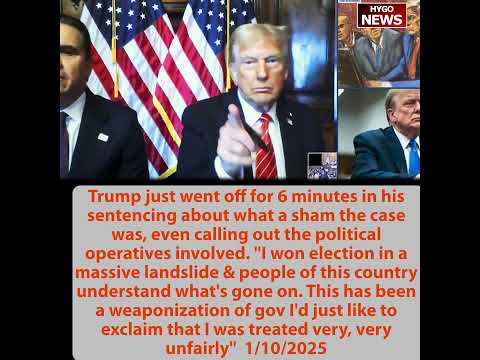
Trump delivers remarks & Trump’s attorney addresses the court: witch hunt & setback for NY court sys
On January 10, 2025, President-elect Donald Trump appeared for his sentencing hearing in the Manhattan criminal case before Judge Juan Merchan. In an extraordinary six-minute address to the court, Trump called the prosecution a “political witch hunt” and a “tremendous setback for New York,” declared himself “totally innocent,” and described the case as “weaponization of government.” His attorney Todd Blanche also addressed the court, arguing that the case should never have been brought. Merchan declined to impose any punishment, making Trump the first president to enter office with a criminal conviction.
Trump’s Courtroom Address
Judge Merchan allowed audio from the courtroom, giving the public an unfiltered view of the sentencing proceedings. Trump used the opportunity to deliver an extended statement that functioned as both a legal argument and a political declaration.
Trump began by attacking the foundation of the case itself. “I think it’s been a tremendous setback for New York or the New York court system,” he said. “This is a case that Alvin Bragg did not want to bring. He thought it was, from what I read and from what I hear, inappropriately handled before he got there.”
He then targeted the circumstances under which the prosecution had been organized. “A gentleman from a law firm came in and acted as a district attorney,” Trump said, referring to Matthew Colangelo, who had previously worked at the Department of Justice before joining the Manhattan District Attorney’s office. “And that gentleman, from what I heard, was a criminal or almost criminal in what he did. It was very inappropriate. It was somebody involved with my political opponent.”
The “Legal Expense” Argument
Trump devoted a significant portion of his remarks to the core charge against him: falsification of business records. He framed the accusation in the simplest possible terms, arguing that the entire case rested on an absurd premise.
“The falsification of business records, as they said, was calling a legal expense in the books where everybody could see them, a legal expense,” Trump said. “In other words, legal fees or legal expense were put down as legal expense by accountants. They weren’t put down by me. They were put down by accountants.”
Trump emphasized the absurdity he saw in the charge. “I didn’t call them construction, concrete work. I didn’t call them electrical work. They called a legal fee or a legal expense, a legal expense. And for this, I got indicted. It’s incredible, actually.”
The argument — that payments to an attorney were logically classified as legal expenses — had been a cornerstone of Trump’s defense throughout the trial and resonated with critics who viewed the prosecution as legally thin.
Citing Legal Scholars
Trump bolstered his argument by citing a roster of legal commentators who had publicly criticized the prosecution. “The top legal scholars and legal pundits in this country, the ones that are quoted all the time on television, highly respected people, have said — everyone, virtually everyone that I know, haven’t seen any to the contrary, not one — this is a case that should have never been brought,” Trump said.
He named specific commentators: “Very respected Jonathan Turley, Andy McCarthy, Judge David Riff — a wonderful man who just passed away, by the way — Greg Jarrett, Elie Honig from CNN of all places. CNN said that. Alan Dershowitz.” Trump emphasized that many of these analysts “are not exactly friends of mine, to put it mildly” yet shared the view that the prosecution was legally unjustified.
The inclusion of Elie Honig, a CNN legal analyst, was particularly pointed. Honig had published analysis arguing that the Manhattan DA’s legal theory was novel and untested, providing Trump with a credible voice from a network generally perceived as hostile to him.
The Election as Public Verdict
Trump framed his sweeping 2024 election victory as a public referendum on the prosecution itself. “I won and got the largest number of votes by far of any Republican candidate in history,” he said. “And won, as you know, all seven swing states, won conclusively all seven swing states, and won the popular vote by millions and millions of votes — and they’ve been watching your trial.”
This argument — that the American public had rendered its own verdict on the case by electing Trump despite the conviction — was central to the political dimension of the sentencing hearing. Trump was not merely defending himself legally; he was asserting that the democratic process had superseded the judicial one.
The Gag Order and Restrictions
Trump also addressed the restrictions he had operated under throughout the trial. “I was under a gag order. I’m the first president in history that was under a gag order where I couldn’t talk about aspects of the case that are very important,” he said. He noted that the key prosecution witness had been allowed to “talk as though he were George Washington” while the Southern District of New York’s assessment of that witness — which Trump described as a 28-page document that “excoriated” the individual — was excluded from evidence.
“He shouldn’t have been allowed,” Trump said of the witness’s testimony. “The Southern District did a book of approximately 28 pages where they — I’ve never seen anything like it. They excoriated him. You wouldn’t let it be put into evidence.”
Trump’s Closing Declaration
Trump concluded his remarks by placing the case in the broader context of the moment. “With all that’s happening in our country today, with a city that’s burning to the ground, one of our largest, most important cities burning to the ground, with wars that are uncontrollably going on, with all of the problems of inflation and attacks on countries and all of the horrible things that are going on, I got indicted over calling a legal expense a legal expense,” he said.
“I just want to say I think it’s an embarrassment to New York, and New York has a lot of problems, but this is a great embarrassment,” Trump stated. He called the prosecution part of a broader “weaponization of government,” noting: “They call it lawfare. Never happened to any extent like this, but never happened in our country before. And I just like to explain that I was treated very, very unfairly.”
Todd Blanche Addresses the Court
Trump’s attorney Todd Blanche followed with his own remarks, arguing that the prosecution’s entire legal framework was flawed. “A lot of what the government just said presupposes that this case is legally appropriate and that the charges brought by the people were consistent with the laws of New York. Again, we very much disagree with that,” Blanche said.
He noted that the objections were not limited to the defense team. “It’s not just counsel and President Trump that feels that way. There’s many, many legal experts that share the same views,” Blanche said. He also pointed to the election results as meaningful: “The American voters got a chance to see and decide for themselves whether this is the kind of case that should have been brought, and they decided. And that’s why in 10 days President Trump is going to assume the office of the President of the United States.”
Key Takeaways
- Trump called his sentencing a “tremendous setback for New York” and a “political witch hunt,” delivering a six-minute courtroom address declaring his total innocence.
- He argued the core charge was absurd: legal expenses were recorded as legal expenses by accountants, not by Trump personally.
- Trump cited legal scholars from across the political spectrum — including CNN’s Elie Honig and Harvard’s Alan Dershowitz — who said the case should never have been brought.
- He framed his landslide election victory as a public verdict rejecting the prosecution, noting voters “watched your trial” and elected him anyway.
- Attorney Todd Blanche told the court the defense intended to appeal and that the majority of the American people agreed the case should not have been brought.
- Judge Merchan declined to impose any punishment, making Trump the first president to enter office with a criminal sentencing on his record.
Transcript Highlights
The following is transcribed from the video audio:
- I think it’s been a tremendous setback for New York or the New York court system. This is a case that Alvin Bragg did not want to bring.
- The falsification of business records, as they said, was calling a legal expense in the books where everybody could see them, a legal expense.
- Very respected Jonathan Turley, Andy McCarthy, Elie Honig from CNN of all places — they all said this is not a case that should be brought.
- I won the election in a massive landslide and the people of this country understand what’s gone on. This has been a weaponization of government.
- I’m totally innocent. I did nothing wrong.
- I just want to say I think it’s an embarrassment to New York. This is a great embarrassment.
- In 10 days President Trump is going to assume the office of the President of the United States.
Full transcript: 1186 words transcribed via Whisper AI.