 HYGO News
 Trump Surprises First White House Tour Group of the Year: 'Some Business Leaders Actually Start Crying'
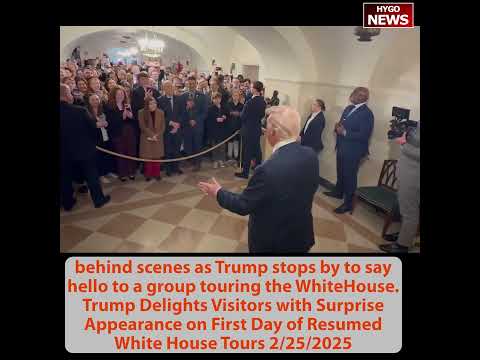
Trump Surprises First White House Tour Group of the Year: “Some Business Leaders Actually Start Crying”
On February 25, 2025, President Trump made a surprise appearance during the first public White House tour since the start of his second term, delighting visitors by stopping to chat, answering questions, and sharing behind-the-scenes stories about the Oval Office. Trump told the tour group that even the biggest business leaders get emotional when they walk into the Oval Office — “some of them actually start crying” — and praised First Lady Melania Trump for working “very hard” to make the tours “perfect.” He also gave the group an impromptu update on the Ukraine peace effort before encouraging them to enjoy an “extra-special tour.” Separately, Defense Secretary Pete Hegseth departed for Guantanamo Bay to tour facilities supporting illegal immigrant deportations.
The Surprise Appearance
White House public tours had been paused during the presidential transition and had recently resumed. Trump chose the first day of the new tour season to make an unannounced visit, turning a routine tourist experience into a once-in-a-lifetime moment.
“I heard you were here, and I said, ‘Let’s stop by and say hello,’” Trump told the group.
The president appeared in the area where the tour group was gathered and immediately began engaging with visitors, making eye contact, singling out individuals, and creating the kind of spontaneous personal interaction that had been virtually absent during the Biden years.
“It’s a group of very smart-looking people, I must say. Very smart,” Trump told them. “Maybe someday you’ll be here as president, right? Somebody in this group has a chance.”
The remark drew laughter and demonstrated Trump’s instinct for making people feel included in the presidential experience. By suggesting that someone in the tour group might one day occupy the office he held, Trump was affirming the democratic promise that the White House belonged to the people — and that any of them could aspire to lead from it.
”Some of Them Actually Start Crying”
Trump shared an observation about the Oval Office’s effect on visitors that revealed a softer side of the presidential experience.
“It’s nothing like the White House. It doesn’t matter where you go — the biggest people come here, and they all have beautiful offices,” Trump said. “But when they walk into the Oval Office, there’s nothing like it.”
He described the emotional impact: “They look, and they — some of them actually start crying. And these are business leaders! I don’t want you to see that — but some of them actually get emotional.”
The anecdote humanized both the Oval Office and the corporate titans who visited it. Trump was telling ordinary Americans that the same room they were touring had the power to move the most powerful people in the business world to tears. The White House was not just a government building; it was a symbol so potent that even those accustomed to power and prestige found it overwhelming.
The “I don’t want you to see that” aside was classic Trump humor — pretending to protect the reputations of tough executives who had been reduced to tears by the mere experience of standing in the Oval Office.
First Lady Melania’s Role
Trump credited Melania Trump for the quality of the tour experience, emphasizing her personal involvement in the preparation.
“The tour is so great, and they did just such a good job. The First Lady worked very hard on making it perfect, and I think you’re going to really love it,” Trump said.
Melania had been known during both the first and second terms for her attention to the aesthetic and experiential dimensions of the White House. Her involvement in the tour program — ensuring that the public’s experience of the People’s House was memorable and well-organized — reflected her approach to the First Lady role: less public visibility than some predecessors, but meticulous attention to the details of the institution she managed.
Trump’s public crediting of Melania served both as a personal tribute and as a signal that the First Lady was actively engaged in her role despite maintaining a lower public profile than some previous occupants of the position.
An Impromptu Ukraine Update
When a visitor asked Trump a question, the president provided an unscripted update on the Ukraine peace effort — a remarkable moment of presidential accessibility.
“We love our country, right?” Trump said. “We’re trying to get rid of this horrible Ukraine-Russia war. And I think we’re doing a lot with the other world, both parties in Europe. Now that people get it done — it should have never started. It should never, ever have started.”
He described the cost of the delay: “And if it did start, it could have been ended in a week, not after three years of bloodshed — people killed. All of that great architecture knocked down, you know, those beautiful spires that are old, knocked down and gone. A thousand years old. It’s terrible.”
The reference to thousand-year-old architecture being destroyed added a cultural dimension to Trump’s anti-war argument. The war was not just killing people; it was destroying irreplaceable historical heritage that had survived centuries of previous conflicts.
“But that’s what it is. But now we’re here. We’re going to solve the problem,” Trump said.
The fact that Trump provided this update to a tour group — rather than saving it for a formal press briefing or international audience — illustrated his governing style. There was no artificial separation between “the president doing his job” and “the president meeting the public.” The Ukraine peace effort, the most consequential diplomatic initiative of his second term, was discussed as casually with White House tourists as it was with foreign leaders.
”Extra-Special Tour”
Trump made sure the visitors knew their experience would be enhanced by his presence.
“Have a good time. Have a great tour. And you’re going to get a special tour, okay? You’re going to get a special tour,” Trump said. “Have fun, everybody!”
He directed the tour guides to provide an upgraded experience: “You’re the first one of the year, so get an extra-special tour — especially for this guy right here,” he said, singling out a young visitor in the group.
The moment captured what supporters valued most about Trump’s public persona: the willingness to engage personally, the instinct to make individuals feel special, and the understanding that small gestures — like stopping by a tour group or pointing out a kid in the crowd — created memories that lasted a lifetime.
Hegseth Heads to Guantanamo Bay
In a separate development noted in the compilation, Defense Secretary Pete Hegseth departed from Joint Base Andrews en route to Naval Station Guantanamo Bay, Cuba. The visit was planned to include a tour of JTF-GTMO facilities and briefings on operations supporting illegal immigrant deportations.
The Guantanamo visit underscored the administration’s use of military facilities for immigration enforcement. Trump had announced earlier in his term that Guantanamo Bay would be used as a detention facility for certain deportees, particularly those classified as dangerous or from countries initially resistant to accepting returnees. Hegseth’s personal visit to the facility signaled that the Defense Department was actively engaged in supporting the deportation mission.
Key Takeaways
- Trump surprised the first White House tour group of 2025, telling visitors that even the biggest business leaders get emotional in the Oval Office: “Some of them actually start crying.”
- He praised First Lady Melania Trump for working “very hard” to make the tours “perfect” after they resumed following the presidential transition.
- Trump gave the tour group an impromptu update on Ukraine, lamenting “those beautiful spires that are a thousand years old, knocked down and gone” and promising “we’re going to solve the problem.”
- He singled out a young visitor for an “extra-special tour” and told the group: “Maybe someday you’ll be here as president. Somebody in this group has a chance.”
- Defense Secretary Hegseth departed for Guantanamo Bay to tour facilities supporting illegal immigrant deportation operations.