 HYGO News
 Trump: Renaming Redskins and Cleveland Indians Was 'Degrading to the Indian Population'; 'Every Leader in the World' Wants to Meet at Pope's Funeral
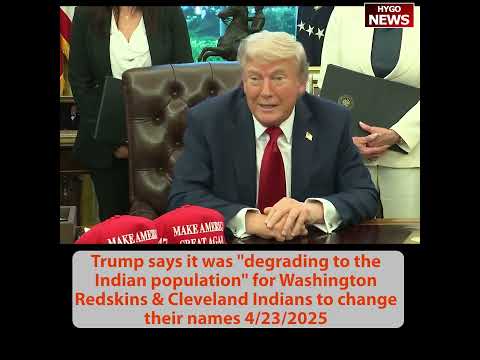
Trump: Renaming Redskins and Cleveland Indians Was “Degrading to the Indian Population”; “Every Leader in the World” Wants to Meet at Pope’s Funeral
President Trump waded into the sports team naming controversy in April 2025, arguing that renaming teams like the Washington Redskins and Cleveland Indians was “degrading to the Indian population.” On the Cleveland Indians becoming the Guardians, Trump said: “Why would you take the name Indians off the Cleveland Indians? For God’s sake. Guardians — it just doesn’t make sense.” He praised the Kansas City Chiefs for keeping their name and said he spoke to “people of Indian heritage that love that name.” On the upcoming trip to Rome for Pope Francis’s funeral, Trump confirmed: “I have a lot of meetings set up. I’ve got every leader in the world — which tells you we have a great product. It’s called the United States of America.” He also honored veterans in the Oval Office: “There’s no group of people more important than the people in this room — and I’m not talking about the media."
"Degrading to the Indian Population”
Trump argued that the progressive campaign to rename teams with Native American imagery had accomplished the opposite of its stated purpose.
“The Indian population is a great part of this country, great heritage,” Trump began.
He worked through the examples: “The Kansas City Chiefs, they’re not changing their name. They have a great team, great people, great owners, great coach, quarterback — I love the quarterback, like his wife too. His quarterback’s mother is incredible. I like that team.”
He assessed the names broadly: “They’re called the Chiefs, and frankly, I see nothing wrong with it. They call them the Warriors — not that team, but a lot of other teams. All of these Indian surnames and different names, and I’m saying that I think that’s a positive thing.”
He stated the core argument: “And when you go back to Indians, they don’t know why these names are being taken off. I think it’s degrading to the Indian population, and it’s a great population, and they like when they’re called by various names.”
He addressed the most controversial name: “Now, Washington, the Redskins — perhaps that’s a little different, a little bit different. But I can tell you that I spoke to people of Indian heritage that love that name and they love that team, and I think it’s a superior name to what they have right now.”
He praised the old name: “It had heritage behind it. It had something special.”
Trump’s argument inverted the progressive narrative. The standard liberal position was that Native American team names were offensive and that renaming was a form of respect. Trump argued that the names were a form of honor — that being associated with warriors, chiefs, and the strength of indigenous peoples was a positive tribute, and that removing those associations was itself the insult.
The argument had support among many Native Americans, though the issue was not monolithic. Polls had consistently shown that a majority of Native Americans did not find team names like “Redskins” offensive, and many took pride in the association. The progressive campaign to rename teams was driven primarily by non-Native activists and corporate pressure, not by the indigenous communities the effort claimed to represent.
”Cleveland Guardians — For God’s Sake”
Trump reserved particular scorn for the Cleveland name change.
“I think they changed the name of the Cleveland Indians,” Trump said. “Why would you take the name Indians off the Cleveland Indians?”
He expressed disbelief: “And now it’s called the Cleveland something else. For God’s sake.”
He named it: “Guardians. It just doesn’t make sense to me.”
He connected the name change to his broader agenda: “We’re about bringing common sense back to this country. And it may be popular or unpopular what I’m saying, but I think most people agree with me.”
He stated the impact: “I think it really is demeaning to Indians to change the name of the Cleveland Indians as an example to the Cleveland Guardians. It’s not the same, and I’m sure it has an impact on the team.”
The Cleveland Indians had been known by that name since 1915 — over a century of baseball tradition, history, and identity. The renaming to “Guardians” in 2022, after the Art Deco “Guardian” statues on the Hope Memorial Bridge near the stadium, was driven by the same cultural pressure that had forced the Washington Redskins to become the “Commanders.”
Trump’s “I’m sure it has an impact on the team” comment suggested he believed that the identity change affected not just branding but the organization’s spirit and fan connection. A team called the Indians carried 107 years of history; a team called the Guardians was starting from scratch. For lifelong fans, the name change represented the erasure of their team’s identity at the demand of people who had never watched a game.
”Every Leader in the World”
A reporter asked about meetings during Trump’s upcoming trip to Rome for Pope Francis’s funeral.
“Do you have any meetings set up?” the reporter asked.
Trump’s answer revealed the diplomatic opportunity: “I have a lot of meetings set up. I don’t know if I can do it.”
He joked with the veterans in the room: “Do you want to help me out, fellas?”
He explained the demand: “I’ve got every leader in the world — which tells you that we have a great product. It’s called the United States of America, and it’s great.”
He connected it to the mission: “And these people know about it better than anybody in this room,” gesturing to the veterans. “But we have a great place, and it should be a lot greater, and that’s what we’re going to do. We’re going to make it greater than ever before.”
The Pope’s funeral was presenting a unique diplomatic opportunity. World leaders from every continent would converge on Rome, creating an environment where Trump could conduct bilateral meetings in rapid succession. The fact that “every leader in the world” wanted time with Trump confirmed the administration’s assertion that America’s leverage had been restored — countries were seeking access to the American president, not avoiding him.
The “great product” metaphor was classic Trump — applying business language to geopolitics. The United States was the product; its military strength, consumer market, technological innovation, and cultural influence were the features. Every country in the world wanted access to those features, which gave the American president leverage that no other leader possessed.
Veterans in the Oval Office
Trump honored the veterans present with characteristic directness.
“There’s no group of people more important than the people in this room,” Trump said.
He drew the contrast with a grin: “And I’m not talking about the media. I’m talking about these people right here.”
He made a commitment: “There’s no group, and they’re going to be taken really well care of. It’s very important to me.”
The juxtaposition of veterans and media in the same room — with Trump explicitly elevating the veterans and diminishing the media — captured a values hierarchy that resonated with the president’s base. In Trump’s framework, the people who had risked their lives for the country deserved more respect than the people who covered it. The veterans were “the most important people in the room”; the media were not.
Key Takeaways
- Trump called renaming the Redskins and Cleveland Indians “degrading to the Indian population” — saying indigenous peoples “like when they’re called by various names.”
- On Cleveland Guardians: “Why would you take Indians off the Cleveland Indians? For God’s sake. Guardians doesn’t make sense.”
- On Rome trip: “I’ve got every leader in the world wanting to meet — which tells you we have a great product: the United States of America.”
- He praised the Kansas City Chiefs for keeping their name and said he spoke to “people of Indian heritage that love the Redskins name.”
- To veterans in the Oval Office: “There’s no group more important than the people in this room — and I’m not talking about the media.”