 HYGO News
 Trump Declares Biden's Autopen Pardons 'Void, Vacant, and of No Further Force or Effect'
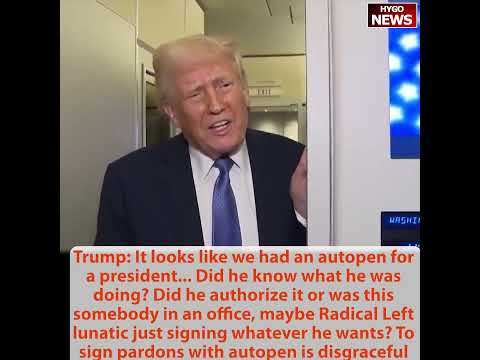
Trump Declares Biden’s Autopen Pardons “Void, Vacant, and of No Further Force or Effect”
President Trump raised what he called a fundamental question about the legitimacy of Biden’s final acts in office, focusing on the use of an autopen — a mechanical device that replicates a signature — to sign executive orders and pardons. “It looked like we had an autopen for a president,” Trump said in March 2025. “Did he know what he was doing? Did he authorize it? Or is this somebody in an office, maybe a radical left lunatic just signing whatever?” Trump declared the autopen-signed pardons “null and void” because “I’m sure Biden didn’t have any idea that it was taking place,” and called the practice “disgraceful” and “disrespectful to the office."
"An Autopen for a President”
Trump framed the autopen issue not as a minor procedural complaint but as evidence of a presidency that had ceased to function as the Constitution intended.
“Biden is incompetent, he first of all is grossly incompetent,” Trump said, establishing the premise. “But it looks to me like — you know, that’s a big subject I’m sure you won’t ask about — but the whole subject of autopen, did he know what he was doing? Did he authorize it?”
Then the question that went to the heart of presidential authority: “Or is this somebody in an office, maybe a radical left lunatic just signing whatever that person was?”
The implication was profound. If Biden had not personally reviewed and authorized the documents that bore his signature, then unelected staffers had been exercising presidential power without presidential knowledge or consent. The autopen was not a convenience tool; it was, in Trump’s framing, a mechanism through which the executive branch had operated without an actual executive.
Trump drew a sharp contrast with his own practices: “I never use it. I mean, we may use it as an example to send some young person a letter — it’s nice, you know, we get thousands and thousands of letters and letters of support for young people, for people that aren’t feeling well.” The distinction was clear: an autopen for correspondence was a thoughtful gesture; an autopen for pardons and executive orders was a constitutional crisis.
”Disgraceful” and “Disrespectful to the Office”
Trump elevated the autopen issue from a question of process to a question of institutional integrity.
“To sign pardons and all of the things that he signed with an autopen is disgraceful,” Trump said.
He then articulated two distinct objections. “Number one, it’s disrespectful to the office,” Trump said. The presidency required a human being to read, understand, and personally authorize the exercise of its powers. Using a machine to replicate the most consequential act a president could perform — granting clemency — degraded the office itself.
“Number two, maybe it’s not even valid,” Trump continued, raising the legal question. “Because, you know, who’s getting him to sign? He had no idea what the hell he was doing.”
Trump described his own signing process to illustrate the standard he believed was constitutionally required: “When my people come up with — Will and all of the people, Steve — they come up and say, this is an executive order. They explain it to me and, you know, 90% of the time I sign it, 99% of the time I say do it. But they come up and I sign it.”
The contrast was deliberate. Trump was describing a process of personal review, explanation, and deliberate authorization — the opposite of a mechanical signature applied to documents the president may never have seen.
”Null and Void”
When asked whether the autopen-signed pardons and executive orders were still valid, Trump gave a measured but pointed answer.
“I think so,” he said. “It’s not my decision — that’ll be up to a court. But I would say that they’re null and void, because I’m sure Biden didn’t have any idea that it was taking place.”
The framing was legally significant. Trump was not claiming the unilateral power to void his predecessor’s acts. He was deferring to the courts while simultaneously stating his belief that the autopen-signed documents lacked legitimacy. By saying “it’s not my decision, that’ll be up to a court,” Trump was positioning himself as someone who respected judicial authority while making clear what outcome he expected.
The “null and void” declaration targeted specific acts. “Somebody was using an autopen to sign off and to give pardons to — as an example, just one example — but the J6, the Unselect Committee, they gave pardons with an autopen,” Trump said. “I don’t think Biden knew anything about it.”
He then added a separate charge: “And what they did is they deleted and destroyed all of the information that took them over a year to get.” The January 6 Committee’s destruction of records was, in Trump’s telling, connected to the autopen pardons — both were acts taken by Biden-era officials who were using the departing president’s authority to protect themselves and cover their tracks.
The Competency Question
Trump wove the autopen issue into the broader narrative about Biden’s mental fitness that had defined much of the political discourse in 2024 and 2025.
“He had no idea what the hell he was doing,” Trump said of Biden. “If he did, all of these bad things wouldn’t be happening right now.”
The argument had a certain logical force. If Biden had been competent enough to knowingly authorize the pardons, executive orders, and other actions taken in his name, then he bore personal responsibility for their consequences. If he had not been competent enough — as Trump and others contended — then the documents signed in his name lacked the essential element of presidential intent.
This created what Trump characterized as a damning paradox: Biden was either culpable for bad decisions or incapable of making decisions at all. Either way, the legitimacy of his final acts was compromised.
Special Counsel Robert Hur’s earlier assessment of Biden as an “elderly man with a poor memory” — which had led to the decision not to prosecute Biden for classified document retention — now provided additional ammunition. If the Justice Department itself had concluded that Biden’s mental state was such that a jury would be sympathetic, the argument that he could not have meaningfully authorized complex legal documents carried weight.
Russia and the Path Forward
Trump briefly addressed the geopolitical consequences of what he characterized as a leaderless administration.
“Joe Biden got us into a real mess with Russia and everything else he did, frankly, but he didn’t know about it,” Trump said. The formulation — “he didn’t know about it” — was consistent with the autopen thesis: consequential decisions had been made in Biden’s name without his knowledge or understanding, and the results had been catastrophic.
“And he, generally speaking, signed it with an autopen,” Trump added. “So how would he know? That autopen is a big deal.”
Trump concluded with a forward-looking promise: “We’re going to get you back into a great position, and we’ve already started.”
The autopen controversy represented something larger than a dispute over signature technology. It was Trump’s most detailed argument that the Biden presidency had been, in its final phase, a presidency in name only — that the man whose signature appeared on pardons, executive orders, and policy documents had not personally authorized them, and that unelected officials had been running the executive branch through a mechanical proxy. Whether the courts would ultimately agree that autopen-signed documents were “null and void” remained an open legal question, but Trump had laid the political and rhetorical groundwork for that argument.
Key Takeaways
- Trump declared Biden’s autopen-signed pardons and executive orders “null and void,” saying “I’m sure Biden didn’t have any idea that it was taking place.”
- He called the autopen practice “disgraceful” and “disrespectful to the office,” saying it raised questions about whether the documents were legally valid.
- Trump specifically targeted January 6 Committee pardons: “They gave pardons with an autopen. I don’t think Biden knew anything about it.”
- He contrasted his own process — staff explains each order, he personally reviews and signs — with Biden’s alleged use of mechanical signatures for consequential documents.
- Trump said the legal determination would be “up to a court” but framed Biden’s mental state as evidence the autopen-signed acts lacked genuine presidential authorization.