 HYGO News
 Trump: deal with Iran cease nuclear; Emir 2022 ball FIFA World Cup in Qatar to 2026 FIFA World Cup
Trump: deal with Iran cease nuclear; Emir 2022 ball FIFA World Cup in Qatar to 2026 FIFA World Cup
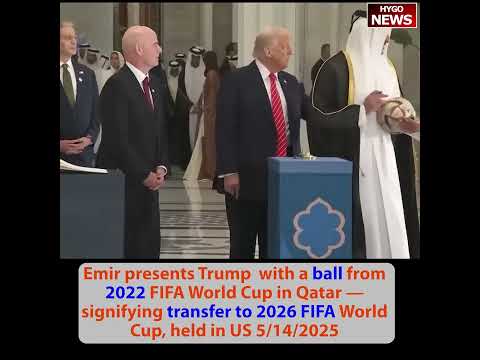
President Trump’s Qatar state visit included substantive Iran policy statements and a symbolic gesture from the Qatari Emir. Trump laid out conditions for an Iran deal — Iran must stop sponsoring terror, halt its bloody proxy wars, and permanently and verifiably cease its pursuit of nuclear weapons. Trump urged all nations to fully and totally enforce the new sanctions he placed on Iran, noting that secondary sanctions were “in certain ways even more devastating.” Trump recalled Iran’s economic state when he left office in 2021 — broke, no money for Hamas, no money for Hezbollah — and asserted “there would have been no attack if I were president.” The Emir of Qatar presented Trump with a soccer ball from the 2022 FIFA World Cup in Qatar — symbolically transferring the World Cup tradition to the 2026 FIFA World Cup being held in the United States, Canada, and Mexico. Trump on Iran deal: “I want to make a deal with Iran. I want to do something if it’s possible. But for that to happen, it must stop sponsoring terror, halt its bloody proxy wars, and permanently and verifiably cease its pursuit of nuclear weapons.” Trump on sanctions: “I’m strongly urging all nations to join us in fully and totally enforcing the sanctions that I just placed on Iran, and we also placed secondary sanctions, which are in certain ways even more devastating.” Trump on Iran’s state when he left office: “Iran, as you know, had no money when I left office. They were broke. They had no money for Hamas. They had no money for Hezbollah.”
Iran Deal Framework
Trump opened with his Iran policy framework. “I want to make a deal with Iran. I want to do something if it’s possible.”
The approach — deal preferred over conflict. Trump’s pattern of preferring negotiated outcomes when achievable.
“But for that to happen, it must stop sponsoring terror, halt its bloody proxy wars, and permanently and verifiably cease its pursuit of nuclear weapons.”
Three conditions for Iran deal:
- Stop sponsoring terror
- Halt bloody proxy wars
- Permanently and verifiably cease nuclear pursuit
Each condition specific:
- Terror sponsorship — Hamas, Hezbollah, Houthis, Iraqi Shia militias funding
- Proxy wars — Yemen, Syria, Iraq, Lebanon proxy operations
- Nuclear — weapons program elimination, not merely suspension
“Permanently and verifiably” — the verification framework. Iran’s prior JCPOA included snapback provisions and inspection framework. New deal would require similar or stronger verification.
Nuclear Red Line
“They cannot have a nuclear weapon.”
Trump’s categorical position — Iran cannot have nuclear weapon. Ever. Period.
“I don’t imagine there’s anybody at this table or anybody in this room that would say they can.”
Trump framing — regional consensus on no Iranian nuclear weapon. Arab states, Israel, Europe all agree. Rare area of international consensus.
The consensus holds because:
- Iranian nuclear weapon destabilizes Middle East
- Regional proliferation risk
- Proxy empowerment through nuclear umbrella
- Missile delivery capability
- Regime irrationality concerns
Sanctions Framework
“I’m strongly urging all nations to join us in fully and totally enforcing the sanctions that I just placed on Iran.”
Trump pushing for universal enforcement. U.S. sanctions work best when:
- Other nations enforce
- No sanctions evasion routes
- Secondary sanctions deployed
- Financial isolation complete
- Oil export restriction total
Early Trump second-term Iran sanctions:
- Maximum pressure restoration
- Oil export sanctions
- Financial system isolation
- Shipping restrictions
- Entity designations
“And we also placed secondary sanctions, which are in certain ways even more devastating.”
Secondary sanctions — penalties on third parties dealing with Iran:
- Banks financing Iranian transactions
- Companies importing Iranian oil
- Shipping services for Iranian cargo
- Insurance companies covering Iranian trade
Secondary sanctions “more devastating” because:
- Forces global compliance
- Isolates Iran from international system
- Multiplier effect on primary sanctions
- Third-party risk calculus changes
- Enforcement burden shared
Iran’s Prior State
“Iran, as you know, had no money when I left office. They were broke.”
Trump’s framework — his first-term maximum pressure left Iran financially devastated.
“They had no money for Hamas. They had no money for Hezbollah.”
The funding consequences:
- Hamas operations degraded
- Hezbollah weapons procurement reduced
- Proxy funding dried up
- Regional capabilities diminished
- Regime survival threatened
“There was no attack. There was no thought of attack. There would have been no attack if I were president.”
Trump’s counter-factual claim — October 7 Hamas attack wouldn’t have occurred under Trump. Iran’s lack of funding would have prevented Hamas capability buildup.
The counterfactual reasoning:
- Biden-era sanctions relief enabled Iranian oil sales
- Iranian funds flowing to proxies again
- Hamas rebuilt rocket and tunnel capability
- October 7 attack enabled by renewed funding
- Under Trump’s maximum pressure, funding absent
Biden Administration Critique
The implicit Biden criticism:
- Sanctions relief (unofficial but effective)
- $6 billion release for hostages
- Oil export enforcement laxity
- Iranian proxy funding enabled
- October 7 facilitated
Trump’s framework — Biden’s Iran engagement enabled the worst attack on Israel since Holocaust. Direct causal chain:
- Biden lifts sanctions pressure
- Iranian oil exports grow
- Iranian revenues increase
- Funds flow to proxies
- Hamas rebuilds capability
- October 7 attack occurs
- Many Americans die
2026 World Cup Ball
“The Emir presents POTUS Trump with a ball from the 2022 FIFA World Cup in Qatar — signifying the transfer to the 2026 FIFA World Cup, held in the United States.”
The symbolic gesture:
- Qatar hosted 2022 World Cup (winner: Argentina)
- U.S.-Canada-Mexico hosting 2026 World Cup
- Ball transfer — host-to-host symbolism
- Qatari Emir to American President
- Bilateral sports diplomacy
The 2022 World Cup ball — official match ball (Al Rihla) — becomes diplomatic gift representing hosting tradition continuity.
2026 World Cup
The 2026 FIFA World Cup:
- June-July 2026 tournament
- 48 teams expanded format (from 32)
- 16 host cities across U.S., Canada, Mexico
- Opening and final in Northeast U.S. (likely New Jersey or New York)
- Major American sporting event
Trump’s role:
- Presidential ceremonial engagement
- Infrastructure coordination
- Security framework
- Economic impact promotion
- International visibility
Qatar Relationship
Trump’s Qatar state visit:
- $1.2 trillion commitment framework
- Defense cooperation
- Energy partnership
- Al Udeid Air Base continuation
- Aircraft (Qatar donated to U.S. for Air Force One)
The World Cup ball gesture — Qatar emphasizing sports and cultural cooperation beyond business and defense. Qatar’s soft power strategy includes:
- Major sports hosting
- Al Jazeera media
- Doha diplomatic framework
- Cultural exports
Iran-Arab Coordination
Trump’s Iran framework presented in Arab capitals (Saudi Arabia, UAE, Qatar) reinforces:
- Arab anti-Iran consensus
- Abraham Accords framework potential expansion
- Maximum pressure support
- Military deterrence cooperation
- Economic pressure coordination
Arab Gulf states — Saudi Arabia, UAE, Qatar, Bahrain, Kuwait — face Iranian threat directly. Their support for U.S. pressure essential for effectiveness.
Sanctions Impact
The combined primary and secondary sanctions framework:
Primary sanctions (on Iran):
- Oil export prohibition
- Financial system isolation
- Trade restrictions
- Individual designations
- Sectoral sanctions
Secondary sanctions (on those dealing with Iran):
- Third-party bank penalties
- Shipping company restrictions
- Insurance provider sanctions
- Trading company exclusions
- Government liability
The impact — global compliance required. Non-compliance costs substantial:
- U.S. market access loss
- Dollar system exclusion
- Asset freezes
- Criminal liability
- Reputational damage
Significance
Trump’s Iran statements and sanctions framework represent:
- Deal framework: Specific conditions for Iran engagement
- Sanctions deployment: Maximum pressure restored and exceeded
- Counterfactual argument: October 7 attributed to Biden’s Iran policy
- Regional consensus: Arab-Israeli-U.S. anti-Iran alignment
The 2026 World Cup ball gesture captures bilateral relationships beyond adversarial politics. Even as Trump pressures Iran, cultural and sports engagement with Qatar continues normally.
Trump’s counterfactual — no October 7 attack under Trump — constructs political argument against Biden’s Iran framework. The direct causal chain (sanctions relief → Iranian funding → proxy capability → attack) provides specific accountability.
Key Takeaways
- Trump on Iran deal conditions: “I want to make a deal with Iran. I want to do something if it’s possible. But for that to happen, it must stop sponsoring terror, halt its bloody proxy wars, and permanently and verifiably cease its pursuit of nuclear weapons.”
- Trump on nuclear red line: “They cannot have a nuclear weapon. I don’t imagine there’s anybody at this table or anybody in this room that would say they can.”
- Trump on sanctions: “I’m strongly urging all nations to join us in fully and totally enforcing the sanctions that I just placed on Iran, and we also placed secondary sanctions, which are in certain ways even more devastating.”
- Trump on Iran’s prior state: “Iran, as you know, had no money when I left office. They were broke. They had no money for Hamas. They had no money for Hezbollah. There was no attack. There was no thought of attack. There would have been no attack if I were president.”
- Qatar-US World Cup transfer: “The Emir presents POTUS Trump with a ball from the 2022 FIFA World Cup in Qatar — signifying the transfer to the 2026 FIFA World Cup, held in the United States.”