 HYGO News
 Trump Cuts Off Canada Question: 'That's Enough'; Starmer: 'You've Created a Moment of Tremendous Opportunity'
Trump Cuts Off Canada Question: “That’s Enough”; Starmer: “You’ve Created a Moment of Tremendous Opportunity”
The Trump-Starmer joint press conference on February 27, 2025, produced several memorable moments. Trump shut down a reporter attempting to create division over Canada with a curt “That’s enough” after Starmer handled the question diplomatically. He complimented a British journalist’s accent — “I would’ve been President 20 years ago if I had that accent” — before delivering a substantive defense of tariffs as “not about inflation” but “about fairness.” When asked about NATO’s Article 5, Trump said “I support it. I don’t think we’re going to have any reason for it.” Starmer closed by praising Trump’s “deep and personal commitment to bring peace,” saying he had created “a moment of tremendous opportunity to reach a historic peace deal."
"That’s Enough”
The sharpest moment of the press conference came when a reporter tried to goad the two leaders into public disagreement over Trump’s statements about Canada.
Starmer handled the question with diplomatic skill, refusing to take the bait. “Look, we had a really good discussion, a productive discussion,” he said. “Our teams are now going to be working together on an economic deal. Our teams are going to be working together on security in Ukraine.”
He addressed the Canada question directly but dismissively. “You mentioned Canada. I think you’re trying to find a divide between us that doesn’t exist,” Starmer said. “We’re the closest of nations and we had very good discussions today, but we didn’t discuss Canada.”
Before Starmer could elaborate further, Trump intervened with two words: “That’s enough.”
The intervention served multiple purposes. It protected Starmer from being drawn into a comment about Canadian annexation that could have created diplomatic complications for the UK. It signaled to the press corps that the administration would not tolerate questions designed to manufacture division between allied leaders. And it demonstrated Trump’s control of the press conference format — a reminder that the president, not the reporters, determined the flow of the event.
”What a Beautiful Accent”
The next reporter, Natasha Clark from the British press, received a warmer reception. “Mr. President, we look forward to welcoming you in the United Kingdom,” she said.
Trump’s response was pure charm: “Thank you very much. What a beautiful accent. I would have been President 20 years ago if I had that accent.”
The quip drew laughter from both the American and British press contingents and defused the tension from the Canada exchange. Trump’s ability to pivot from a curt shutdown to warm humor within seconds illustrated the range that made his press interactions unpredictable and entertaining. The British accent compliment also served as a subtle tribute to the special relationship itself — Trump was not merely praising an individual reporter but expressing genuine affection for British culture.
Tariffs: “Not About Inflation — About Fairness”
Trump then used Clark’s question as a platform for his most concise defense of tariff policy.
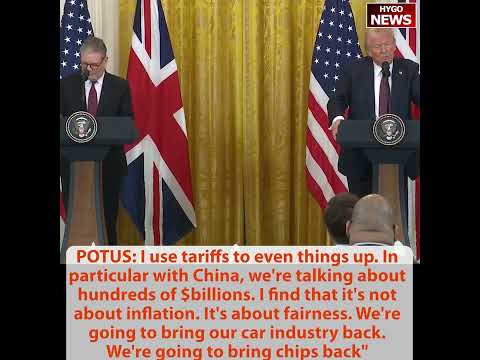
“I use tariffs to even things up, and in particular with China, we took in hundreds of billions of dollars, and we had no inflation,” Trump said. “And it’s a myth. It’s a myth that’s put out there by foreign countries that really don’t like paying tariffs, especially to even up.”
He stated his core finding: “I find that it’s not about inflation. It’s about fairness. And the inflation for us has not existed. And I don’t think it’s going to exist.”
Trump then described the reshoring objectives. “We’re going to bring our car industry back. We’re going to bring our chips back. We’re going to bring so many things back to our country, including pharmaceuticals and drugs,” he said. “The thing that’s going to get us there is tariffs.”
He delivered his signature tariff line with the now-standard comedic preface: “I say often it’s my favorite word in the dictionary, but I always preface that by saying — because I got into a lot of trouble with the fake news where they say that’s not good — so I say God, love, family, wife. They’re all my favorite words. But tariff is about number four or five on the list.”
The serious conclusion: “It’s going to make our country rich, and it’s going to stop us from being a laughingstock all over the world. Because we have been taken advantage of like no country has ever been taken advantage of.”
The “not about inflation, about fairness” formulation was the administration’s most effective rebuttal to the primary critique of tariff policy. Economists who argued tariffs would raise consumer prices were addressing a different question than the one Trump was answering. Trump was not claiming tariffs had no price effects; he was arguing that the relevant metric was fairness in trade relationships, not short-term price movements. If other countries were charging the United States 20% or more while the U.S. charged them 2.5%, the imbalance was the problem — and tariffs were the solution.
NATO Article 5: “I Support It”
A reporter asked the direct question: “Do you support Article 5 of the NATO treaty? And are you concerned that it might be triggered if European peacekeeping forces end up in Ukraine?”
Trump’s answer was concise and confident. “I support it. I don’t think we’re going to have any reason for it,” he said.
He connected the Article 5 question to the peace process. “I think we’re going to have a very successful peace. And I think it’s going to be a long-lasting peace. And I think it’s going to happen hopefully quickly,” Trump said. “If it doesn’t happen quickly, it may not happen at all.”
He articulated the dual motivation: “We want it for two reasons. Number one, I want to see — on a humane basis — I don’t want to pay billions and billions and billions of dollars. Nor does the Prime Minister or anybody else on a senseless war that should have never happened.”
Trump concluded: “But I think it’s going to be a peace that’s going to be long-lasting.”
The Article 5 affirmation was significant given Trump’s history of criticizing NATO members for not meeting their defense spending commitments. By explicitly stating “I support it,” Trump removed any ambiguity about the U.S. commitment to collective defense while simultaneously predicting that a successful Ukraine peace deal would make the question moot. The implication was that a negotiated peace was the best way to ensure Article 5 was never tested.
Starmer: “The Prize”
Starmer closed the press conference with the most emphatic endorsement of Trump’s peace efforts that any European leader had offered.
“Mr. President, I welcome your deep and personal commitment to bring peace,” Starmer said. “You’ve created a moment of tremendous opportunity to reach a historic peace deal. A deal that I think would be celebrated in Ukraine and around the world. That is the prize.”
The word “prize” was well-chosen. It elevated the peace deal from a policy objective to an achievement of historic significance — something worth striving for, celebrating, and remembering. Starmer was lending the full weight of the UK’s diplomatic credibility to Trump’s peace initiative, providing the kind of international validation that strengthened Trump’s negotiating position with both Russia and Ukraine.
For Starmer personally, the endorsement represented a political calculation. By aligning with Trump on peace, Starmer was positioning Britain as a key partner in the eventual settlement — ensuring the UK would have influence over the terms and implementation of any agreement. The alternative — standing apart from Trump’s peace process — would have marginalized Britain at the very moment when European security was being reshaped.
Key Takeaways
- Trump shut down a Canada question with “That’s enough” after Starmer diplomatically said the topic wasn’t discussed and “you’re trying to find a divide that doesn’t exist.”
- He complimented a British reporter’s accent: “I would’ve been President 20 years ago if I had that accent.”
- Trump called tariff-driven inflation “a myth put out by foreign countries,” insisting tariffs are “not about inflation — about fairness.”
- On NATO Article 5: “I support it. I don’t think we’re going to have any reason for it” — predicting a lasting Ukraine peace.
- Starmer closed by telling Trump “you’ve created a moment of tremendous opportunity to reach a historic peace deal. That is the prize.”