 HYGO News
 Trump Cuts G7 Visit Short, Fires Back at Tucker Carlson; 100% chance of rain, didn't rain at all
Trump Cuts G7 Visit Short, Fires Back at Tucker Carlson; 100% chance of rain, didn’t rain at all
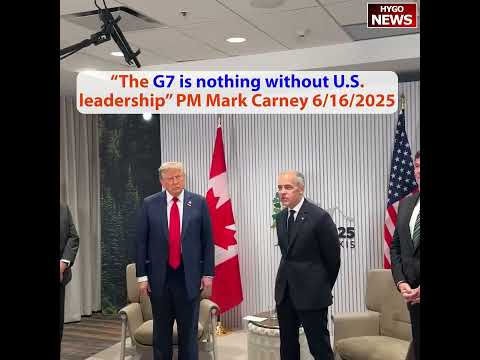
President Trump cut his G7 Summit visit short to return to Washington ahead of schedule, citing the need to meet with his National Security Council team in the Situation Room as the Iran-Israel situation escalated. He also told everyone in Tehran to evacuate — a public warning that escalates his posture while still offering an off-ramp. During his remaining time at the G7, Trump fired back at former Fox News host Tucker Carlson, who had accused him of being complicit in the Israeli strikes on Iran. Trump’s response — “let him go get a television network and say it so that people listen” — is one of the sharper put-downs he has leveled at a former ally on the political right. Canadian Prime Minister Mark Carney used his public remarks to affirm that “the G7 is nothing without U.S. leadership.” Defense Secretary Pete Hegseth laid out the Peace Through Strength doctrine that now defines the administration’s Middle East posture. And Trump, ever attentive to the small victories, called out the weather forecasters who had predicted a 100% chance of rain for the Army parade that went off under clear skies.
The Early Departure
The president opened his departure remarks. “Well, I have to be back. Very important. I want to just thank our great host. Fantastic job. Thank you. Canada. But you probably see what I see. And I have to be back as soon as I can. I’m going to have dinner with these wonderful leaders, and then I get on the plane. I have to be back early for the conversation.”
The phrasing — “you probably see what I see” — is an invitation to the press to read the situation rather than having it explained to them. Trump is signaling that the Iran-Israel escalation is producing developments that require presidential attention in the Situation Room, not commentary from the G7 podium. The departure is not a snub of the summit. It is a choice about where his attention is required.
“I have to be back as soon as I can” and “I have to be back early for the conversation” are consecutive sentences that emphasize urgency. Presidents do not cut G7 summits short without reason, and Trump is signaling that the reason exists but does not need to be spelled out for the audience.
”I Have To Be Back Early For The Conversation”
The reference to “the conversation” is likely the NSC meeting that the video elsewhere references. The administration’s messaging has been consistent: the Iran situation requires the president’s direct engagement, including in-person meetings with the NSC principals, and that engagement cannot be fully delegated or conducted remotely from a G7 summit.
”The UK, We Signed A Big, Great Deal Today”
Before leaving, Trump acknowledged the substantive wins of the summit. “I loved it. I tell you, I loved it. And I think we got a lot done. Really a lot done. In fact, the UK, we signed a big, great deal today. We’re working on others, but we had just a really great relationship with everybody. It’s really nice. I wish I could stay for tomorrow, but they understand this is big stuff.”
The accomplishment ledger at the G7 — signed UK deal, progress on Canada deal, bilateral conversations with other leaders — is the record Trump is leaving behind. “I wish I could stay for tomorrow” is a concession to the summit’s importance that also underscores what he is leaving for.
The Tucker Carlson Response
The most-clipped moment of the video came when a reporter asked Trump about Tucker Carlson’s criticism. “In response to Tucker Carlson criticizing you, saying that you were complicit in the war…”
Trump’s answer was classic dismissal. “I don’t know what Tucker Carlson is saying. Let him go get a television network and say it so that people listen.”
The put-down is sharp. Carlson is one of the most influential voices in the right-wing media ecosystem, but his current independent podcast reaches a smaller audience than his Fox News show did. Trump’s line — that Carlson should “go get a television network” — is both a reference to that lost reach and a claim that television networks remain the primary venue for influence over public opinion.
Why The Carlson Exchange Matters
The Trump-Carlson divergence on Iran is one of the more significant fractures on the current American political right. Carlson has been vocal in opposing expanded American military involvement in the Middle East, framing it as the kind of forever-war entanglement that MAGA nationalism was supposed to repudiate. Trump, in his second term, has been navigating between that nationalist skepticism of military engagement and his own commitment to Israeli security and to preventing Iranian nuclear weapons.
Trump’s dismissal of Carlson — delivered publicly at a G7 bilateral meeting — signals that the president is willing to break with the isolationist wing of his coalition when he views the strategic situation as requiring it. The break is consequential because it tells both Carlson’s audience and the broader conservative coalition which voice will carry authority in moments of genuine disagreement.
Carney: “The G7 Is Nothing Without U.S. Leadership”
Canadian Prime Minister Mark Carney, as host, used his public remarks to affirm the American leadership role. “G7 is nothing without US leadership. So I’m your personal leadership in the United States. Many issues. Geopol takes economic, technology, and working hand-in-hand with the United States, Canada, the United States, and the other G7 partners with your leadership. I’m very much looking forward to the future. Thank you very much, Mark. I appreciate it.”
The transcript is choppy, but the message is clear. Carney is publicly acknowledging that the G7 derives much of its relevance from American participation and leadership. For a Canadian Prime Minister hosting the summit, that is a generous acknowledgment. It is also a diplomatic investment — Carney wants a productive relationship with the Trump administration, and the acknowledgment is the kind of rhetorical deposit that pays dividends in subsequent negotiations.
The Army Parade Weather Story
Trump then pivoted to one of his favorite genres — calling out media predictions that failed. “It was a tremendous success with a fantastic audience. It was supposed to rain. They gave it a 100% chance of rain, and it didn’t rain at all. It was beautiful.”
“100% chance of rain, and it didn’t rain at all” is the kind of detail Trump cannot resist. Weather forecasts do not typically express 100% confidence in rain, but when they do, they are meant to indicate near-certainty. A 100% chance that failed to materialize is a meaningful forecasting error.
”How Did They Predict 100 Years Out?”
Trump’s philosophical extension was direct. “So I asked if they gave it 100% chance, right? 100% it was going to rain like crazy, and it didn’t rain at all. How did they predict 100 years out and 50 years out or 200 years out?”
The implicit target is climate forecasting. Trump’s argument is that if short-term weather forecasting is prone to error, long-term climate forecasting should be held to even higher scrutiny. The argument is, from an atmospheric science perspective, not exactly right — climate models operate on different principles than short-term weather forecasts — but the intuitive appeal is real. If the experts cannot get tomorrow’s rain right, why should anyone defer to their predictions about 2050?
“They didn’t do too well, the weather people last night, but it was beautiful.” The editorial verdict is delivered.
Hegseth: Peace Through Strength
Defense Secretary Pete Hegseth’s contribution laid out the administration’s doctrine in its cleanest public formulation. “Is he still aiming for a nuclear deal with the Iranians? Of course. The president, as he said today, his position has not changed. What you’re watching in real time is peace through strength and America first.”
“Peace through strength” is the Reagan-era formulation that the Trump administration has reclaimed as its own. The logic: peace is most reliably secured when adversaries believe force will be used against them if they behave aggressively. Weak postures invite aggression. Strong postures deter it.
”Postured Defensively In The Region”
Hegseth explained the operational implementation. “Our job is to be strong. We are postured defensively in the region to be strong in pursuit of a peace deal. And we certainly hope that’s what happens here. And America first means we’re going to defend American personnel and American interests.”
“Postured defensively” is the administration’s term of art for the current U.S. military disposition in the Middle East. American forces are in position to defend American personnel, American assets, and American partners. They are not, in the administration’s telling, pre-positioned for offensive operations. But they are positioned.
”Jets, Air Defense Assets, And Counter UAS Assets”
Hegseth offered specifics on what “posture” means. “So when you see jets and you see air defense assets and counter UAS assets, that’s because my job as the Secretary of Defense is to ensure that our people are safe and that we’re strong, so that we can set the conditions for a deal.”
Each element matters. Jets establish air superiority and provide strike capability if ordered. Air defense assets — including THAAD, Patriot, and shipboard SM-3 systems — protect American personnel and partners from missile attacks. Counter-UAS (counter-unmanned aerial systems) assets are the defenses against drone attacks, which have become a dominant feature of Middle East combat over the past several years.
The combination is a comprehensive defensive posture. It is also a posture from which offensive operations could be launched if circumstances required.
”It’s On The Table. The Question Is Whether Iran Will Take It”
Hegseth’s framing of the current negotiating state was direct. “And President Trump’s made it clear it’s on the table. The question is whether Iran will take it.”
The framing places responsibility on Tehran. The Americans are offering the deal. The Americans are postured defensively. The Americans are ready to negotiate. The question is whether Iran will accept the terms, and the administration’s patience for Iranian foot-dragging is limited.
”All Options Are On The Table”
The reporter followed up on the implications. “All right, so the deal is still on the table, but all options are on the table from what it sounds like. What does that look like?”
Hegseth’s response was composed. “What it looks like right now is we’re vigilant. We’re prepared, and we’ve messaged consistently from the beginning that we’re in the region to defend our people and our assets. And Israel took an action out of self-defense. We believe that Iran, as President has said from the beginning, should not have a nuclear weapon. That position hasn’t changed. They can give it up peacefully. That position hasn’t changed.”
The “give it up peacefully” framing is the off-ramp. Iran’s nuclear program can be dismantled through negotiation, or it can be dismantled through other means. The administration prefers negotiation. But negotiation is not the only option.
”We’re Strong. We’re Prepared. We’re Defensive.”
Hegseth’s closing was the compression of the administration’s Middle East posture into a single tagline. “So people are reading into a lot of aspects right now. We’re strong. We’re prepared. We’re defensive. And the President Trump hopes there can be peace.”
The sentence order is deliberate. Strong comes first. Prepared comes second. Defensive comes third. And hope for peace comes last. The sequence communicates that hope rests on the foundation of strength and preparation, not the other way around.
The Strategic Summary
The G7 departure, the Carlson dismissal, the weather observation, and the Hegseth doctrine all fit together as facets of a single administration that is moving quickly across multiple fronts. Trump left the G7 because Iran was escalating. He dismissed Carlson because the intra-coalition disagreement could not be permitted to interfere with policy execution. He noted the failed weather forecast because the public record matters. And he authorized Hegseth to articulate the doctrine publicly because the strategic posture depended on clear communication.
Each small moment added up to a coherent posture. The administration is not improvising. It is executing.
Key Takeaways
- Trump cut G7 short: “I have to be back as soon as I can…I wish I could stay for tomorrow, but they understand this is big stuff.”
- Trump on Tucker Carlson: “I don’t know what Tucker Carlson is saying. Let him go get a television network and say it so that people listen.”
- Carney: “G7 is nothing without US leadership.”
- Trump on weather forecasting: “They gave it a 100% chance of rain, and it didn’t rain at all…How did they predict 100 years out and 50 years out or 200 years out?”
- Hegseth’s doctrine: “We’re strong. We’re prepared. We’re defensive. And the President Trump hopes there can be peace.”