 HYGO News
 Trump Creates White House Office of Shipbuilding; Surprises Student with West Point Acceptance; MAHA and Autism
Trump Creates White House Office of Shipbuilding; Surprises Student with West Point Acceptance; MAHA and Autism
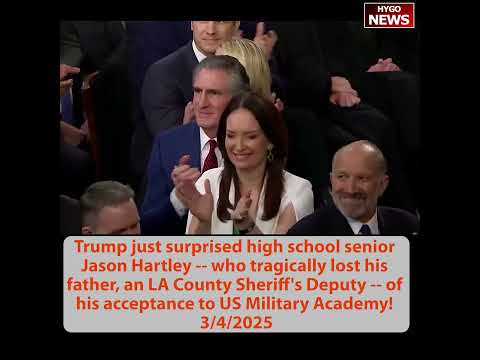
President Trump used his March 2025 joint address to Congress to announce the creation of a new White House Office of Shipbuilding with “special tax incentives to bring this industry home to America,” surprised high school senior Jason Hartley — who lost his father, an LA County Sheriff’s Deputy — with his acceptance to West Point, and tasked RFK Jr.’s Make America Healthy Again commission with investigating why “rates of child cancer have increased by more than 40% since 1975” and autism has gone from “one in 10,000 children” to “one in 36.”
Resurrecting American Shipbuilding
Trump announced a new institutional commitment to rebuilding an industry that had once been a cornerstone of American manufacturing and national defense.
“To boost our defense industrial base, we are also going to resurrect the American shipbuilding industry, including commercial shipbuilding and military shipbuilding,” Trump said.
He then revealed the specific mechanism: “For that purpose, I am announcing tonight that we will create a new Office of Shipbuilding in the White House and offer special tax incentives to bring this industry home to America where it belongs.”
Trump acknowledged the scale of the decline: “We used to make so many ships. We don’t make them anymore very much, but we’re going to make them very fast, very soon.”
The creation of a White House-level office for shipbuilding signaled that the administration viewed the industry’s revival as a presidential priority rather than merely a Pentagon procurement issue. The Office of Shipbuilding would have the authority to coordinate across the Defense Department, Commerce Department, and other agencies to remove regulatory barriers, direct investment, and ensure that the tax incentives produced actual shipyard construction.
The strategic rationale was compelling. China had become the world’s dominant shipbuilder, producing more naval and commercial vessels than the rest of the world combined. The United States, which had built the fleets that won World War II and dominated the Cold War’s seas, had seen its shipbuilding capacity shrink to a fraction of China’s output. Rebuilding that capacity was essential for both military readiness and commercial competitiveness.
The inclusion of “commercial shipbuilding” alongside military shipbuilding was significant. Previous shipbuilding initiatives had focused narrowly on naval vessels. Trump was extending the commitment to the merchant marine and commercial fleet, recognizing that a healthy commercial shipbuilding base provided the workforce, supply chains, and industrial infrastructure that military shipbuilding depended on.
Jason Hartley: West Point Surprise
The evening’s most emotional surprise came when Trump revealed that a young man in the audience was about to learn, on national television, that his dream was coming true.
“We’re joined tonight by a young man, Jason Hartley, who knows the weight of that call of duty,” Trump said. “Jason’s father, grandfather, and great-grandfather all wore the uniform.”
He described the family’s sacrifice: “Jason tragically lost his dad, who was also a Los Angeles County Sheriff’s Deputy, when he was just a boy. And now he wants to carry on the family legacy of service.”
Trump listed Jason’s credentials: “Jason is a senior in high school, a six-letter varsity athlete — a really good athlete, they say — a brilliant student with a 4.46 GPA. And his greatest dream is to attend the U.S. Military Academy at West Point.”
Trump set up the moment: “And Jason, that’s a very big deal getting in. That’s a hard one to get into.”
Then the announcement: “But I’m pleased to inform you that your application has been accepted.”
The chamber erupted as Jason reacted to the news. The moment combined several elements that made it both politically effective and genuinely moving: a young man who had lost his father in the line of duty, a multigenerational military family, academic and athletic excellence, and a president who used the grandest stage in American politics to make a teenager’s dream come true.
The West Point acceptance — revealed before a joint session of Congress with the entire nation watching — transformed a routine admissions decision into a national celebration of service, sacrifice, and aspiration. Jason Hartley would enter West Point not just as a cadet but as someone whose story had been told by the President to the country.
Make America Healthy Again: Cancer and Autism
Trump then turned to the health agenda that RFK Jr. had been tasked with leading, presenting two statistics that framed the crisis.
“Since 1975, rates of child cancer have increased by more than 40%,” Trump said. “Reversing this trend is one of the top priorities for our new Presidential Commission to Make America Healthy Again, chaired by our new Secretary of Health and Human Services, Robert F. Kennedy Jr.”
Trump noted the irony of the Democratic response: “With the name Kennedy, you would have thought everybody over here would have been cheering. How quickly they forget.”
He outlined the commission’s mission: “Our goal is to get toxins out of our environment, poisons out of our food supply, and keep our children healthy and strong.”
Trump then cited the autism statistic that had been one of Kennedy’s signature talking points. “Not long ago — and you can’t even believe these numbers — one in 10,000 children had autism. One in 10,000,” Trump said. “And now it’s one in 36. Something’s wrong. One in 36. Think of that.”
He directed Kennedy to find the answer: “So we’re going to find out what it is, and there’s nobody better than Bobby and all of the people that are working with you. You have the best to figure out what is going on.”
Trump concluded with characteristic directness: “Okay, Bobby, good luck. It’s a very important job.”
The autism statistic — from 1 in 10,000 to 1 in 36 — was one of the most alarming data points in American public health. Whether the increase reflected genuine rising incidence, expanded diagnostic criteria, greater awareness, or some combination, the magnitude of the change demanded investigation. Kennedy’s appointment as HHS Secretary had placed someone at the helm who was committed to pursuing the question aggressively, regardless of where the answers led.
The “something’s wrong” assessment from the President of the United States, delivered from the floor of Congress, legitimized a line of inquiry that had been marginalized in mainstream public health discourse. Parents who had been told the autism increase was merely an artifact of better diagnosis now had a president and an HHS secretary who shared their concern that something environmental or systemic might be contributing to the trend.
Three Stories, One Theme
The three segments — shipbuilding, Jason Hartley, and MAHA — shared a common theme: rebuilding. America was rebuilding its industrial base through shipyards and tax incentives. America was rebuilding its military tradition through young men like Jason who carried on their families’ legacy of service. And America was rebuilding the health of its children by investigating why cancer and autism rates had skyrocketed and committing to removing the toxins responsible.
Each represented a different dimension of the “renewal of the American dream” that Speaker Johnson had identified as the speech’s central theme. The American dream required industrial capacity, military readiness, and healthy children. Trump was addressing all three in a single address, demonstrating the breadth of an agenda that encompassed shipyards and food safety, West Point admissions and environmental toxins.
Key Takeaways
- Trump announced a new White House Office of Shipbuilding with “special tax incentives” to resurrect both commercial and military shipbuilding, saying “we used to make so many ships.”
- He surprised high school senior Jason Hartley — a 4.46 GPA student and six-letter varsity athlete who lost his sheriff’s deputy father — with his acceptance to West Point on national television.
- Trump tasked RFK Jr.’s MAHA commission with investigating why child cancer rates have risen 40% since 1975 and autism has gone from 1 in 10,000 to 1 in 36: “Something’s wrong.”
- He outlined the MAHA mission: “Get toxins out of our environment, poisons out of our food supply, and keep our children healthy and strong.”
- Trump noted that Democrats refused to cheer for a Kennedy: “With the name Kennedy, you would have thought everybody over here would have been cheering. How quickly they forget.”