 HYGO News
 Trump Changing the Gulf of Mexico's Name to "Gulf of America What a Beautiful Name", turn econ very
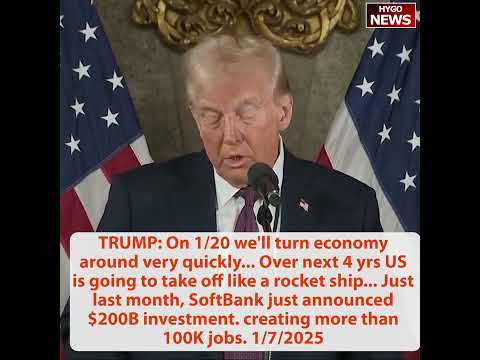
Trump Changing the Gulf of Mexico’s Name to “Gulf of America What a Beautiful Name”, turn econ very quickly
On January 7, 2025, President-elect Donald Trump held his first press conference at Mar-a-Lago following the congressional certification of his 2024 election victory. The wide-ranging event produced several major headlines, most notably Trump’s announcement that he intended to rename the Gulf of Mexico to the “Gulf of America.” He also projected rapid economic improvement, cited billions in new investment commitments, and had his senior adviser Jason Miller outline a more assertive U.S. posture on national security, including the Panama Canal, the Arctic, and relations with Canada.
”The Gulf of America” — Renaming a Major Body of Water
The most attention-grabbing moment of the press conference came when Trump announced his plan to rename the Gulf of Mexico.
“We’re going to be changing the name of the Gulf of Mexico to the Gulf of America, which has a beautiful ring that covers a lot of territory,” Trump declared. “The Gulf of America, what a beautiful name. And it’s appropriate. It’s appropriate.”
The announcement was met with immediate media coverage and public debate. The Gulf of Mexico, a semi-enclosed basin bordered by the United States, Mexico, and Cuba, has carried its current name since the early European exploration of the Americas. Trump’s proposal to rename it was both a symbolic assertion of American dominance in the region and a provocative gesture toward Mexico at a time of heightened tension over immigration, trade, and border security.
The president’s authority to rename a major body of water through executive action was itself a subject of debate. Geographic names in the United States are overseen by the U.S. Board on Geographic Names, a federal body, but international recognition of any name change would require broader acceptance. Regardless of the legal complexities, the announcement served its intended purpose of dominating the news cycle and projecting an assertive “America First” posture.
Economic Optimism: “Take Off Like a Rocket Ship”
Trump pivoted from the renaming announcement to a bullish assessment of the economy under his incoming administration. He acknowledged current challenges while projecting rapid improvement.
“On January 20th, we’ll turn the economy around very quickly, because right now, when I think of our economy, I think about inflation,” Trump said. “We have inflation, I believe, at a level that we never had before. There’s never been anything like it. And over the next four years, the United States is going to take off like a rocket ship.”
Trump argued that the economic turnaround was already underway, driven by investor confidence in his election. “But really, it’s already doing it,” he said, citing several data points to support his case.
“Since my election, the stock market has set records. The S&P 500 index has broken above 6,000 points for the first time ever, never even close,” Trump noted. “In a single month, small business optimism soared 41 points. It went up 41 points. And that’s the largest in the 39-year history of the group that does it. According to Gallup, the American people’s confidence in the economy has just surged to the highest level in history.”
Major Investment Announcements: SoftBank and DAMAC
Trump highlighted major private investment commitments as evidence of the economic confidence his election had generated.
“Just last month, SoftBank announced the $200 billion,” Trump said, referring to SoftBank CEO Masayoshi Son’s announcement of a massive U.S. investment plan. Trump took credit for pushing the figure higher: “He said between 100, and I said, how about making it 200? And you sort of said yes. But let’s say it’s 100, but it might be 200, right, Brian? Dollars. United States. Creating more than 100,000 jobs.”
He also referenced the DAMAC Properties investment announced earlier that day by Hussain Sajwani: “Hussain just announced tremendous investment that he’s going to make. And that’s money that’s in the bank. He’s going to come and do it, and he’ll do a great job. And he’ll build the best centers in the country, I guarantee, because I know the way he builds.”
The combined investment announcements of $220 billion or more from SoftBank and DAMAC Properties represented an effort by the incoming administration to build momentum and demonstrate that Trump’s election was already producing tangible economic results before he even took office.
Criticizing the Biden Administration’s Final Actions
Trump used the press conference to criticize the outgoing Biden administration for actions he characterized as attempts to obstruct his incoming agenda.
“We are inheriting a difficult situation from the outgoing administration. And they’re trying everything they can to make it more difficult,” Trump said. “Inflation is continuing to rage and interest rates are far too high. And I’ve been disappointed to see the Biden administration’s attempt to block the reforms of the American people and that they voted for.”
He invoked his election mandate to underscore the point: “We had a landslide election. We won every swing state. We won the popular vote by millions and millions of people.”
Jason Miller on National Security: “Not Going to Be Pushovers”
Trump Senior Adviser Jason Miller provided a broader strategic framework for the incoming administration’s approach to national security and international relations.
“What I can say very certainly is that he is going to stand up for the United States and our security, whether that be national security, whether that be economic security, and we’re not going to be pushovers any longer,” Miller said.
Miller identified specific geopolitical concerns driving the administration’s posture: “We’ve seen what’s happened with continued Russian aggression in the Arctic Circle and near Greenland as that’s become an increasingly powerful shipping lane. We’ve seen China expand their influence, whether that be in Central or South America.”
On the Panama Canal specifically, Miller framed the issue in urgent national security terms: “Right now, this is a massive national security risk that China could effectively just flip a switch and the canal would be shut down. This would cause massive chaos and massive havoc to the United States.”
Miller concluded by placing Trump’s various policy positions into a unified strategic vision: “President Trump is coming in, having done this before, having had this great set of results, looking at the entire chess board, saying he is going to position the United States in a place where we can succeed. That includes securing our southern border, by the way, and making sure that folks, even neighbors, even friends such as the Canadians, are no longer taking advantage of us when it comes to economic or trade issues.”
Additional Context
The January 7 press conference was notable for the breadth of topics covered and the assertive tone that previewed the style of Trump’s second term. From renaming a body of water to criticizing allies and warning adversaries, Trump used the event to establish that his administration would move aggressively across multiple fronts simultaneously.
The Gulf of America renaming, in particular, became one of the most discussed moments of the transition period, generating debate about presidential authority, geographic naming conventions, and the symbolic dimensions of American foreign policy.
Key Takeaways
- Trump announced plans to rename the Gulf of Mexico to the “Gulf of America,” calling it “a beautiful name” that “covers a lot of territory.”
- Trump projected the U.S. economy would “take off like a rocket ship” over the next four years and cited record stock market performance and surging small business optimism since his election.
- SoftBank’s $100-200 billion investment and DAMAC Properties’ $20 billion commitment were cited as evidence of economic confidence driven by Trump’s election.
- Trump criticized the Biden administration for “trying everything they can to make it more difficult” for the incoming government and for attempting to block the reforms voters supported.
- Senior Adviser Jason Miller outlined national security concerns including Russian Arctic aggression, Chinese influence in Latin America, and the Panama Canal, stating the U.S. would no longer “be pushovers.”