 HYGO News
 Trump: ceasefire rapidly, if not work out well I would walk; not doing this for my health
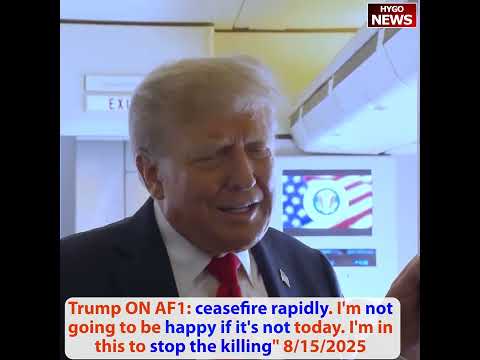
Trump: ceasefire rapidly, if not work out well I would walk; not doing this for my health
Trump aboard Air Force One en route to the historic Alaska summit with Vladimir Putin, outlining his specific approach to the meeting and the consequences of Putin’s failure to cooperate. Trump: “I want to see a ceasefire rapidly. I don’t know if it’s going to be today, but I’m not going to be happy if it’s not today … Everyone said it can’t be today, but I’m just saying I want the killing to stop. I’m in this to stop the killing.” On U.S. financial position: “We’re not putting up any money. We’re making money. They’re buying our weapons and we’re sending them to NATO, and NATO is sending us big, beautiful checks.” On the human cost: “They lost, last week, 7,011 people were lost. Almost all soldiers … 36 people in a town which got hit by a missile.” On the walk-away option: “If it doesn’t, I’m going to head back home real fast.” Bret Baier: “If it doesn’t, you walk?” Trump: “I would walk.” On Putin’s potential consequences: “Economically severe. Yes, it will be very severe.” And his motivation: “I’m not doing this for my health. Okay, I don’t need it. I’d like to focus on our country, but I’m doing this to save a lot of lives."
"I Want to See a Ceasefire Rapidly”
Trump’s specific summit objective. “What will make a success of this summit today? I can’t tell you that. I don’t know. There’s nothing set in stone. I want certain things. I want to see a ceasefire. This is not to do with Europe. Europe’s not telling me what to do, but they’re going to be involved in the process obviously, as will Zelensky.”
“I want to see a ceasefire.” The specific goal. Not a comprehensive peace agreement immediately. Not resolved territorial questions. A ceasefire — pause in military operations — as the immediate operational priority.
“This is not to do with Europe. Europe’s not telling me what to do.” That is important positioning. European leaders have specific preferences about the shape of any Ukraine resolution. Trump is asserting U.S. independence from European direction while acknowledging European involvement in the process.
“They’re going to be involved in the process obviously, as will Zelensky.” European participation and Zelensky participation are both part of the eventual process. Trump’s Alaska meeting is Putin-Trump bilateral. Later meetings will include Zelensky and European leaders.
”I Want the Killing to Stop”
“But I want to see a ceasefire rapidly. I don’t know if it’s going to be today, but I’m not going to be happy if it’s not today. Everyone said it can’t be today, but I’m just saying I want the killing to stop. I’m in this to stop the killing.”
“Rapidly.” Trump’s specific timeline vocabulary. Not “eventually.” Not “when conditions are right.” Rapidly.
“I don’t know if it’s going to be today, but I’m not going to be happy if it’s not today.” That is pressure. Trump is conveying to Putin, via press availability, his specific expectation: ceasefire today. Not next week. Not after further negotiations. Today.
“Everyone said it can’t be today, but I’m just saying I want the killing to stop.” Trump rejecting the conventional wisdom. Experts and Russian negotiators have said immediate ceasefire is not possible. Trump is pushing past that limitation.
“I’m in this to stop the killing.” The specific motivation. Not territorial adjustments. Not geopolitical rebalancing. Ending the killing. That framing resonates with Americans who support ending the war but are uncertain about specific territorial or political outcomes.
”We’re Not Putting Up Any Money”
“You know, we’re not putting up any money. We’re making money. They’re buying our weapons and we’re sending them to NATO, and NATO is sending us big, beautiful checks.”
The U.S. financial position. Under Trump’s framework, the U.S. is not funding Ukraine directly with taxpayer money. European NATO members are purchasing U.S. weapons. Those weapons flow to Ukraine through NATO. NATO pays the U.S. in “big, beautiful checks.”
That is structurally different from the Biden-era arrangement. Under Biden, U.S. taxpayer dollars directly funded Ukraine aid — approximately $175 billion across multiple authorizations. Under Trump, U.S. weapons flow to NATO. NATO pays the U.S. Europe absorbs the financial cost.
“Big, beautiful checks” — Trump’s characteristic vocabulary. NATO payments to U.S. defense contractors become revenue for the U.S. economy. U.S. defense industrial base benefits. Jobs in defense manufacturing expand.
”Biden Spent $350 Billion and Got Nothing”
“But I don’t care about that. I care about… It was a big factor when Biden spent $350 billion and got nothing.”
$350 billion is the cumulative U.S. Ukraine-related spending across the Biden administration. Trump’s framing: “got nothing” — meaning the spending did not produce victory, did not end the war, did not achieve specific strategic outcomes proportional to the cost.
“I care about…” Trump’s trailing thought returns to the core issue. Not the money. The human cost.
”7,011 People Were Lost Last Week”
“But what I do care about is they lost, last week, 7,011 people were lost. Almost all soldiers.”
7,011 casualties in one week. “Almost all soldiers” — primarily military deaths rather than civilian. That is an enormous weekly loss. Over 52 weeks, that would be approximately 365,000 deaths per year.
The specific weekly numbers Trump cites are at the upper end of Ukrainian casualty estimates. Ukrainian government figures typically range from 31,000-70,000 military deaths since the invasion began in February 2022. Trump’s 7,011 per week would substantially exceed the official Ukrainian totals if sustained.
More credible Russian casualty estimates from various open-source analysts range from approximately 250,000-800,000 total killed and wounded across the war. Trump’s specific 7,011 number may aggregate Ukrainian + Russian casualties for the week.
”36 People in a Town Hit by a Missile”
“36 people in a town which got hit by a missile. But 7,000, over 7,000 soldiers. It’s crazy.”
A specific civilian casualty incident. 36 civilian deaths in one town from one missile strike. That is the kind of specific atrocity that continues happening regularly across the war.
“But 7,000, over 7,000 soldiers. It’s crazy.” Trump’s emphasis. The civilian atrocity is horrific. But the soldier deaths are larger in number and represent a more consistent pattern. Whether Russian or Ukrainian soldiers, 7,000+ military deaths per week is an extraordinary loss rate.
“It’s crazy.” That is Trump’s specific characterization. The war’s casualty rate has no reasonable justification. Continuing the war produces thousands more deaths weekly. Ending the war, even on imperfect terms, saves those lives.
”Setting Records Economically”
“The country is doing very well. We’re setting records economically like we never have before. Excluding the stock markets are all at a record high. We’re taking in trillions and trillions of dollars with tariffs.”
Trump’s economic framing. Stock markets at record highs. Tariff revenue at “trillions and trillions” (which is somewhat aspirational — projected annual tariff revenue is in the hundreds of billions rather than trillions, but cumulative multi-year totals could reach trillions).
That economic framing provides Trump with diplomatic leverage. A U.S. economy performing well has credibility in diplomatic negotiations. Counterparts know U.S. economic strength enables various economic pressure options.
“Setting records” — Trump’s specific claim. Whether that claim survives detailed economic scrutiny (are we actually setting records across all metrics?) is debatable. But the general direction — economic strength, rising markets, reducing inflation, increasing tariff revenue — supports the general framing.
”Alaska Meeting”
“We’re going for a meeting with President Putin in Alaska. And I think it’s going to work out very well. And if it doesn’t, I’m going to head back home real fast.”
Alaska as the summit location. Joint Base Elmendorf in Anchorage, specifically. That location is U.S. territory — Putin traveling to America rather than Trump traveling to Russia or a neutral third location.
“I think it’s going to work out very well.” Optimistic framing. Trump believes the summit will produce results.
“If it doesn’t, I’m going to head back home real fast.” The contingency. If the summit is not producing progress, Trump exits quickly rather than extending unproductive negotiations.
”I Would Walk”
Bret Baier: “If it doesn’t, you walk?” Trump: “I would walk there. I would walk.”
That is the specific commitment. Trump would walk away from a Putin meeting that is not producing progress. Not endlessly negotiate. Not accept face-saving incremental progress. Actual meaningful movement toward ceasefire, or walk away.
That framing creates leverage for Trump. Putin cannot assume Trump will stay in negotiations indefinitely. Putin must produce enough progress to justify Trump’s continued engagement. If Putin stonewalls, Trump exits — and the U.S. posture shifts to different tools (economic pressure, weapons support for Ukraine, sanctions).
”Economically Severe” Consequences
Baier continuing. “You had said earlier this week that Putin would face severe consequences. If you get the sense from him that he’s not interested, what do you mean by that?”
Trump: “Economically severe. Yes, it will be very severe.”
That is the specific consequence. Economic measures — potentially including secondary sanctions on countries buying Russian oil, expanded financial restrictions on Russian entities, trade pressure on countries continuing significant commerce with Russia. “Very severe” — not incremental. Substantial.
“I’m not doing this for my health. Okay, I don’t need it. I’d like to focus on our country, but I’m doing this to save a lot of lives.”
Trump’s motivation. Not personal gain. Not diplomatic glory. Specifically to save lives. The 7,011 lost last week. The tens of thousands lost this year. The hundreds of thousands lost since February 2022.
“I’d like to focus on our country.” That is honest statement. Trump’s domestic priorities are substantial. Ukraine diplomacy consumes time and attention that could go to domestic issues. Trump is engaging with Ukraine despite the preference for domestic focus because the moral imperative — stopping the killing — outweighs the preference.
The Historic Alaska Summit
“Air Force One is officially wheels down at Joint Base Elmendorf in Anchorage, Alaska.”
The arrival. Joint Base Elmendorf — the combined U.S. Air Force and Army installation in Anchorage. The specific location provides security, meeting facilities, and symbolic weight (Alaska was purchased from Russia in 1867 — the historic echo is relevant).
“President Trump en route to ALASKA!” and “POTUS Trump departs for Anchorage, Alaska, where he will hold a historic summit with President Vladimir Putin.”
“Historic” is the specific framing. The Alaska summit is historically significant regardless of outcome. Previous Russia-U.S. summits have occurred at various neutral locations. A Putin visit to U.S. soil is a specific diplomatic event with specific symbolic meaning.
The Climate Socialist Contrast
The segment ends with an unrelated socialist climate commentary. “When it comes to the climate crisis, democracy as a failure, you were talking about earlier, democracy is the solution, socialism is the solution, right? The liberals out there want to have regulation. They want to go around with the clipboard police and pretend that we can actually regulate these companies when we know that the only solution is to bring industry under public and worker ownership.”
That is socialist framing. Democracy as a “failure” that must be replaced with “socialism.” Industry brought “under public and worker ownership” — i.e., nationalization or socialization of private enterprise.
The contrast with Trump’s Alaska summit framing matters. Trump is operating within standard democratic-capitalist frameworks — using economic tools, diplomatic leverage, market-based incentives to produce specific outcomes. The socialist framing rejects those frameworks entirely.
The juxtaposition shows the political polarity. Trump represents one pole — active diplomacy, economic leverage, market-based outcomes. Some Democratic voices represent the opposite pole — rejection of markets, rejection of democracy-as-currently-practiced, advocacy for public ownership.
Three Clear Commitments
Ceasefire rapidly (summit objective). Walk away if not productive (summit limit). Severe economic consequences (summit stakes). Three specific commitments that create a specific structure for the Alaska meeting. Putin knows exactly what Trump wants (ceasefire today or tomorrow), what Trump will do if he does not get it (walk away), and what consequences will follow (severe economic pressure).
That clarity of stakes is itself a diplomatic tool. Ambiguity allows each side to find face-saving middle ground. Clarity forces the counterparty to choose — cooperate or face specific consequences.
Key Takeaways
- Trump on the Alaska summit objective: “I want to see a ceasefire rapidly. I don’t know if it’s going to be today, but I’m not going to be happy if it’s not today … Everyone said it can’t be today, but I’m just saying I want the killing to stop. I’m in this to stop the killing.”
- On the U.S. financial position: “We’re not putting up any money. We’re making money. They’re buying our weapons and we’re sending them to NATO, and NATO is sending us big, beautiful checks” — vs. “when Biden spent $350 billion and got nothing.”
- On the human cost: “They lost, last week, 7,011 people were lost. Almost all soldiers … 36 people in a town which got hit by a missile.”
- On the walk-away option: “If it doesn’t, I’m going to head back home real fast” — Baier: “If it doesn’t, you walk?” Trump: “I would walk.”
- On severity of consequences: “Economically severe. Yes, it will be very severe. I’m not doing this for my health. Okay, I don’t need it. I’d like to focus on our country, but I’m doing this to save a lot of lives.”