 HYGO News
 Trump Cambodia & Thailand peace; Scotland Trump supporters; Trade Greer: amazing offshoring reverse
Trump Cambodia & Thailand peace; Scotland Trump supporters; Trade Greer: amazing offshoring reverse
Three threads from Trump’s Scotland trip. On the Cambodia-Thailand ceasefire: “It’s peace. That was going to be a very bad war … that could have gone on for years. Millions of people could have been killed.” Scottish supporters — contradicting the narrative that “all Scotland hates Trump” — gathered to see the president, with one German visitor who traveled specifically from Germany to record the Turnberry and Aberdeen visits saying the Russia hoax and assassination attempt made him “double down on the man himself, the resilience that he has as a character.” Trump arrived at Trump International in Aberdeen with Keir Starmer. Von der Leyen’s praise for Trump’s personal leadership: “He is a tough negotiator, but he is also a dealmaker.” And U.S. Trade Representative Greer delivered the structural argument: “For 70 years we followed a trade policy that … ultimately the net result was other countries that hired tariffs and non-tariff barriers on the United States. We had a very open economy and a lot of it resulted in offshoring of manufacturing … President Trump is now reversing that through these deals.”
Cambodia: “Millions of People Could Have Been Killed”
Trump’s direct confirmation of the Cambodia-Thailand outcome. “As you know with Cambodia, we just announced a very big… What’s that? Yeah, the island of the peace. That was going to be a very bad war.”
“The island of the peace” — Whisper’s partial rendering. Trump is describing the Cambodia-Thailand conflict resolution.
“And so we’re honored we got involved. And it’s actually settled. I think they’re going to be settling it today. So it went for a few days. That was going to go on for years. That could have gone on for years. Millions of people could have been killed. We ended the war and we’re very happy about it.”
“Millions of people could have been killed.” That is the counterfactual Trump keeps returning to. The Cambodia-Thailand conflict — had it escalated into full-scale war — would have produced casualties at scales that Southeast Asian conflicts have historically reached. Vietnamese, Cambodian, and other regional wars have produced millions of deaths in previous decades.
“We ended the war and we’re very happy about it.” The claim: the U.S. intervention ended what would have been a prolonged, devastating regional war in days rather than years.
Scottish Supporters
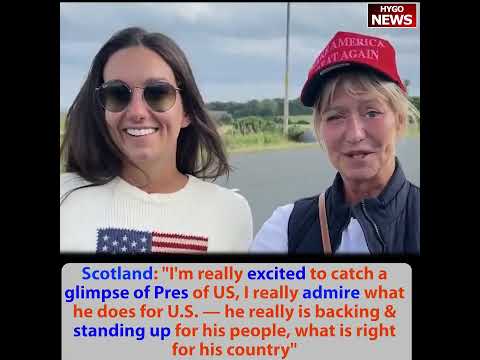
A cut to a German supporter who traveled to Scotland specifically to see Trump. “I’m really excited to catch a glimpse of the President of the United States. I think I really admire what he does for the US. He really is backing and standing up for his people and what’s right for his country.”
That is a European citizen — not an American — expressing admiration for Trump’s specific style of defending national interests. In European political discourse, that admiration is complicated. Many Europeans are openly hostile to Trump. Others, like the German visitor, view his posture as a model their own national leaders should adopt.
“So I only hope our Prime Minister could take a little bit of advice or inspiration from him.”
That is the specific ask. The German visitor is implicitly criticizing Friedrich Merz or whichever German leader is currently struggling with the country’s challenges. Germany has been under economic, industrial, and immigration pressure. The visitor is suggesting Germany needs Trump-style leadership.
The Russia Hoax and Butler
“I’ve traveled to Scotland from Germany in order to record President from Smutter Cades. I’ve been to Turmburi a few days ago and now I’m here in Aberdeen.”
A German citizen who has personally traveled to multiple Trump Scotland properties to observe and record the visit. That is unusual civic engagement for a foreign visitor.
“Ever since there’s been the fake Russia-Russia hoax, the assassination attempt from last year, all the kangaroo court hearings, all of these things, they’ve just made me double down on the man himself, the resilience that he has as a character.”
“Double down on the man himself.” The German visitor is describing a specific psychological trajectory. The anti-Trump pressure campaign — Russia collusion narrative, Butler assassination attempt, the various court cases characterized as “kangaroo court hearings” — have not weakened international admiration for Trump among his supporters. They have strengthened it.
“The resilience that he has as a character” is the specific attribute being admired. Surviving eight years of coordinated institutional opposition, including a genuine assassination attempt, has demonstrated something about Trump’s character that international observers have registered.
”We’re All Trump Supporters”
“We’re all Tom supporters. A lot of the media reports that all Scotland hates Trump and not the case, we think the majority of people are for Trump.”
“Tom” is obviously a Whisper rendering of “Trump.” The quotes are from Scottish supporters.
The media-framing counter is important. The narrative in UK press has been that Trump is deeply unpopular in Scotland — that Scottish public opinion is overwhelmingly against him, that his property holdings in Scotland are politically toxic. The reality, per the supporters interviewed, is more complex. Scottish Trump supporters exist in substantial numbers, organized around specific localities and demographic groups. The media narrative has minimized their visibility.
“We think the majority of people are for Trump.” Whether that claim holds up against systematic polling is a separate question. But the supporters are making clear that Scottish public opinion is not uniform in its hostility.
Von der Leyen’s Praise
European Commission President Ursula von der Leyen’s personal tribute. “I want to thank President Trump personally for his personal commitment and leadership to achieve this breakthrough. He’s a tough negotiator, but he is also a deal maker.”
“Tough negotiator” and “deal maker.” Von der Leyen is using Trump’s own preferred framing. A tough negotiator is someone who pushes hard for their side’s interests. A deal maker is someone who, having pushed hard, ultimately closes an agreement. Both are required for successful negotiation.
The “breakthrough” she is referring to is the EU trade deal. Her personal thanks to Trump — not to the U.S. Trade Representative, not to Commerce Secretary Lutnick, but to Trump personally — reflects that she believes the deal happened because of Trump’s direct engagement.
U.S. Trade Rep Greer on 70 Years
U.S. Trade Representative Ambassador Greer’s structural framing. “It’s an amazing thing for our country. For 70 years we followed a trade policy that maybe at a certain time made sense, but ultimately the net result was other countries that hired tariffs and non-tariff barriers on the United States.”
“70 years” traces back to the post-WWII Bretton Woods consensus and GATT-era trade architecture. The framework made sense in 1945-1955. The United States was the uncontested economic hegemon. American trade policy could afford to subsidize allies’ reconstruction through asymmetric market access. Europe needed to rebuild. Japan needed to industrialize. Asia broadly needed development.
“But ultimately the net result was other countries that hired tariffs and non-tariff barriers on the United States.”
By the 1970s, the original economic rationale had dissipated. Europe was rebuilt. Japan was industrialized. But the asymmetric market access continued. Other countries maintained their tariffs on American goods. The U.S. did not reciprocate with equivalent tariffs on their goods.
“We had a very open economy and a lot of it resulted in offshoring of manufacturing and jobs to other countries.”
The operational consequence. American manufacturing could not compete with foreign production that had protected domestic markets and open access to the U.S. market. Capital flowed to where production was cheapest. American manufacturing moved abroad. American jobs followed.
”President Trump Is Now Reversing That”
“President Trump is now reversing that through these deals. We’re essentially reaching settlements with countries that are good for them and good for us, where we get to keep some level of tariff on the country, but we also open their markets to our exports.”
That is the structural theory of the deals. Not simply imposing tariffs. Negotiating settlements that:
- Preserve some level of tariff on the foreign country’s exports to the U.S. (revenue and protection for domestic industry)
- Open the foreign country’s markets to U.S. exports (addressing the decades-long asymmetry)
Both sides benefit. The U.S. gets tariff revenue plus market access. The foreign country retains access to the U.S. market plus gets their commercial relationship with the U.S. back on a predictable footing. Neither side walks away from the trading relationship, but the terms are rebalanced.
“And this is how you get rid of trade deficits. It’s how you create a manufacturing boom.”
Two outcomes Greer is pointing to. Trade deficits narrowing. Manufacturing expanding in the U.S.
The trade deficit narrowing is the macro-economic consequence. If American exports grow faster than American imports (because foreign markets are opening and tariffs are constraining imports), the trade balance improves.
The manufacturing boom is the domestic-industry consequence. If tariffs make imports more expensive while market-opening deals create new export opportunities, domestic manufacturers face both reduced import competition and expanded export markets. Both effects support U.S. manufacturing expansion.
“So these are obviously huge net positives for America and American workers.”
The 70-Year Reversal
Greer’s historical framing — 70 years of a specific trade policy architecture being reversed — is not a routine policy update. It is the kind of structural rewrite that happens once in multiple generations.
Post-1945 trade policy was the Cold War trade policy. Post-1989 trade policy was the globalization trade policy. Current trade policy is becoming something new — call it reciprocal trade, fair trade, managed trade. Whatever the label, it is a break from the architecture that has governed American trade for seven decades.
That break is controversial. Some economists — generally free-trade-oriented — view it as a mistake that will produce slower growth, higher consumer prices, and strategic isolation. Other economists — generally industrial-policy-oriented — view it as the correction of a long-standing asymmetry that will produce domestic manufacturing revival and more balanced economic relationships.
The administration is betting on the latter view. The data so far — inflation stable, record stock markets, continued growth, declining unemployment, trade deals being signed — supports the administration’s framing. Whether the pattern holds through the full term will be the test.
Three Threads, One Frame
Trump on Cambodia. Scottish supporters on Trump’s resilience. Von der Leyen on Trump’s negotiating ability. Greer on Trump’s reversal of 70 years of trade policy. Four pieces of evidence for the same underlying frame: Trump’s approach to foreign policy and trade is producing specific, documentable outcomes.
Whether those outcomes translate into durable improvements for American workers, American businesses, and American strategic position is the long-term question. The short-term evidence — peace deals, trade agreements, declining inflation, market highs — provides the administration’s political case.
Key Takeaways
- Trump on Cambodia-Thailand: “It’s peace. That was going to be a very bad war … that could have gone on for years. Millions of people could have been killed. We ended the war.”
- A German visitor traveled to multiple Trump Scotland properties: “Ever since there’s been the fake Russia-Russia hoax, the assassination attempt … they’ve just made me double down on the man himself, the resilience that he has as a character.”
- Scottish supporters: “The media reports that all Scotland hates Trump and not the case, we think the majority of people are for Trump.”
- Von der Leyen: “I want to thank President Trump personally for his personal commitment and leadership to achieve this breakthrough. He is a tough negotiator, but he is also a dealmaker.”
- USTR Greer on 70 years of trade policy being reversed: “Net result was other countries that hired tariffs and non-tariff barriers on the United States … resulted in offshoring of manufacturing and jobs. President Trump is now reversing that through these deals.”