 HYGO News
 Trump: CA EV mandates never coming back, I don't feel like king; Jeffries lying again costs going up
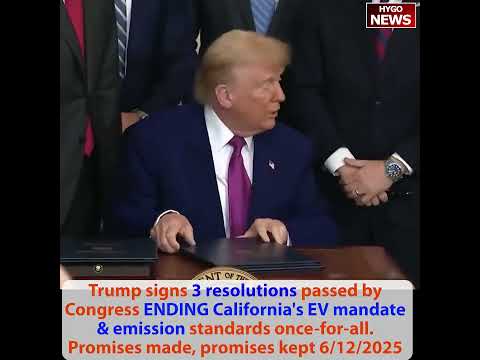
Trump: CA EV mandates never coming back, I don’t feel like king; Jeffries lying again costs going up
The California EV mandate signing ceremony was meant to produce a single story and ended up producing four. President Trump signed three pieces of legislation permanently killing the California electric vehicle mandate and emissions standards. He then pivoted, unprompted, to deconstruct the “No Kings” protest movement that had been scheduled for the following Saturday. House Democratic Leader Hakeem Jeffries, in a separate appearance, tried to reassert the Democratic talking point that prices are going up despite the morning’s data showing the opposite. And Trump addressed the Air India plane crash with an offer of full federal assistance. The through-line is the question of who is winning the political arguments of the moment — and the videos, read in sequence, make clear that the administration is running victory laps on policy, economic data, and rhetoric simultaneously.
”Kill The California Mandates Forever”
Trump’s opening at the signing ceremony set the tone. “But in a few moments I’ll sign three pieces of legislation that will kill, totally killed. They can’t do anything about it. They can’t take us to court. They can’t do any of the things they can do with the executive orders. And it’s permanent.”
The word “permanent” is the key. Executive orders can be reversed by subsequent presidents. Regulatory actions can be rolled back by subsequent administrations. Legislation signed into law cannot be undone without new legislation — which in the current Congress is a heavier lift than a simple pen stroke.
Trump’s framing — “they can’t take us to court. They can’t do any of the things they can do with the executive orders” — is a direct response to a pattern that had characterized much of his first-term agenda. Executive actions were repeatedly challenged, injoined, or reversed. Legislative actions enjoy a different legal posture, and Trump is making clear he understands the difference.
”They’re Never Coming Back”
The repetition is worth noting. “I’ll sign three pieces of legislation that will kill the California mandates forever. And they’re never coming back.”
“Forever” and “never coming back” is the language of finality. Trump is saying, in public and on the record, that the California EV mandate is not being paused, not being modified, not being negotiated. It is being ended. The rhetorical punch of the finality matters for the audience in the room — automakers, labor representatives, and members of Congress who spent years fighting to reach this outcome.
The “No Kings” Pivot
A reporter then asked about the “No Kings” protests scheduled for the weekend. “No Kings protests planned across the country on Saturday as well. What are your thoughts on those?”
Trump’s response was one of the funnier retorts of his presidency. “What are they going to do? No Kings? No Kings. I don’t feel like a king. I have to go through hell to get stuff approved.”
The dismissal works on multiple levels. First, it is deadpan. Trump is treating the premise of the protest — that he is behaving like a king — as laughable on its face. Second, it is grounded in the experience of the immediate moment. Trump had just spent paragraphs explaining that the EV mandate termination required legislation, which required the House, which required the Senate, which required reconciliation. That process is, in his view, the exact opposite of monarchy.
”A King Would Say, I’m Not Going To Get This”
Trump extended the deconstruction of the “No Kings” frame. “A king would say, I’m not going to get this. A king would have never had the California mandate to even be talking to him. He wouldn’t have to call up Mike Johnson and Thune and say, fellas, you got to pull this off. And after years we get it done.”
The observation is operationally accurate. Kings do not call congressional leaders to whip votes. Kings do not negotiate with committees. Kings do not wait “years” for legislation to clear procedural hurdles. Trump is describing, in ordinary terms, the actual work of the American presidency — and using that description to refute the “No Kings” protest premise.
“No, no, we’re not a king. We’re not a king at all.” The repetition is emphasis, not doubt.
The Signing
The signing itself was small theater. “Okay, we’re going to sign three bills that do everything I just said. No auto pencil out. Yeah, that bill was so good. Give it back to me. That was a good one. I’ll sign all three of them because you never know what you get with the door.”
The “no auto-pen” reference is to the autopen signing technology that allows documents to be signed by proxy. Trump has made a point of signing personally, by hand, as a gesture of direct authorship. The “no auto-pen” comment is a small but deliberate signal that he wants the physical act of signing to be documented.
”Lower Prices, Better Cars, And Choice”
Trump summarized the policy impact in three phrases. “Lower prices, better cars, and choice. You can say choice. We have choice for education and you have choice for cars now. Common sense is right. You’re right. Common sense is right.”
Each phrase deserves parsing.
“Lower prices” — the administration’s case is that the EV mandate raised the cost of conventional vehicles by forcing manufacturers to cross-subsidize EV production. Removing the mandate, in that analysis, removes the cross-subsidy and allows conventional vehicle prices to stabilize or fall.
“Better cars” — the argument is that regulatory constraints on internal combustion engines had forced compromises in performance, reliability, and design. Removing the mandate, the administration argues, allows engineers to optimize conventional vehicles rather than designing them as losing products in a forced transition.
“Choice” — the consumer-facing argument. Americans who want EVs can still buy them. Americans who want conventional vehicles can still buy them. The mandate had been tilting the market toward one option at the expense of the other.
Jeffries’s Counter-Narrative
House Minority Leader Hakeem Jeffries, in a separate appearance, was working to sustain the Democratic case against the administration’s economic record. “We’re months into the administration. Costs aren’t going down. They are going up. The Trump tariffs is actually raising costs by thousands of dollars a year and making life more expensive. So there’s a reason why the GOP tax scam right now is deeply unpopular.”
The phrasing is precise. Jeffries is asserting that costs are rising, not falling. He is attributing that rise to the tariff regime. And he is arguing that the tax legislation is “deeply unpopular” — which is a survey-research claim that can be evaluated empirically.
The Empirical Problem With Jeffries’s Framing
The empirical problem with Jeffries’s statement is that the May CPI data had just shown the opposite of what Jeffries was asserting. The annual inflation rate came in at 2.4% — better than expected. The month-over-month change came in at 0.1% — a deceleration, not an acceleration. Core inflation, excluding food and energy, came in better than expected. And egg prices had fallen month-over-month again.
Those data points are not friendly to Jeffries’s “costs are going up” framing. Americans just saw the first drop in consumer prices in years, not an acceleration.
The Polling On No Tax On Tips/Overtime
The “deeply unpopular” claim is similarly complicated by the available polling. The individual provisions of the One Big Beautiful Bill — no tax on tips, no tax on overtime, no tax on seniors, 100% expensing for manufacturing — poll in the 70-80% range across partisan lines. “No tax on tips” in particular has been polling near 80% approval.
Jeffries is not arguing about the individual provisions. He is arguing about the aggregate bill, which includes provisions Democrats oppose on Medicaid, immigration, and rescissions. But the rhetorical move of calling the whole bill “deeply unpopular” glosses over the fact that the headline provisions are overwhelmingly popular. The administration is betting that when voters hear “tax cuts for working people,” they hear the specific provisions, not the aggregate package.
”The First Drop In Consumer Prices In Years”
The administration’s counter-framing is that Jeffries is not just wrong about the direction of prices — he is wrong about a genuinely remarkable moment in recent economic history. A year-over-year price decline had not occurred in many quarters. The appearance of one in the May data is a data point the administration can use to anchor future arguments about the policy direction.
Jeffries’s alternative — to insist that prices are rising — requires Americans to disbelieve the official inflation release. That is a heavy ask, and the administration is happy to draw the contrast.
The Air India Plane Crash
The video closed with Trump’s response to the Air India plane crash that had dominated international news in the preceding hours. “The plane crash was terrible. I’ve already told them anything we can do. It’s a big country, a strong country. They’ll handle it, I’m sure, but I let them know that anything we can do will be over there immediately.”
The offer of full federal assistance — “anything we can do” — is standard presidential diplomacy in the aftermath of a mass-casualty event involving a friendly nation. Trump is extending that assistance without caveat. The choice to do so personally, and to do so publicly, is itself a diplomatic gesture to India at a moment when the country is grieving.
”A Couple Of Pointers”
Trump’s analytical observation about the crash was characteristically direct. “But it was a horrific crash. It looks like most are gone. They actually maybe have a couple survivors, which is just heard. But that was a horrible crash. Nobody knows. Nobody has any idea what it might be. I gave them a couple of pointers. I said, maybe you’ll look at this so that, you know, we saw the plane. It looked like it was flying pretty well. It didn’t look like there was an explosion. It just looked like the engines maybe lost power.”
Presidents do not normally offer aerodynamic analysis of foreign plane crashes. Trump’s willingness to do so reflects his longstanding interest in aviation and his comfort with speaking publicly about the technical details of events others might treat more formally. The observation — that the plane appeared to be flying normally before what looked like engine power loss — is the kind of comment an experienced aviation observer might offer. Whether it will prove accurate as the investigation proceeds is a separate question.
”One Of The Worst In Aviation History”
Trump’s closing line placed the event in historical context. “It’s one of the worst in aviation history.”
The characterization appears accurate based on the casualty reports available. The Air India crash, based on initial reports, appears to rank among the most lethal commercial aviation disasters of the twenty-first century. The administration’s early offer of full assistance is the kind of diplomatic gesture that can matter to the bilateral relationship for months and years after the immediate event.
Key Takeaways
- Trump on the EV mandate termination: “They can’t take us to court…I’ll sign three pieces of legislation that will kill the California mandates forever. And they’re never coming back.”
- Trump on “No Kings” protests: “I don’t feel like a king. I have to go through hell to get stuff approved. A king would have never had the California mandate to even be talking to him.”
- Trump’s three-phrase policy summary: “Lower prices, better cars, and choice. You can say choice. We have choice for education and you have choice for cars now.”
- Jeffries claims costs are “going up” while CPI data just showed the first annual price decline in years; individual bill provisions poll near 80% while he calls the overall bill “deeply unpopular.”
- Trump on Air India crash: “anything we can do will be over there immediately…It looked like the engines maybe lost power. But boy, that is a terrible crash. It’s one of the worst in aviation history.”