 HYGO News
 Trump on Qatar 747 Gift: 'Very Nice Gesture -- I'd Be Stupid to Turn Down a Free Plane'; Boeing 'Way Behind' on 40-Year-Old Air Force One
Trump on Qatar 747 Gift: “Very Nice Gesture — I’d Be Stupid to Turn Down a Free Plane”; Boeing “Way Behind” on 40-Year-Old Air Force One
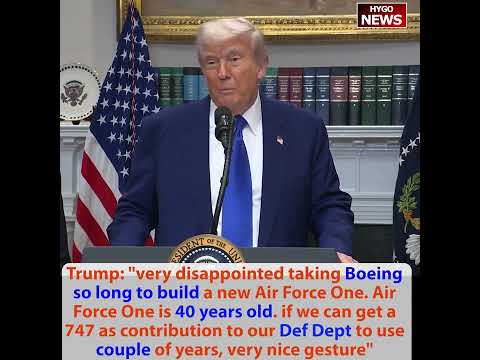
President Trump addressed the controversy over Qatar’s offer of a Boeing 747 to the Defense Department in May 2025. “We’re very disappointed that it’s taking Boeing so long to build a new Air Force One. We have an Air Force One that is 40 years old. If we can get a 747 as a contribution to our Defense Department to use during a couple of years while they’re building the other ones, I think that was a very nice gesture.” He defended accepting: “I could be a stupid person and say, ‘Oh no, we don’t want a free, very expensive airplane.’ But I thought it was a great gesture.” He suggested the plane could eventually go to his presidential library, just as Reagan’s Air Force One had gone to the Reagan Library.
”40 Years Old”
Trump opened with the core problem.
“We’re very disappointed that it’s taking Boeing so long to build a new Air Force One,” Trump said.
He described the current aircraft: “We have an Air Force One that’s 40 years old. If you take a look at that compared to the new plane of equivalent stature at the time, it’s not even the same ballgame.”
He offered a telling comparison: “You look at some of the Arab countries and the planes they have parked alongside the United States of America plane — it’s like from a different planet.”
He restated the age: “It’s close to 40 years old — might be more than 40 years old now.”
The “40 years old” framing was itself understated. The current Air Force One fleet — two modified Boeing 747-200B aircraft designated VC-25A — had entered service in 1990, making them 35 years old at the time of Trump’s statement. But the airframes themselves were older, as Boeing had begun building them in the mid-1980s. The maintenance costs, parts availability, and operational reliability of aircraft of this age were all significant concerns.
The comparison to Arab state aircraft was embarrassingly accurate. Saudi Arabia, the UAE, Qatar, and other Gulf states had taken delivery of new, state-of-the-art Boeing 747-8s and other modern aircraft configured for heads of state. These planes had the latest avionics, advanced defensive systems, luxurious interiors, and reliability that the aging American VC-25As could not match.
The Boeing Delays
Trump traced the history of the new Air Force One program.
“When I first came in, I signed an order to get it built,” Trump recalled. “I took it over from the Obama administration. They had originally agreed — I got the price down much lower.”
He described what went wrong: “When the election didn’t exactly work out the way that it should have” — a reference to his 2020 electoral defeat — “a lot of work was not done on the plane because a lot of people didn’t know they made change orders that were so stupid, so ridiculous.”
He characterized the result: “It ended up being a total mess, a real mess.”
He described the current status: “When I came back, I said, ‘By the way, what’s going on with the Boeings that are coming in?’ Well, sir, they’re way behind. They are way behind. Another mess that I inherited from Biden.”
He predicted the timeline: “It’s going to be a while before we get them.”
The Boeing delays were genuine and significant. The program — originally contracted under Obama, renegotiated under Trump for a fixed price of $3.9 billion, and supposed to deliver aircraft by 2024 — had slipped repeatedly. Boeing had lost billions on the fixed-price contract as costs escalated. The company’s broader problems — safety issues, production quality failures, and management turnover — had bled into the Air Force One program.
By mid-2025, the earliest realistic delivery date for a new Air Force One was pushed to 2028 or beyond. This meant that if Trump completed his second term, he might never fly on the new aircraft that his first administration had contracted.
The Qatar Gift
Trump explained how the Qatar offer came about.
“Qatar has really — we’ve helped them a lot over the years in terms of security and safety,” Trump said. “I have a lot of respect for the leadership and for the leader, Qatar.”
He described the offer: “They buy Boeings — they buy a lot of Boeings. And they knew about it. And they said, ‘We would like to do something.’ And if we can get a 747 as a contribution to our Defense Department to use during a couple of years while they’re building the other ones, I think that was a very nice gesture.”
He defended accepting: “Now, I could be a stupid person to say, ‘Oh no, we don’t want a free plane. We give free things — we’ll take one too.’”
He explained the fiscal case: “It helps us out because again, we’re talking about — we have 40-year-old aircraft. The money we spend, the maintenance we spend on those planes to keep them tippy-top is astronomical. You wouldn’t even believe it.”
He expressed gratitude: “So I think it’s a great gesture from Qatar. I appreciate it very much. I would never be one to turn down that kind of an offer.”
He placed it in context: “It was because of the fact that we have helped and continue to — we will continue to all of those countries, Saudi Arabia, UAE, Qatar, and others. We keep them safe. If it wasn’t for us, they probably wouldn’t exist right now. And I think this was just a gesture of good faith.”
The “free plane” argument was economically sound. The United States had indeed spent enormous sums protecting Qatar and other Gulf states for decades. The American military presence in the region, the extended deterrence against Iran, and the general security architecture that allowed Gulf states to exist without fear of invasion were all provided at American taxpayer expense. A $400 million gift from Qatar in the form of an aircraft was a small fraction of what the United States had spent providing Qatari security over the years.
The “stupid person” framing was characteristic Trump. By explicitly rejecting the obvious counterargument — that accepting foreign gifts raised ethical questions — Trump was declaring that he did not find those arguments compelling. The plane would belong to the Defense Department, not to him personally. It would serve the same function as the current Air Force One. Refusing it out of abstract concerns about propriety would mean continuing to fly on 40-year-old aircraft at enormous maintenance cost.
The Reagan Library Parallel
Trump noted the historical precedent for presidential aircraft.
“Someday it’ll be like Ronald Reagan — they decommission them,” Trump said. “They get to a certain age, they decommission them. It’ll go to my library. They’re talking about going to my library in years out.”
He described the Reagan model: “It’s something that was done by Ronald Reagan. They actually decommissioned the plane and he put it in his library. And it actually has made the library, I think — a Boeing 707. It’s actually made the library more successful.”
The Reagan Library in Simi Valley, California, housed the Boeing 707 that had served as Air Force One from 1973 until 2001, including during the Reagan presidency. The aircraft — suspended from the ceiling of a dedicated pavilion — had become one of the library’s main attractions, drawing visitors who wanted to walk through the plane that had carried Reagan on his historic trips.
Trump’s suggestion that the Qatar 747 might eventually reach his presidential library was forward-looking. After serving a few years as Air Force One while the new Boeing aircraft were completed, the plane could be decommissioned and transferred to a Trump library. This would create continuity with the presidential tradition while resolving the immediate aircraft availability problem.
Key Takeaways
- Trump: “Very disappointed it’s taking Boeing so long. Air Force One is 40 years old. Compared to Arab countries’ planes, it’s from a different planet.”
- Qatar 747 gift: “A very nice gesture. I could be stupid and say ‘we don’t want a free plane’ — but I thought it was great.”
- Maintenance on current fleet: “Astronomical — you wouldn’t believe it.”
- The Qatar gift reflected U.S. security contributions: “If it wasn’t for us, they probably wouldn’t exist right now.”
- Potential future: “Someday it’ll be like Reagan. His went to his library. They’re talking about this going to my library.”