 HYGO News
 Trump: Zelensky Has 'Big Problems' If He Renegotiates; Venezuela Ships 'Dropped Hoses and Left'; Iran Deal or 'Not Pretty'
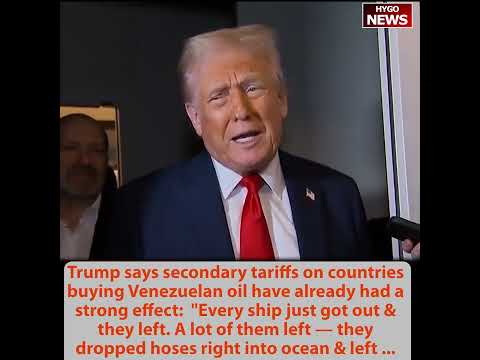
Trump: Zelensky Has “Big Problems” If He Renegotiates; Venezuela Ships “Dropped Hoses and Left”; Iran Deal or “Not Pretty”
President Trump delivered a wide-ranging Air Force One press gaggle on April 2, 2025 — Liberation Day itself — warning Zelensky that trying to renegotiate the rare earth deal meant “he’s got big problems,” revealing that Venezuelan secondary tariffs had caused Chinese ships to flee so fast they “dropped the hoses right into the ocean and left,” and issuing a direct ultimatum to Iran: “I would prefer a deal to the other alternative, which everybody on this plane knows what that is — and that’s not going to be pretty.” He also previewed the reciprocal tariffs: “Far more generous than those countries were to us. They ripped us off like no country has ever been ripped off.”
Zelensky: “Big, Big Problems”
Trump opened with a warning to Ukrainian President Zelensky that was both specific and ominous.
“Zelensky, by the way, I see he’s trying to back out of the rare earth deal, and if he does that, he’s got some problems,” Trump said. “Big, big problems.”
He described the situation: “We made a deal on rare earth, and now he’s saying, ‘Well, you know, I want to renegotiate the deal.’”
Trump then connected the rare earth dispute to the NATO question: “He wants to be a member of NATO. Well, he was never going to be a member of NATO. He understands that. So if he’s looking to renegotiate the deal, he’s got big problems.”
The rare earth deal had been one of the administration’s most significant diplomatic achievements with Ukraine — an agreement that gave the U.S. access to Ukraine’s substantial rare earth mineral deposits in exchange for continued American support. Rare earth minerals were essential for electronics, defense systems, and clean energy technologies, and reducing dependence on China’s dominant supply was a strategic priority.
Zelensky’s attempt to renegotiate the deal after it was agreed upon crossed a line that Trump was not willing to accept. The “big, big problems” warning suggested that the consequences of renegotiation would extend far beyond the rare earth deal itself — potentially affecting the level and nature of American support for Ukraine in the ongoing conflict with Russia.
Venezuelan Secondary Tariffs: “They Left Empty”
Trump described the immediate impact of secondary tariffs on countries buying Venezuelan oil.
“We put secondary tariffs on, as you know, in Venezuela,” Trump said. “And it’s had a very strong impact on Venezuela.”
He described what happened in vivid terms: “Every ship just got out and they left. A lot of them left. They dropped the hoses right into the ocean and they left. They didn’t want to be there for a minute because they didn’t want those tariffs to catch on, or they didn’t want me to see them there.”
He cited the most dramatic example: “In the case of Venezuela, as you know, China pulled up anchor and left. They were there. They had two ships there and they left. They left empty. They didn’t want to take a chance.”
Trump stated the principle: “Now, we’re not playing games. The secondary tariffs, all secondary tariffs, are very strong because essentially it says if you disobey our orders, you cannot do business in the United States of America. That’s the cash cow.”
The image of Chinese tankers dropping their loading hoses into the ocean and fleeing Venezuelan ports was the most visceral illustration of secondary tariff power. China had calculated instantly that the value of Venezuelan oil was not worth the cost of being cut off from American markets. The choice between Venezuelan crude and access to the world’s largest consumer economy was no choice at all.
The “cash cow” reference to the American consumer market was the foundation of all secondary sanctions. The United States did not need to physically block Venezuelan oil shipments or intercept Chinese tankers. It simply needed to say: choose between their oil and our market. Every rational economic actor would make the same choice China’s ships made — abandon the sanctioned product and preserve access to America.
Iran: “The Other Alternative Is Not Pretty”
Trump issued his most direct and detailed Iran ultimatum.
“The secondary tariffs on Iran — we’ll probably give it a couple of weeks,” he said. “And if we don’t see any progress, we’re going to put them on.”
He cited his first-term precedent: “We’re not putting them on right now, but if you remember, I did that six years ago and it worked very well, to put it mildly.”
Trump assigned blame for the current situation: “And if the election weren’t rigged, you would have a situation where there would be no problem with Iran today. But it was. Biden didn’t know what he was doing, obviously. And we have a very rough situation in the Middle East because of that. You ended up with October 7th. And you would have never had October 7th, and you would have never had Russia going into Ukraine.”
He outlined the framework: “We’re going to make a decision on secondary tariffs on Iran based on whether or not they’re going to make a deal. If they’re going to make a deal, then we’re never going to put secondary tariffs on Iran. We’re going to hope they have a great, long, and successful life as a country.”
Then the ultimatum: “I can’t imagine them doing anything else but making a deal. I would prefer a deal to the other alternative, which I think everybody on this plane knows what that is. And that’s not going to be pretty. And I do not prefer that.”
The “everybody on this plane knows” reference to the alternative was the most explicit acknowledgment Trump had made that military action against Iran was on the table. The phrasing was deliberately ambiguous — it could refer to strikes on nuclear facilities, a broader military campaign, or crippling secondary sanctions that would devastate Iran’s economy. The ambiguity was the point: Iran could not prepare for a specific threat if they didn’t know which form it would take.
”Best Almost 100 Days”
Trump reflected on his administration’s trajectory.
“I think I’m popular because we’ve done a great job,” he said. “I think we’ve had the best almost 100 days of any president. And most people are saying that. It’s an honor.”
He described the transformation: “We’re bringing back our country. We’re respected as a country again. And we’re strongly respected.”
He cited external validation: “I was with some very important people today, and they said that they’ve never seen a turnaround of a country as fast as this.”
On the border: “Even look at our border. We have nobody coming in. And you can’t come into a country, but you have to come in legally. But we have nobody coming into our country. It’s almost shut down. They’ve never seen anything like it.”
Liberation Day Tariffs Preview
Trump previewed the tariff announcement he would make hours later.
“The tariffs will be far more generous than those countries were to us,” he said. “Meaning they will be kinder than those countries were to the United States of America over the decades.”
He added: “They ripped us off like no countries have ever been ripped off in history. And we’re going to be much nicer than they were to us. But it’s substantial money for the country.”
The “more generous” framing was designed to preempt criticism that the tariffs were punitive or aggressive. Trump was arguing that even at the rates he was about to announce, America’s tariffs would be lower than the tariffs other countries had imposed on American goods. The reciprocal tariffs were not retaliation; they were a discount.
Key Takeaways
- Trump warned Zelensky that renegotiating the rare earth deal meant “big, big problems” and that “he was never going to be a member of NATO.”
- Venezuelan secondary tariffs caused Chinese ships to “drop the hoses into the ocean and leave empty — they didn’t want to take a chance.”
- Trump gave Iran “a couple of weeks” to show progress on a deal before imposing secondary tariffs: “The other alternative is not going to be pretty.”
- He connected Biden’s failures to October 7th and the Ukraine invasion: “You would have never had either” under Trump.
- Liberation Day tariffs would be “far more generous than those countries were to us — they ripped us off like no country has ever been ripped off.”