 HYGO News
 TRUMP: Biden banned drilling, I'll unban it immediately; Press Sec: exact political revenge
TRUMP: Biden banned drilling, I’ll unban it immediately; Press Sec: exact political revenge
In the final days of the Biden administration, a sweeping ban on oil and gas drilling across 625 million acres of U.S. coastal territory sparked an immediate and forceful response from President-elect Donald Trump. Trump pledged to reverse the ban on day one, while incoming White House Press Secretary Karoline Leavitt accused the Biden administration of attempting to “exact political revenge on the American people and President Trump.” The exchange, captured in early January 2025, highlighted the stark divide between the outgoing and incoming administrations on energy policy and set the stage for one of the first executive actions of Trump’s second term.
Trump Responds to Biden’s Offshore Drilling Ban
President-elect Trump addressed the ban directly, leaving no ambiguity about his intentions. “I see it just came over that Biden has banned all oil and gas drilling across 625 million acres of US coastal territory,” Trump said. “It’s ridiculous. I’ll unban it immediately. I will unban it. I have the right to unban it immediately. What’s he doing? Why is he doing it?”
Trump framed the issue in terms of American economic advantage, emphasizing the scale of the nation’s energy resources. “We have something that nobody else has. I mean, nobody has to the extent we have it,” he said. “And it’ll be more by the time we finish because I’ll be able to expand. You know, we’re going to expand our country. And it’ll be more. We have oil and gas.”
He drew a comparison between energy-rich America and other nations, arguing that the country’s oil and gas reserves represent an unmatched competitive advantage. “Whether you manufacture widgets or whatever you happen to be doing, some countries have to work very hard to do that. We do too, and we will. But we have oil and gas at a level that nobody else has. And we’re going to take advantage of it.”
Trump also questioned Biden’s understanding of the scale of his own executive action. “When I see somebody saying he’s going to ban 625 million acres, he doesn’t know what that is. He doesn’t even know what 625 million acres would look like,” Trump said. “And we can’t let that happen to our country. It’s our greatest, it’s really our greatest economic asset. And we’re not going to let that happen to our country.”
Biden Reflects on His Career in the Senate
In a separate segment, President Biden offered a reflective moment about his career, providing a striking contrast to the energy policy battle. Biden spoke about his relationships in the Senate and the evolution of bipartisan comity over his decades in Washington.
“You began to look at other people’s perspectives and it becomes less personal,” Biden said. He recalled his time as Vice President under Barack Obama, noting: “I think you’ll tell you the main reason Barack picked me to be Vice President was my background in American foreign policy because I had done so much of it. And because of my relationships in the Senate and the Congress.”
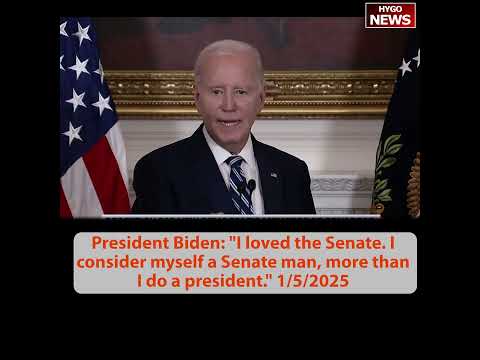
Biden then made a candid admission about where his true political loyalties lay: “I love the Senate. I consider myself a Senate man more than I do a president, for real, after 36 years.”
The comment was notable coming from a sitting president in the closing days of his term. Biden’s self-identification as a senator rather than a president underscored the sense that his presidency was effectively over in spirit even before Trump’s inauguration.
Karoline Leavitt: “Exact Political Revenge”
Incoming White House Press Secretary Karoline Leavitt delivered the sharpest criticism of the drilling ban, framing it as a deliberate act of political sabotage by the outgoing administration.
“This is a disgraceful decision by the Biden administration,” Leavitt said. “And I say the administration because we all know Joe Biden doesn’t know what’s going on. This isn’t him. This is the radical left environmental extremists in his administration who don’t care about what’s in the best interest of the American people.”
Leavitt invoked the 2024 election results as a mandate for the opposite approach to energy policy. “The American people who just reelected President Trump with a resounding mandate to drill, baby, drill,” she said.
She then addressed the motivation behind the timing of the ban directly: “This decision, the intent behind it is to exact political revenge on the American people and on President Trump to try to slow down his administration and make it harder to implement the agenda that he campaigned on.”
Leavitt concluded with a pledge of swift action: “But the good news is President Trump is going to get to work day one. His administration will look at how we can rescind this radical order and expedite permits for drilling and for fracking to bring down the cost of living and energy in this country. That’s what he campaigned on. And the American people can expect President Trump to deliver on that promise. He will not be deterred.”
The Scope of Biden’s Offshore Drilling Ban
The ban that triggered the confrontation covered approximately 625 million acres of U.S. coastal waters, one of the most expansive offshore drilling restrictions ever enacted by a president. Biden used authority under the Outer Continental Shelf Lands Act to withdraw the areas from future oil and gas leasing. The affected areas included waters along the Atlantic and Pacific coasts as well as portions of the Gulf of Mexico and Arctic waters.
Environmental groups had long advocated for such protections, arguing that offshore drilling poses risks to marine ecosystems and contributes to climate change. However, critics of the ban, including the incoming Trump team, argued that it was timed to maximize political disruption rather than to address genuine environmental concerns. The fact that the ban came in the final weeks of the Biden presidency, after Trump had won the 2024 election on a platform explicitly promising expanded drilling, intensified the perception of political motivation.
Additional Context
The legal question of whether a president can simply “unban” areas withdrawn from drilling by a predecessor is more complex than Trump’s rhetoric suggested. Previous legal analyses have debated whether withdrawals under the Outer Continental Shelf Lands Act are permanent or can be reversed by a subsequent president through executive action alone. The issue was the subject of litigation during Trump’s first term when he sought to reverse Obama-era drilling withdrawals in the Arctic.
Regardless of the legal complexities, the political battle lines were drawn clearly by January 2025. The Biden administration’s last-minute drilling ban and the Trump team’s immediate vow to reverse it encapsulated the fundamental energy policy divide between the two administrations and previewed one of the first policy confrontations of Trump’s second term.
Key Takeaways
- President-elect Trump vowed to immediately reverse Biden’s ban on oil and gas drilling across 625 million acres of U.S. coastal territory, calling it “ridiculous” and asserting he had the right to unban it immediately.
- President Biden, in a reflective moment, described himself as “a Senate man more than I do a president” after 36 years in the upper chamber.
- Incoming Press Secretary Karoline Leavitt accused the Biden administration of attempting to “exact political revenge on the American people and on President Trump” through the last-minute drilling ban.
- Leavitt attributed the decision not to Biden personally but to “radical left environmental extremists in his administration,” pledging that Trump would rescind the order and expedite drilling permits on day one.
- The ban covered approximately 625 million acres of coastal waters and was one of the most expansive offshore drilling restrictions ever enacted by a president.