 HYGO News
 Trump, Azerbaijani Pres Ilham Aliyev, & Armenian PM Pashinyan sign peace & economic, Trump Route
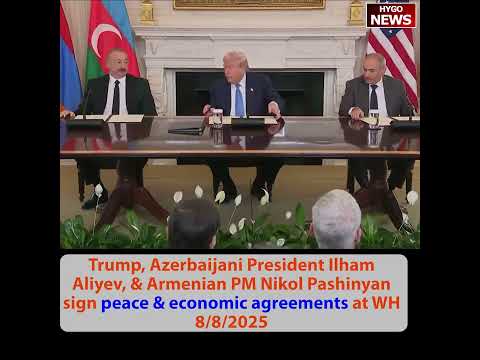
Trump, Azerbaijani Pres Ilham Aliyev, & Armenian PM Pashinyan sign peace & economic, Trump Route
The historic signing ceremony itself. Trump, Azerbaijani President Ilham Aliyev, and Armenian Prime Minister Nikol Pashinyan signed the Joint Declaration on the Outcomes of the Trump Route for International Peace and Prosperity Summit. Three copies in English. Trump signed as witness. “Very importantly, we have also resolved the key issue that foiled previous negotiations.” The declaration establishes the “Trump Route” — a special transit corridor giving Azerbaijan full access to its exclave territory of Nakhchivan while respecting Armenian sovereignty. Armenia is also creating “an exclusive partnership with the United States” to develop the corridor on terms extending up to 99 years. American companies will provide significant infrastructure investment. “It’s amazing. So this is a very important territory, I guess very special territory to you and to you, and now they work together.”
The Signing Ceremony
The procedural announcement. “President of the United States, the President of the Republic of Azerbaijan, and the Prime Minister of the Republic of Armenia will now sign a joint declaration on the outcomes of the Trump Root for International Peace and Prosperity Summit.”
“Trump Root” is Whisper’s rendering of “Trump Route” — the specific naming of the transit corridor at the heart of the peace agreement.
“They will sign three copies in English.”
Three copies. Each party — U.S., Azerbaijan, Armenia — receives one. The English-only language is significant. Azerbaijan speaks Azerbaijani. Armenia speaks Armenian. The agreement being only in English reflects American brokering and ongoing American involvement in implementation.
“The President of the United States signs as a witness to the President of the Republic of Azerbaijan and the Prime Minister of the Republic of Armenia, affirming their path to peace, stability, and prosperity.”
“Signs as a witness.” That is the specific American role. Trump is not a party to the peace agreement itself — that is between Armenia and Azerbaijan. But he is the witness whose signature validates the agreement.
The witness role has specific significance. The United States, by witnessing, accepts implicit responsibility for the agreement’s durability. If either party violates the agreement, the U.S. has grounds to respond diplomatically, economically, or through other levers.
“We kindly ask that all guests remain seated for the signing of the documents.”
Ceremonial protocol. The historic moment is treated with the formal procedure it deserves.
”That Is So Great”
Trump’s spontaneous reaction. “That is so great. And we’ll hold up. How about holding up that document? Thank you.”
Trump asking the leaders to hold up the signed document for cameras. That visual — three heads of government jointly holding the signed peace agreement — becomes the historic photograph of the moment. Photo journalism requires that image. Trump is staging it deliberately.
”The Key Issue That Foiled Previous Negotiations”
Trump’s substantive summary. “Very importantly, we have also resolved the key issue that foiled previous negotiations.”
“The key issue.” That is the specific resolution claim. Previous Armenia-Azerbaijan negotiations had repeatedly broken down over a specific issue. That issue has now been resolved.
The specific issue is geography. Azerbaijan has two major territorial components: the main country and Nakhchivan (an exclave separated from the main country by a strip of Armenian territory). Connecting Nakhchivan to main Azerbaijan requires transit through or around Armenian territory.
Previous negotiations had foundered on exactly that question. Azerbaijan wanted corridor access. Armenia insisted on sovereignty over any route through its territory. The two positions were irreconcilable — until the Trump Route framework.
The Trump Route
“As declaration establishes what they are calling a great honor for me. I didn’t ask for this, the Trump Root for International Peace and Prosperity, which is a special transit area that will allow Azerbaijan to get full access to its territory of Nakhchivian while fully respecting Armenia’s sovereignty.”
The Trump Route (sometimes referred to as “TRIPP” or “Trump Route for International Peace and Prosperity”) is the specific transit mechanism.
The balance: Azerbaijan gets full access to Nakhchivan. Armenia retains sovereignty over the territory. Both requirements are simultaneously satisfied.
The mechanism presumably involves American-managed or American-partnered corridor operations. Rather than Armenia managing the corridor (which Azerbaijan would not accept) or Azerbaijan managing it (which Armenia would not accept), the U.S. provides a third-party operator with both countries’ consent.
“I didn’t ask for this.” Trump noting that the naming — “Trump Route” — came from the parties, not from Trump. Aliyev had proposed calling the corridor “Trump Route for International Peace and Prosperity” as a way of honoring Trump’s role in the agreement. Trump is accepting the honor while noting he did not request it.
“So they’re going to be able to really live and work together. It’s amazing.”
Trump’s assessment. The agreement does not merely resolve the geographic issue. It creates conditions for the two peoples to “live and work together.” Commercial, cultural, and personal interactions between Armenians and Azerbaijanis become possible in ways that decades of war had prevented.
”Very Important Territory”
“So this is a very important territory, I guess very special territory to you and to you, and now they work together.”
Trump acknowledging that the territory has specific meaning for both countries. Nakhchivan is historically Azerbaijani — populated by Azerbaijanis and culturally tied to Azerbaijan. The surrounding Armenian territory is, by contrast, historically Armenian. Both peoples have deep ties to lands that are, in close geographic proximity, each other’s.
“Now they work together.” Cooperation replacing conflict over specific territorial arrangements.
”99 Years”
“Armenia is also creating an exclusive partnership with the United States to develop this corridor, which could extend for up to 99 years, and then they promise in 99 years they’ll extend it, right? You’ll promise.”
“Up to 99 years.” That is an extraordinary timeframe. Standard infrastructure agreements typically have 10-30 year terms. 99 years is multi-generational — spanning the lifetimes of negotiators’ grandchildren.
For comparison, the U.K.’s 99-year lease of Hong Kong was similarly long-term (1898-1997). Long-term leases of that duration are associated with specific colonial-era arrangements or with major permanent infrastructure.
Trump’s joking “in 99 years they’ll extend it, right?” captures the significance. The arrangement is designed to be effectively permanent. The 99-year term is long enough that practical concerns become irrelevant. Whatever political environment exists in 2124 will shape any renewal, but the Trump Route will have operated continuously for a century by then.
“You’ll promise.” Trump is asking for informal commitment that the arrangement will be extended at expiration. Both leaders presumably assented.
”American Companies”
“But we anticipate significant infrastructure development by American companies. They’re very anxious to go in to these two countries, and they’re going to spend a lot of money, a lot of money, which will economically benefit all three of our nations.”
American companies. Infrastructure investment. That is the commercial dimension of the agreement.
Which American companies will benefit? Construction firms (Bechtel, Fluor, similar large contractors). Energy companies (if oil/gas corridors are part of the infrastructure). Logistics and transportation (rail, pipeline, highway). Security and surveillance firms. Technology integrators.
The economic value of a 99-year exclusive corridor between Azerbaijan and its exclave could be substantial. Goods flowing through the corridor. Transit fees. Infrastructure maintenance contracts. Security services. Over 99 years, cumulative revenue from the corridor could exceed $100 billion depending on traffic volumes.
“Economically benefit all three of our nations.” The three-way distribution. Armenia (hosting the corridor through its territory). Azerbaijan (gaining the transit access). United States (American companies developing and operating the infrastructure).
”Incredibly Positive News”
“This is incredibly positive news for the future of the entire region, and it’s a very important region, as you know.”
“The entire region.” Not just Armenia and Azerbaijan. The South Caucasus broadly — including Georgia, Turkey, Iran, Russia all border the region. The resolution of Armenia-Azerbaijan tensions has regional ripple effects.
For Georgia: improved regional stability, potential for expanded transit relationships with both neighbors. For Turkey: Azerbaijan is Turkey’s closest ally (Turkic peoples, similar languages, historical solidarity). Improved Azerbaijan position benefits Turkey. For Iran: complicates Iranian influence in the region (Iran had complex relationships with both Armenia and Azerbaijan). For Russia: displaces Russian mediation role that had been central for decades.
The Geographic Reality
Nakhchivan is historically interesting. It is an autonomous republic of Azerbaijan, geographically separated from main Azerbaijan by a strip of Armenian territory (the Syunik Province of Armenia). Nakhchivan borders Iran to the south and Turkey (briefly) to the west.
During the Soviet era, Nakhchivan was connected to Azerbaijan through rail and road networks that crossed Armenian territory. Those connections functioned under Soviet authority. Post-1991, as Armenia and Azerbaijan became hostile, those connections were severed. Nakhchivan has been accessible to Azerbaijan only via Iran (land) or via air.
The Trump Route restores the connection. A specific transit corridor through Armenia’s Syunik Province. American-managed operation ensuring neither party can arbitrarily disrupt access.
Why Previous Negotiations Failed
The Armenia-Azerbaijan conflict had two interlinked components: Nagorno-Karabakh (the Armenian-populated region within Azerbaijan) and the Nakhchivan connection (the Azerbaijani exclave separated by Armenia).
Most previous negotiations focused on Nagorno-Karabakh — trying to find governance arrangements that both sides would accept. The Nakhchivan issue was treated as secondary.
The 2020 Second Karabakh War and subsequent 2023 Azerbaijani operations effectively resolved the Nagorno-Karabakh question (Azerbaijan reasserted territorial control). That removed the primary obstacle to comprehensive peace. But the Nakhchivan connection remained unresolved — Azerbaijan’s reconquest of Karabakh did not give it direct access to Nakhchivan.
Trump’s solution addresses specifically the remaining issue. With Nagorno-Karabakh effectively resolved and the Nakhchivan corridor now established through the Trump Route, the comprehensive peace becomes possible.
The Nobel Case
The signing ceremony validates Aliyev’s Nobel nomination proposal from the prior segment. Trump achieved in six months what 30+ years of mediation had failed to achieve. The agreement is concrete, signed, and witnessed. Infrastructure investment is planned. A 99-year framework is established.
If the Nobel Committee applies concrete achievement as its standard (as some past awards have not), Trump’s case is strong. The Armenia-Azerbaijan peace agreement alone would justify the award. Combined with other conflict resolutions Trump has brokered, the case becomes overwhelming.
Whether the Committee acts on the case is the political question. Past Committee decisions have reflected both genuine achievement assessment and European political preferences. If the latter dominates, Trump’s award may be denied regardless of achievement. If the former dominates, Trump should win.
Key Takeaways
- The signing: “President of the United States … Azerbaijan … Armenia will now sign a joint declaration on the outcomes of the Trump Route for International Peace and Prosperity Summit.”
- Trump as witness: “Signs as a witness to the President of the Republic of Azerbaijan and the Prime Minister of the Republic of Armenia, affirming their path to peace, stability, and prosperity.”
- The key resolution: “The Trump Route for International Peace and Prosperity, which is a special transit area that will allow Azerbaijan to get full access to its territory of Nakhchivan while fully respecting Armenia’s sovereignty.”
- 99-year partnership: “Armenia is also creating an exclusive partnership with the United States to develop this corridor, which could extend for up to 99 years.”
- American commercial benefit: “Significant infrastructure development by American companies … they’re going to spend a lot of money, a lot of money, which will economically benefit all three of our nations.”