 HYGO News
 Trump at West Point: 'Most Elite and Storied Military Academy in Human History'; 'You Chose Honor and Sacrifice -- Not Stock Options, Muddy Boots Not Business Suits'; 'Not to Host Drag Shows, Spread Democracy at Point of Gun -- Dominate Any Foe, Annihilate Any Threat'
Trump at West Point: “Most Elite and Storied Military Academy in Human History”; “You Chose Honor and Sacrifice — Not Stock Options, Muddy Boots Not Business Suits”; “Not to Host Drag Shows, Spread Democracy at Point of Gun — Dominate Any Foe, Annihilate Any Threat”
President Trump delivered the commencement address at the United States Military Academy at West Point on May 24, 2025. The speech combined traditional military honors with a substantive redirection of the American military mission. Trump: “Every cadet on the field before me should savor this morning, because this is a day that you will never, ever forget. In a few moments, you will become graduates of the most elite and storied military academy in human history, and you will become officers in the greatest and most powerful army the world has ever known.” He framed the career choice: “You could have done anything you wanted… writing your own ticket to top jobs on Wall Street or Silicon Valley wouldn’t be bad, but I think what you’re doing is better… Instead of stock options… you chose honor and you chose sacrifice. Instead of business suits and dress shoes, you chose muddy boots and fatigues.” He declared the military’s mission: “The job of the U.S. armed forces is not to host drag shows, to transform foreign cultures, or to spread democracy to everybody around the world at the point of a gun. The military’s job is to dominate any foe and annihilate any threat to America, anywhere, any time, any place.” He invoked the lineage: “Each of you continues down the same hallowed path walked by Titans and legends — Grant, Pershing, Eisenhower, MacArthur, Patton, Stormin’ Norman Schwarzkopf."
"Most Elite and Storied Military Academy”
Trump’s opening frame was gravitational.
“Every cadet on the field before me should savor this morning, because this is a day that you will never, ever forget,” Trump said.
He delivered the superlative: “In a few moments, you will become graduates of the most elite and storied military academy in human history.”
He extended the frame: “And you will become officers in the greatest and most powerful army the world has ever known.”
The “most elite and storied” claim was defensible. West Point had been founded in 1802, making it over 220 years old. Its alumni had included:
- 2 American presidents (Ulysses S. Grant, Dwight D. Eisenhower)
- 74 Medal of Honor recipients
- Most of America’s great military commanders
- Leaders of major American businesses and institutions
- Key figures in American government and society
The comparison with other military academies worldwide was apt. Sandhurst in Britain, Saint-Cyr in France, and various other national military academies had produced notable graduates, but West Point’s combination of historical depth, cadet quality, and alumni impact was unmatched.
Trump’s “greatest and most powerful army the world has ever known” was also empirically defensible. The American military in 2025:
- Had the largest military budget in world history
- Controlled the most sophisticated technology
- Had more global presence than any other military
- Maintained approximately 750 bases in 80 countries
- Had the most numerous modern aircraft carriers
- Had the largest nuclear arsenal
- Had the most advanced cyberwarfare capability
The Career Choice
Trump’s framing of the cadets’ career choice was striking.
“Each of you on the field today is among the most talented members of your generation,” Trump said. “You could have done anything you wanted. You could have gone anywhere. You could have gone to any school.”
He noted the selectivity: “This is one of the hardest schools to get into.”
He described the alternatives: “And writing your own ticket to top jobs on Wall Street or Silicon Valley wouldn’t be bad, but I think what you’re doing is better.”
He made the substantive contrast: “Instead of sports teams and spreadsheets and software, you chose a life of service, very important service, instead of stock options.”
He offered self-aware commentary: “And I do that stuff. It’s sort of boring. Honestly, compared to what you’re doing, it’s real boring.”
The “I do that stuff” acknowledgment was characteristic Trump. Trump had spent most of his career in business, real estate, and commercial ventures — the same “stock options” and “spreadsheets” world he was contrasting with military service. His acknowledgment that military service was “better” than what he had done was unusual self-deprecating praise of the cadets’ choice.
The West Point graduates faced genuine career opportunity costs. A Harvard, Stanford, or MIT graduate with similar credentials would typically:
- Enter Wall Street at $100,000+ starting compensation
- Or enter Silicon Valley at $150,000+ with equity packages
- Potentially earn $500,000-$1M+ within 3-5 years
- Have substantial personal freedom and lifestyle options
A West Point graduate:
- Received specific compensation around $80,000 with housing benefits
- Had a 5-year minimum service commitment
- Deployed based on military needs, not personal preference
- Faced significant risk in combat deployments
- Had limited lifestyle autonomy
Trump’s framing celebrated this trade-off as honorable. The cadets had chosen “honor and sacrifice” over “stock options.” This rhetorical framing honored traditional military values while implicitly critiquing the pure materialism that had dominated much of American elite culture.
”Business Suits and Dress Shoes vs. Muddy Boots and Fatigues”
Trump extended the physical contrast.
“And instead of business suits and dress shoes, you chose muddy boots and fatigues, keeping yourself in shape,” Trump said.
He gave the essential characterization: “Because West Point cadets don’t just have the brightest minds, you also have the bravest hearts and the noblest souls, you’re amazing people.”
The “muddy boots and fatigues” imagery was deliberate. West Point cadets had spent years in physical training, field exercises, and combat preparation. Their education had produced not just minds trained in academics but bodies and characters trained for combat.
The “brightest minds, bravest hearts, noblest souls” framing invoked classical military virtues:
- Bright minds: Intellectual capability needed for modern warfare, from tactics to technology to leadership
- Brave hearts: Physical courage needed for combat and its risks
- Noble souls: Moral character needed to exercise military authority without abusing it
This trinity — intellectual, physical, and moral excellence — had been the traditional ideal of military officers. It contrasted with any single-dimensional view of soldiers as merely physical, merely strategic, or merely obedient. Trump was honoring the cadets as fully developed human beings, not just military functionaries.
”Not to Host Drag Shows”
The most politically provocative line came next.
“The job of the U.S. armed forces is not to host drag shows, to transform foreign cultures, or to spread democracy to everybody around the world at the point of a gun,” Trump said.
He delivered the alternative: “The military’s job is to dominate any foe and annihilate any threat to America, anywhere, any time, any place.”
The “drag shows” reference was specific. During the Biden administration, various military installations had reportedly hosted or facilitated drag show performances as part of diversity and inclusion programming. These had been controversial among military traditionalists and conservative critics. Trump was explicitly rejecting such programming as inconsistent with the military’s core mission.
The broader context was the Trump administration’s systematic reversal of Biden-era DEI programming in the military:
- Elimination of race-based preferences in promotions
- Reversal of transgender service policies
- End to critical race theory training
- Elimination of DEI-focused officer positions
- Return to traditional military culture and standards
The “transform foreign cultures” and “spread democracy at the point of a gun” lines addressed the neoconservative foreign policy of the post-9/11 era. The Bush administration’s Iraq war and related interventions had been partly justified as democracy-promotion missions — efforts to remake Middle Eastern societies in democratic form through military action.
Trump had consistently rejected this framework throughout his political career. His May 2025 Riyadh speech (earlier in that month) had explicitly critiqued the “interventionists” and their failed nation-building projects. The West Point speech continued this framing: American military was for defending American interests, not for remaking foreign societies.
”Dominate Any Foe, Annihilate Any Threat”
The positive mission statement was decisive.
“The military’s job is to dominate any foe and annihilate any threat to America, anywhere, any time, any place,” Trump said.
This was a concise articulation of what Trump believed the military should actually do:
- Dominate any foe: Defeat enemies in combat when defeat was necessary
- Annihilate any threat: Eliminate threats to American security when elimination was possible
- Anywhere: Global operational capability without geographic constraints
- Any time: Rapid response capability without readiness gaps
- Any place: No geographical sanctuary for American adversaries
This was a traditional military mission statement without the progressive mission creep that had accumulated over recent decades. The military existed to fight and win wars. It did not exist to:
- Promote specific social values
- Transform foreign societies
- Promote democracy universally
- Advance human rights globally
- Lead domestic cultural change
These other missions might be legitimate American foreign policy objectives, but they belonged to diplomacy, aid, civil society engagement, or other tools — not to the military. The military’s comparative advantage was in overwhelming force application, and that was its appropriate mission.
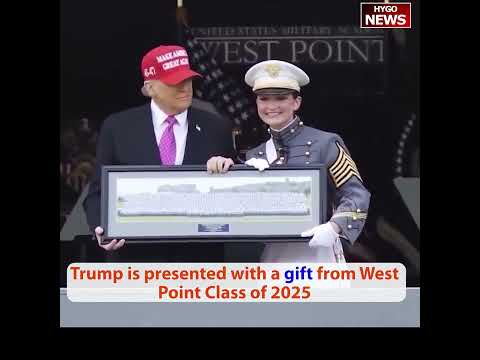
The Class Gift
The formal ceremony included the traditional class gift.
“Ladies and gentlemen, at this time, please remain standing for the presentation of the class gift,” the announcer said. “The class president, Cadet Catherine LaRue, will present a panoramic photo of the class of 2025 to the president.”
Cadet LaRue presented the gift: “President Trump, on behalf of the class of 2025, I would like to present you with this class photo as a token of appreciation for your inspiring words today.”
Trump’s response: “Thank you very much. Thank you very much. It’s fantastic. Thank you very much. Thank you.”
The class photo tradition was long-established at West Point graduations. Each class presented some token — often a class photo or commemorative item — to significant attendees at their graduation. Having the Commander-in-Chief personally present to receive the class gift reflected the exceptional significance of the 2025 graduating class and its commanding officer recognition.
Cadet LaRue’s role as class president indicated her leadership standing within the class. West Point’s class president was a significant honor reflecting peer recognition of leadership capability.
”The Long Gray Line”
Trump closed with the traditional framing.
“As you receive your commissions as second lieutenants, each of you continues down the same hallowed path, walked by Titans and legends of U.S. military lore,” Trump said.
He listed specific examples: “Giants like Ulysses S. Grant, John ‘Blackjack’ Pershing, Dwight David Eisenhower, the one and only Douglas MacArthur, old blood and guts George Patton, and Stormin’ Norman Schwarzkopf.”
He emphasized the succession: “All great. So many more. They and countless other patriots before you have walked out of these halls and straight into history.”
He invoked the institutional tradition: “And today, you officially joined those immortal heroes in the proud ranks of the Long Gray Line. You know that term. So beautiful. The Long Gray Line.”
The “Long Gray Line” was West Point’s traditional term for its graduates — referencing the gray uniforms worn throughout the academy’s history. The Long Gray Line extended from the earliest graduates of the early 19th century through every subsequent class. Each graduating class was symbolically added to this continuous line.
Trump’s invocation of specific historical figures was notable. The names he cited represented:
- Grant: Civil War general, 18th President, saved the Union
- Pershing: WWI commander, General of the Armies
- Eisenhower: WWII Supreme Allied Commander, 34th President
- MacArthur: WWII Pacific commander, Korean War commander, post-war Japan rebuilder
- Patton: WWII armored warfare master, Battle of the Bulge hero
- Schwarzkopf: Gulf War commander, Desert Storm architect
These were not controversial figures. All had served American interests in decisive military victories. All had contributed to American strategic dominance. By invoking their names specifically, Trump was situating the 2025 graduates in a lineage of American military greatness that none could dispute.
Key Takeaways
- Trump at West Point: “Most elite and storied military academy in human history. Greatest and most powerful army the world has ever known.”
- Career framing: “Instead of stock options, you chose honor and sacrifice. Muddy boots, not business suits.”
- Trump self-deprecation: “I do that [Wall Street/business] stuff. It’s sort of boring. Compared to what you’re doing, it’s real boring.”
- Mission redirection: “Not to host drag shows, transform foreign cultures, or spread democracy at point of gun. Dominate any foe, annihilate any threat anywhere, any time.”
- “Long Gray Line” invocation: “Grant, Pershing, Eisenhower, MacArthur, Patton, Schwarzkopf — you officially join these immortal heroes.”