 HYGO News
 Memorial Day 2025 at Arlington: Trump at Tomb of Unknown Soldier with VP Vance, Sec Def Hegseth; Callback to 2017 Moment with 6-Year-Old Christian Jacobs at Father's Grave; 'From Bunker Hill to Bastogne, Concord to Kabul -- America's Best and Bravest Have Fought, Bled, and Died'
Memorial Day 2025 at Arlington: Trump at Tomb of Unknown Soldier with VP Vance, Sec Def Hegseth; Callback to 2017 Moment with 6-Year-Old Christian Jacobs at Father’s Grave; “From Bunker Hill to Bastogne, Concord to Kabul — America’s Best and Bravest Have Fought, Bled, and Died”
On Memorial Day 2025, President Trump visited Arlington National Cemetery’s Tomb of the Unknown Soldier alongside Vice President JD Vance and Secretary of Defense Pete Hegseth. The broadcast included a callback to Memorial Day 2017, when Trump had shared a moving moment with 6-year-old Christian Jacobs at the grave of his father, Marine Sgt. Christopher Jacobs. Trump’s 2025 speech connected the generations: “From Bunker Hill to Bastogne, Cantigny to Coral Sea, from Gettysburg to Guadalcanal, and Concord to Kabul, America’s best and America’s bravest have fought, bled, and died so that we could pick up the torch of liberty, raise it high, high, high, and carry it onward to places they could never have dreamed of before.” On the meaning of sacrifice: “The sacrifice that they made was not merely for a single battle, a long-ago victory, or a fleeting triumph decades or centuries past. Their sacrifice was for today, tomorrow, and every morning thereafter.” On eternal debt: “Our debt to them is eternal and it does not diminish with time. It only grows and grows and grows with each passing year.” On the chosen few: “A chosen few have given all on the altar of freedom — they plunged into the crucible of battle, stormed into the fires of hell, charged into the valley of death, and rose into the arms of angels.”
The Arrival Ceremony
The video opened with the military ceremony at Arlington.
Military commands rang out: “Present! Present! Out! Three, two, one. One, two, three, set, go.”
Trump was accompanied by Vice President JD Vance and Secretary of Defense Pete Hegseth. This was the traditional Memorial Day presidential appearance at Arlington National Cemetery, where the president typically laid a wreath at the Tomb of the Unknown Soldier and delivered brief remarks at the Memorial Amphitheater.
The presence of Hegseth was particularly significant. Hegseth himself was a combat veteran who had served in Iraq and Afghanistan with the Army National Guard. His appointment as Secretary of Defense had brought direct combat experience to the role at a level not seen in decades. When Hegseth accompanied Trump at Memorial Day ceremonies, he did so not merely as a cabinet official but as someone who had personally served in wars that produced many of the fallen being honored.
Vance had not served in combat himself but had served in the Marine Corps as a military journalist in Iraq from 2005-2007. He brought respect for military service and connection to the military community that differed from politicians with no military experience whatsoever.
The three-person principal group — Trump, Vance, Hegseth — represented:
- Civilian leadership (Trump as Commander-in-Chief)
- Military service background (Vance as Marine Corps veteran)
- Combat experience (Hegseth as Army combat veteran)
This was a visually powerful combination for Memorial Day.
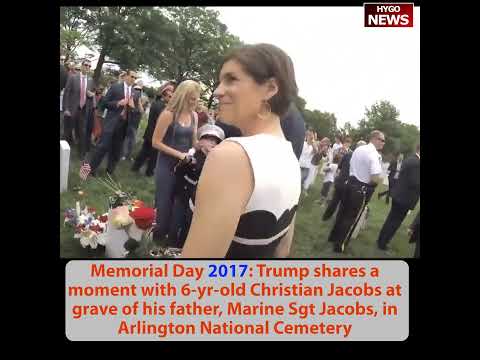
The 2017 Christian Jacobs Moment
The broadcast included footage from Memorial Day 2017.
The audio captured fragments of conversation: “This is the one. Yeah, and a lady gave me this. And she has a picture of it.” “She’s so lucky.” “This is the one. Is that you? I’m from the family of the baby.”
A woman’s voice responded: “This is the little Mary ghost.”
Trump: “Good looking ghost? Your dad’s great dad, right?”
The young boy’s response was simple: “Yeah.”
Trump: “I remember right, I’m on and on, and dad’s this one’s like, the right one.”
The woman: “That’s what they throw around, huh? Yeah.”
Trump: “What a boy. What a boy, huh? Absolutely. Absolutely.”
He noted something: “What is that? As a law firm.”
Trump addressed the boy: “Your father would be so proud of you.”
The boy: “Because daddy said he was a lawful.”
Trump responded: “Salute the president. Look at him. Can I see him? Take care of my brother. Hey Tim.”
The exchange continued with further fragments about the boy’s activities.
The 2017 moment had captured 6-year-old Christian Jacobs at the grave of his father, Marine Sgt. Christopher Jacobs. Christian had been visiting his father’s grave with his mother. Trump had personally engaged with the young boy, showing both genuine care and the ability to connect across generations.
Christian Jacobs’s Story
Marine Sgt. Christopher Jacobs had been killed in 2011 at age 21. Christian Jacobs, then a toddler, had grown up visiting his father’s grave. The photo of Trump with young Christian at the grave in 2017 had become iconic:
- A President treating a Gold Star child with genuine warmth
- A 6-year-old who barely remembered his father
- The weight of military sacrifice measured in personal loss
- Generations connected across war and peace
By Memorial Day 2025, Christian would have been about 14. The inclusion of the 2017 footage served multiple purposes:
- Demonstrated Trump’s continued personal connection to military families
- Showed that his engagement with Gold Star families was not performative
- Connected past to present across Memorial Day observances
- Reminded viewers of the human cost of military service through a specific child’s story
”From Bunker Hill to Bastogne”
Trump’s 2025 Memorial Day speech connected American military history.
“From Bunker Hill to Bastogne to Cantigny to Coral Sea, from Gettysburg to Guadalcanal, and Concord to Kabul,” Trump said.
He stated the purpose: “America’s best and America’s bravest have fought, bled, and died so that we could pick up the torch of liberty.”
He developed the imagery: “Raise it high, high, high and carry it onward to places they could never have dreamed of before.”
The battlefield list spanned American military history:
Revolutionary War:
- Bunker Hill (1775): Early major engagement, Pyrrhic British victory with heavy casualties
- Concord (1775): Opening battles of the Revolutionary War
Civil War:
- Gettysburg (1863): Turning point, largest battle in Western Hemisphere
World War I:
- Cantigny (1918): First major American battle, demonstrating AEF capability
- Bastogne (1944 - WWII): Battle of the Bulge, 101st Airborne’s heroic defense
- Note: Bastogne is actually World War II, not WWI
World War II:
- Coral Sea (1942): First major naval battle of Pacific War, stopped Japanese expansion
- Guadalcanal (1942-43): Turning point in Pacific War
War on Terror:
- Kabul (2001, 2021): Afghanistan War bookends
The specific battle selection was notable. Rather than listing only famous American victories, Trump included:
- Pyrrhic victories (Bunker Hill)
- Early defensive engagements (Concord)
- Major naval battles (Coral Sea)
- Island warfare (Guadalcanal)
- Evacuation-adjacent (Kabul)
The inclusion of Kabul was particularly pointed. The disastrous 2021 withdrawal from Afghanistan under Biden had been widely criticized. Trump mentioning Kabul alongside glorious battles of American history honored the service members who had died there without endorsing the policy choices that had led to their deaths.
The Meaning of Sacrifice
Trump articulated the meaning of military sacrifice.
“The sacrifice that they made was not merely for a single battle, a long-ago victory, or a fleeting triumph decades or centuries past,” Trump said.
He made the eternal claim: “Their sacrifice was for today, tomorrow, and every morning thereafter.”
He elaborated the ongoing debt: “Every child that lives in peace, every home that is filled with joy and love, every day the republic stands is only possible because of those who did what had to be done when duty called and the cost was everything to them and to their families.”
He stated the nature of the debt: “Our debt to them is eternal and it does not diminish with time. It only grows and grows and grows with each passing year.”
The theological framing of sacrifice was characteristic American Memorial Day rhetoric. Unlike simple utilitarian analysis of military operations, this framing recognized that:
- Each fallen service member’s sacrifice had transformative impact
- The ongoing preservation of American society depended on past sacrifices
- Current prosperity was made possible by historical sacrifice
- The debt could never be fully repaid
- Honoring the fallen was a civilian moral obligation
The “grows and grows and grows with each passing year” framing was striking. Rather than sacrifices fading into forgotten history, Trump was asserting that the moral debt grew larger over time. Each generation that benefited from past sacrifices added to the obligation without ever being able to fully discharge it.
The Greatest Monument
Trump transitioned to the living memorial.
“The greatest monument to their courage is not carved in marble or cast in bronze,” Trump said.
He identified what the monument was: “It’s all around us — an American nation 325 million strong which will soon be greater than it has ever been before.”
He stated the future: “It will be.”
The “greatest monument” framing was theologically rich. Traditional monuments — marble statues, bronze plaques, stone memorials — were physical artifacts that would eventually erode. The true monument to fallen service members was the continuing existence and flourishing of the nation they had died to defend.
By this framing:
- American prosperity honored the fallen
- American freedom was their living memorial
- Each American child growing up in safety was their testimony
- Each American family enjoying ordinary life was their legacy
- Each continuing day of American civilization was sacred
The “325 million strong” figure referenced American population in 2025. The “greater than it has ever been before” was Trump’s characteristic confidence about American future trajectory.
The Battlefield Names Continue
Trump extended the battlefield catalog.
“Every generation since at Trenton and Yorktown, at Vicksburg and Shiloh,” Trump said.
He continued the sweep: “And in far away places with names like Château-Thierry, Anzio, Iwo Jima, Khe Sanh, Kandahar — really just a few chosen names.”
He elevated the language: “And these are names that have become so important on the altar of freedom.”
The additional battles added to the chronological coverage:
Revolutionary War:
- Trenton (1776): Washington’s surprise attack, “the tide turned”
- Yorktown (1781): Final major battle, British surrender
Civil War:
- Vicksburg (1863): Grant’s victory that split Confederacy
- Shiloh (1862): Massive casualties, turning point in Western theater
World War I:
- Château-Thierry (1918): American forces halt German advance
World War II:
- Anzio (1944): Difficult Italian beachhead
- Iwo Jima (1945): Brutal Pacific island battle
Vietnam War:
- Khe Sanh (1968): Marine Corps siege defense
War on Terror:
- Kandahar (2001-2021): Major theater of Afghanistan War
”Plunged Into the Crucible of Battle”
Trump’s closing rhetoric was especially elevated.
“They plunged into the crucible of battle, stormed into the fires of hell, charged into the valley of death, and rose into the arms of angels,” Trump said.
The classical imagery was deliberately powerful:
“Crucible of battle”: A crucible is a vessel used for melting metals at extreme temperatures. The metaphor suggested that combat transformed those who entered it, either destroying them or refining them to a purer form.
“Fires of hell”: The literal horror of modern combat — explosions, burns, chemical weapons, flame — was evoked alongside the theological imagery of hell. Soldiers willingly entered conditions resembling the traditional Christian image of damnation.
“Valley of death”: An allusion to Psalm 23 (“Yea, though I walk through the valley of the shadow of death, I will fear no evil”). Also an allusion to “The Charge of the Light Brigade” by Tennyson (“Into the valley of death rode the six hundred”).
“Rose into the arms of angels”: The theological resolution of the preceding imagery. Those who died in battle were received by angels into heaven. Their mortal sacrifice was recognized by divine welcome.
The progression from hellish earthly combat to heavenly reception captured Christian theological framing of military sacrifice. Rather than meaningless death, military sacrifice was:
- Willingly accepted
- Performed in horrific conditions
- Compensated by eternal reward
- Sanctified by divine acknowledgment
- Meaningful beyond mortal calculation
This was Trump at his most elevated rhetorical mode. The language was consciously biblical, classical, and poetic — matching the occasion’s gravity with language worthy of the dead being honored.
The Memorial Day Tradition
Memorial Day had evolved from Decoration Day, originally observed after the Civil War to honor Union dead. By the early 20th century, it had expanded to honor all American military dead. By 2025, the tradition encompassed:
Civil War dead: Over 750,000 American military dead from the war World War I dead: Approximately 116,000 American military dead World War II dead: Approximately 405,000 American military dead Korean War dead: Approximately 54,000 American military dead Vietnam War dead: Approximately 58,000 American military dead Gulf War and post-9/11 dead: Several thousand American military dead
The cumulative total of American military dead since the Civil War exceeded 1.5 million. Each individual represented a family, community, and contribution to American life that ended in military service.
The Two Trumps
The broadcast’s combination of 2025 formal speech with 2017 informal interaction with Christian Jacobs captured two sides of Trump’s presidential persona:
2025 formal Trump: Elevated rhetoric, classical imagery, theological framing, presidential gravitas.
2017 informal Trump: Direct engagement with a specific child, genuine warmth, personal connection, accessible style.
Both were authentic. Both served the occasion. Both honored the fallen in different ways. The combination showed that Trump could operate in both registers — the grand historical narrative and the specific human connection — without contradiction.
For military families, both aspects mattered. The elevated rhetoric validated the significance of their loved ones’ sacrifices. The personal engagement showed that the President cared about specific people, not just abstract military abstractions.
Key Takeaways
- Trump at Tomb of Unknown Soldier with VP Vance and Sec Def Hegseth on Memorial Day 2025.
- 2017 callback: Trump with 6-year-old Christian Jacobs at grave of father Marine Sgt. Christopher Jacobs.
- Battle catalog: “From Bunker Hill to Bastogne, Gettysburg to Guadalcanal, Concord to Kabul.”
- On sacrifice: “Not merely for a single battle or fleeting triumph. Their sacrifice was for today, tomorrow, every morning thereafter.”
- On chosen few: “Plunged into the crucible of battle, stormed into fires of hell, charged into valley of death, rose into arms of angels.”