 HYGO News
 Trump: are you fools asking me to do that? Susie Wiles; statehood for DC ridiculous unacceptable
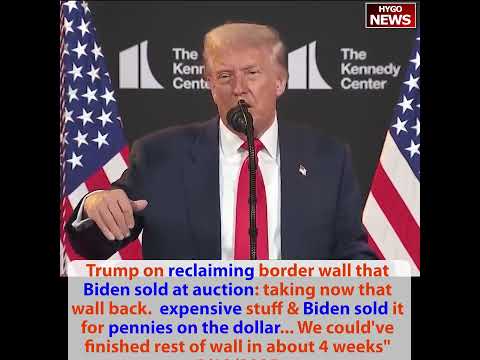
Trump: are you fools asking me to do that? Susie Wiles; statehood for DC ridiculous unacceptable
Trump covered three distinct stories in this exchange. His unusual acquiescence to hosting a specific event only because Chief of Staff Susie Wiles asked. His firm rejection of DC statehood as “ridiculous” and “unacceptable.” And his exposure of the Biden administration’s sale of border wall materials for pennies on the dollar, now being recovered through a Pam Bondi-led settlement. On the hosting request: “I’ve been asked to host. I said, I’m the president of the United States. Are you fools asking me to do that? … And then Susie Wells said to me, sir, right in our house. I said, okay, Susie, I’ll do it. That’s the power she’s got.” On DC statehood: “Statehood is ridiculous. It’s unacceptable. The Democrats want it because the Democrats have about 95% in this little area … They want to pick up two senators and it’s not going to happen.” On the border wall recovery: “Biden sold it for pennies on the dollar, three cents on the dollar, four cents on the dollar … Pam Bondi has been working very hard on suing that company. And I think they reached a settlement where we’re taking the wall back."
"I’m the President of the United States”
Trump’s opening story. “I’ve been asked to host. I said, I’m the president of the United States. Are you fools asking me to do that?”
The specific event is not identified clearly in this segment, though the context suggests it was a major entertainment or cultural event that approached Trump about hosting duties. Trump’s initial response: no. The presidency is not a hosting gig. “Are you fools asking me to do that?” — sharp rejection framed as incredulity.
“Sir, you’ll get much higher ratings. I said, I don’t care. I’m president of the United States. I won’t do it.”
The ratings argument. The requesters offered higher ratings as incentive. Trump dismissed the argument. Ratings are not relevant to the presidential role. The presidency carries specific responsibilities that do not include hosting entertainment events for ratings purposes.
“They said, please. And then Susie Wells said to me, sir, right in our house. I said, okay, Susie, I’ll do it. That’s the power she’s got.”
“Susie Wells” is Whisper’s rendering of Susie Wiles — Trump’s Chief of Staff, the first woman to hold that position in U.S. history. Wiles intervened. “Right in our house” — the event was at the White House, which addresses Trump’s ratings/privacy concerns.
Wiles’s influence is the notable point. Trump was saying no to press, staff, and various advocates. Wiles said the one sentence that changed his mind. “Okay, Susie, I’ll do it” is the specific concession.
”That’s the Power She’s Got”
“That is the power she’s got.” Trump’s explicit acknowledgment of Wiles’s authority within the administration.
Wiles’s power is institutionally unique. She manages the West Wing. She controls access to the Oval Office. She coordinates among the various policy advisors, communications staff, political operators, and external stakeholders. A Chief of Staff with Trump’s trust has effective veto power over much of what reaches the president.
Trump’s public acknowledgment of that power matters. It signals to the administration and to external observers that Wiles’s voice carries unique weight. Decisions that go through her are decisions she has sanctioned. Decisions she opposes face substantial headwinds.
”Statehood Is Ridiculous”
Trump pivoting to DC statehood. “Statehood is ridiculous. We want to straighten the place out. Statehood is ridiculous. It’s unacceptable.”
The repetition is specific. “Ridiculous” twice. “Unacceptable” once. Trump is emphatic. DC statehood is not merely bad policy — it is absurd policy that should not even be under consideration.
“We want to straighten the place out. Statehood is ridiculous.” Those are two distinct points. DC needs operational improvement (streets, public safety, governance). DC becoming a state is a separate question — and, per Trump, not legitimate.
”Democrats Have About 95% in This Little Area”
“The Democrats want it because the Democrats have about 95% in this little area. Even I, I didn’t get it very much.”
DC’s partisan composition. In 2020, Biden won DC with approximately 92% of the vote. In 2024, Trump modestly improved his DC performance but still received well under 10%. DC is more Democratic than any state.
“Even I, I didn’t get it very much.” Trump’s self-deprecating note. Despite his improved 2024 performance nationally, Trump did not meaningfully improve in DC. The district’s 95% Democratic composition is structural.
”Two Senators — Not Going to Happen”
“They want that. They want to pick up two senators and it’s not going to happen. It’s not going to happen.”
The specific partisan calculation. DC statehood would create two new U.S. Senators. Given DC’s Democratic lean, both Senators would essentially certainly be Democrats. That would permanently shift the Senate composition by two seats toward Democrats.
Senate composition. Current split is roughly 53-47 Republican (depending on specific independent caucus alignments). Adding two permanent Democratic senators shifts that to approximately 53-49 — still Republican majority but thinner. More importantly, it changes the math for future cycles when specific seats are contested.
“Not going to happen” is repeated. Trump will not support DC statehood. Republicans in Congress will not pass it. Without Republican support, DC statehood cannot achieve the 60 Senate votes required for regular order legislation (or the majority required if the filibuster were modified).
”Least of the Reasons Why”
“And that’s the least of the reasons why, by the way, but that’s one of the reasons why.”
That qualifier matters. Trump is saying the Senate-seat partisan gain is the least of his reasons for opposing DC statehood. Other reasons (which he does not fully articulate) include:
- Constitutional design (DC was specifically not a state under the Framers’ plan)
- Federal district purpose (DC is meant to be neutral territory for federal government)
- DC governance capacity (DC has not demonstrated ability to govern itself even as a district)
- Geographic/demographic concerns (DC is extremely small for a state)
The constitutional argument is substantial. The Constitution’s Seat of Government Clause (Article I, Section 8, Clause 17) creates specific constitutional protection for the federal district status. Statehood would require either a constitutional amendment or complex legal maneuvers to circumvent that provision.
”Greatest, Most Beautiful, Safest Capital”
“What we want to do is make Washington, D.C. the greatest, most beautiful, safest capital anywhere in the world. And that’s going to happen.”
That is Trump’s affirmative vision. Not statehood. Operational excellence. DC as a world-class capital city:
- Greatest (best-functioning)
- Most beautiful (aesthetic restoration)
- Safest (crime reduction)
“That’s going to happen.” Trump’s confidence. The operational improvements are underway. The federalization, the encampment clearances, the MPD coordination — all are moving DC toward the vision.
”Built Hundreds of Miles of Wall”
Trump pivoting to the border wall. “Well, I built hundreds of miles of wall. I was getting very close. I actually finished the wall, but then I added another 200 miles because when you do the original wall that I said I was going to build, which I got built, and I got it to the specifications of the Border Patrol and I.”
Trump built hundreds of miles of wall during his first term. “Got it to the specifications of the Border Patrol” — the wall design was informed by Border Patrol operational requirements rather than merely political optics.
“I actually finished the wall, but then I added another 200 miles.” That is the specific first-term output. The original proposed wall. Plus another 200 miles beyond that. Substantial construction across the U.S.-Mexico border.
The Wall Specifications
“It’s the exact, they wanted steel, they wanted concrete inside, they wanted rebar inside that, they wanted it to have wires.”
Four-component specification from Border Patrol:
- Steel (primary structural material)
- Concrete inside (reinforced)
- Rebar (additional reinforcement)
- Wires (sensors for detection)
“We have, the walls are wired for, you know, all of the internet stuff and security things. And we built it hundreds of miles.”
Internet-connected sensors. Security systems integrated into the wall itself. The wall is not merely a physical barrier — it is a sensor network that detects and reports crossing attempts in real time.
“That’s one of the reasons even now we’re able to have such good numbers at zero, essentially very little people coming in.”
The wall’s contribution to current border security. Not the only factor — Trump’s operational changes (deportation tempo, asylum policy changes, agency coordination) are also critical. But the physical wall infrastructure provides the baseline layer that makes the operational changes more effective.
”Another 200 Miles” Ordered
“I ordered for another 200 miles. I was going to do another 200 because so it is. We’re all set to do it. Then we had the bad election result.”
Trump’s first-term ordering of another 200 miles of wall construction. That additional segment was ready to proceed — materials ordered, foundations prepared, contractors engaged. “All set to do it.”
“Then we had the bad election result.” The 2020 election outcome. Trump’s loss. Biden’s inauguration.
“The horrible, horrible with what happened to our country, what they’ve allowed to happen to our country.”
Trump’s characterization of the Biden-era border policy. “Horrible, horrible.” The repetition emphasizes the degree of damage. The Biden administration’s specific decisions produced specific border chaos that “happened to our country” — Biden’s immigration posture was, in Trump’s framing, damage to America rather than mere policy difference.
”Biden Sold It for Pennies on the Dollar”
“We are taking now that wall back. Now this is expensive stuff. Hardened steel, very expensive. 9,000 pound concrete and rebar. Rebar is very expensive. The hardest rebound. No, it’s very, very hard to cut. You have different materials. It’s very hard to cut because they cut it down if they can. It’s very hard to cut.”
The wall material descriptions. Hardened steel. 9,000-pound concrete. Rebar — specifically hard-to-cut rebar designed to resist improvised cutting tools. Each material component specified for resistance to circumvention.
“Biden sold it for pennies on the dollar, three cents on the dollar, four cents on the dollar. He sold it.”
That is the Biden administration action Trump is exposing. Border wall materials — hundreds of millions or billions of dollars in specialized materials — were sold at scrap value. 3-4% of their original cost. “Pennies on the dollar.”
The Biden administration framing at the time was that wall construction was suspended and stored materials needed to be disposed of. The Trump framing: the materials should have been preserved for future wall construction, which the Biden administration specifically wanted to prevent.
”Four Weeks” to Finish
“That was when I first realized when I saw the wall was big, but because we could have finished the rest of the wall in about four weeks, anywhere from three to four weeks, it was all set to go. It was laying down, ready to be put up. The foundations were, they took over and they said, we’re going to sell the wall.”
Timing detail. 3-4 weeks to complete the remaining wall sections. Materials were on-site. Foundations were prepared. Contractors were ready. The Biden administration blocked completion despite the project being weeks from finish.
“They took over and they said, we’re going to sell the wall. And they sold it, as you know, for pennies on the dollar.”
The specific policy choice. Not: pause construction. Not: store materials for future use. Actively sell the materials at scrap value.
Pam Bondi’s Recovery Effort
“Well, Pam Bondi has been working very hard on suing that company. And I think they reached a settlement where we’re taking the wall back, but they stole the wall from us.”
Attorney General Pam Bondi leading litigation against the company that purchased the scrap-rate wall materials from the Biden administration. Settlement reached. The wall materials are being returned to federal control.
“They stole the wall from us.” Trump’s framing. The sale was theft. Whether the company knew the materials were being sold at below-market rates (and thus benefited from what Trump frames as Biden administration’s deliberate underselling), or merely accepted the offered price, the net effect was that specialized wall materials worth far more than the sale price transferred out of government possession.
”First Realized That These People Actually Want to Have Open Borders”
“What a shame that is. But that was when I first realized that these people actually want to have open borders.”
That is Trump’s specific conclusion. The sale of wall materials was the moment of clarity. Previous Biden administration immigration decisions could be framed as policy differences. But actively selling the wall materials — preventing their future use for border security — was, in Trump’s view, evidence of intentional open-borders policy rather than mere policy disagreement.
“They actually want to have open borders.” The specific accusation. Not: they have different policy views. Not: they prioritize different values. They “actually want” open borders as the desired outcome. The wall sale was the operational proof of that intent.
Three Distinct Stories
The Susie Wiles hosting request (personal administration detail). DC statehood rejection (constitutional and partisan politics). Border wall recovery via Pam Bondi settlement (Biden administration exposure + Trump administration recovery).
Each reflects a specific administration dimension. Personnel dynamics (Wiles’s authority). Institutional politics (DC statehood refusal). Legal/operational recovery (wall material retrieval). All three demonstrate ongoing administration activity across the political, institutional, and operational domains.
Key Takeaways
- Trump on Susie Wiles’s influence: “I’ve been asked to host. I said, I’m the president of the United States. Are you fools asking me to do that? … And then Susie Wells said to me, sir, right in our house. I said, okay, Susie, I’ll do it. That’s the power she’s got.”
- On DC statehood: “Statehood is ridiculous. It’s unacceptable. The Democrats want it because the Democrats have about 95% in this little area … They want to pick up two senators and it’s not going to happen.”
- Trump’s affirmative DC vision: “Make Washington, D.C. the greatest, most beautiful, safest capital anywhere in the world. And that’s going to happen.”
- On the Biden wall material sale: “Biden sold it for pennies on the dollar, three cents on the dollar, four cents on the dollar … we could have finished the rest of the wall in about four weeks, anywhere from three to four weeks.”
- On the Pam Bondi recovery: “Pam Bondi has been working very hard on suing that company. And I think they reached a settlement where we’re taking the wall back, but they stole the wall from us.”