 HYGO News
 Trump: AOC & Crockett IQ test; $15B Homer City; Payments start on 8/1, surplus $25B; superpower AI
Trump: AOC & Crockett IQ test; $15B Homer City; Payments start on 8/1, surplus $25B; superpower AI
A Pittsburgh-area event on energy and AI produced one of the more compressed stretches of Trump rhetoric in weeks. The president opened by proposing an IQ test showdown between Reps. Alexandria Ocasio-Cortez and Jasmine Crockett — “AOC, look, I think she’s very nice, but she’s very low IQ … Between her and Crockett, we’re going to give them both an IQ test to see who comes out best” — before announcing a $15 billion Knighthead Capital Management investment that would resurrect the Homer City power plant, shuttered under what he called Biden’s “Green News scam,” as the largest natural gas-fired power plant ever built in North America. He pointed to a $25 billion federal budget surplus driven by “good management and tariffs” and announced tariff payments begin August 1. He declared that “America’s destiny is to dominate every industry and be the first in every technology … including being the world’s number one superpower in artificial intelligence,” and previewed a pharmaceutical tariff coming at month’s end with a phased ramp designed to force pharma manufacturing back to U.S. soil.
”AOC … She’s Very Low IQ”
Trump opened with a sharp personal jab targeting two of the Democratic Party’s highest-profile young members. “You know, AOC, look, I think she’s very nice, but she’s very low IQ. And we really don’t need low IQ.”
“Between her and Crockett, we’re going to give them both an IQ test to see who comes out best.”
The IQ-test framing is classic Trump escalation. He has been using it against opponents for decades. In 2018, he proposed the same test against then-Secretary of State Rex Tillerson. Against AOC and Rep. Jasmine Crockett, he is deploying the same rhetorical device against two of the most prominent progressive women in Congress — members who have sharpened their public profiles through viral committee clashes.
“Now, I took my test. I took a real test at Walter Reed Medical Center, and I aced it. I got every one of all those questions right.” The Walter Reed cognitive test reference is Trump’s standard comeback when the issue of mental acuity comes up. “Now it’s time for them to take a test. Anyway, have a good time."
"Green News Scam”
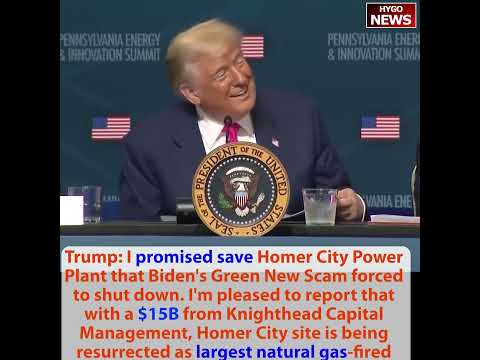
The Homer City announcement was the event’s economic centerpiece. “In the campaign, I promised that I would save the Homer City power plant 50 miles east of here, that Joe Biden’s Green News scam forced to shut down. It’s a Green News scam. Greatest scam in history?”
“Green News scam” is Trump’s neologism for what the rest of the political world calls the Green New Deal and related climate-policy measures. The substitution of “News” for “New” is not accidental — it reinforces Trump’s broader argument that environmental regulations are an information-laundering operation that dresses policy preferences in scientific clothing.
“The greatest in history.” Then a pause, and a correction. “The auto pen, I think, is a bigger scam, if you want to know. Actually, I do believe that.”
Trump ranking “the auto pen” — his name for the Biden autopen controversy — above the Green New Deal as “the greatest scam in history” is the president’s latest attempt to elevate the autopen issue. The autopen, in Trump’s framing, is a scandal about the legitimacy of every Biden-era signature. If he can make that scandal the top-line fraud of the preceding administration, it becomes a tool for unwinding Biden-era actions across multiple domains.
The $15 Billion Knighthead Investment
“Today, we’re pleased to report that a $15 billion investment from Nighthead Capital Management, who’s here from Nighthead? Well, I’m very impressed with that. $15 billion. That’s pretty good.”
The reference is to Knighthead Capital Management, a multi-billion-dollar investment firm. A $15 billion commitment to a single Pennsylvania power plant project is a substantial bet. It reflects the administration’s success in attracting private capital to projects aligned with its energy-abundance agenda.
“That’s a great location, too. Wow. That’s very impressive. Thank you very much. That’s a big number, huh? It’s a big number, and yet it’s peanuts relative to water.” (The “peanuts relative to water” phrasing appears to have been Whisper’s rendering of a line Trump actually spoke differently — likely “peanuts relative to what’s coming” or similar, given the follow-on context about further announcements.)
”The Largest Natural Gas-Fired Power Plant Ever”
The announcement’s core claim: “The Homer City site is being resurrected as the largest natural gas-fired power plant ever to be built in North America. Is that right? That’s fantastic.”
That is a specific, verifiable claim. The Homer City Generating Station in Indiana County, Pennsylvania, was a coal-fired plant that ceased operations under environmental-regulatory pressure. Rebuilding the site as a natural gas-fired facility of record-breaking size would make it the anchor of a new wave of U.S. power generation, capable of supplying electricity to the AI data-center buildout the president was also announcing.
”Payments Start on August 1st”
On tariffs, Trump delivered a specific, memorable date. “The only thing about that’s really sacred about August 1st is that’s when payments start. So they have to start paying billions of dollars to you and people.”
August 1 is the date when a major expanded tranche of tariffs was set to take effect — the culmination of a series of letter-based and bilateral-deal determinations the administration has been issuing through the summer. Trump’s framing — “payments start” — treats the tariffs as a revenue stream, paid by foreign exporters (or, more accurately, by importers who pass costs through the supply chain) into the U.S. Treasury.
“Are you a citizen of the country? I’m sure. All right, good. You’ll be very happy because you’re going to be getting a lot of money.” The aside to a member of the audience frames tariffs as a direct benefit to ordinary Americans.
The $25 Billion Budget Surplus
“Just like they found a budget surplus, they have a budget surplus of $25 billion. Everyone said, how did that happen? It hasn’t happened in many years. It happened because of good management and tariffs.”
A $25 billion monthly federal surplus is an unusual event. The federal government has run monthly deficits in most months for most of the past two decades. A surplus month typically reflects a convergence of favorable factors — strong tax receipts (often from corporate or estate tax deadlines), restrained spending, and, in the current case, tariff revenue inflows that have climbed substantially year-over-year.
“Good management and tariffs” is Trump’s two-factor explanation. The “good management” piece references the executive branch’s broader effort to cut federal spending, through DOGE-driven personnel reductions and agency-level efficiencies. The “tariffs” piece references the revenue side — the new duties flowing into the Treasury as imports clear customs under the expanded tariff schedule.
”$56 Billion Energy, $36 Billion Data Centers”
Trump laid out additional investment figures from the Pittsburgh event. “The investments being announced this afternoon include more than $56 billion in new energy infrastructure and more than $36 billion in new data center projects. And a lot more than that are going to be announced in the coming weeks, not even months. I think we could say weeks, right, Howard?”
“Howard” is almost certainly Howard Lutnick, the Commerce Secretary, or another member of the economic team. The implicit confirmation — “right, Howard?” — signals the numbers have been vetted against the administration’s internal projections.
$56 billion in energy infrastructure and $36 billion in data center projects, in a single afternoon’s announcements. That is the tempo the administration is hitting in its second-term economic rollout — concentrated announcement events designed to put several headline capital commitments on the ledger at once.
”World’s Number One Superpower in Artificial Intelligence”
The AI framing was the event’s strategic climax. “We’re here today because we believe that America’s destiny is to dominate every industry and be the first in every technology. And that includes being the world’s number one superpower in artificial intelligence. And we are way ahead of China, I have to say, we’re way ahead of China.”
“America’s destiny is to dominate every industry and be the first in every technology” is the most expansive statement of American industrial ambition Trump has offered in a single sentence. It is not narrow to AI — it covers “every industry” — but AI is the named frontier.
“Way ahead of China” is a contested claim. On some measures, the U.S. is ahead — frontier-model capabilities at OpenAI, Anthropic, and Google DeepMind are competitive and in some specific evaluations lead Chinese labs. On other measures — manufacturing-scale AI deployment, certain application categories — China is ahead or close. Trump’s “way ahead” framing is the most optimistic version of that comparison.
The Construction Starts
“And the plants are starting up, the construction is starting up.” That phrase operationalizes the investment numbers. Capital commitments are valuable but become real only when the concrete is poured. Trump’s claim: the commitments from the past six months are translating into actual groundbreaking now, not in some unspecified future.
“Did you notice that two days ago they just announced that they had a budget surplus of $25 billion in this country? Right, Howard? They never saw anything like that. They would say, what are that? That’s been like decades, $25 billion, and that’s peanuts compared to what it’s. And it’s good business practices.”
Repeating the $25 billion surplus number twice in the same appearance signals Trump’s assessment that it is a breakthrough political data point — one he wants voters to internalize.
Pharmaceuticals Tariff: A Phased Approach
Trump previewed a new tariff category. “The tariffs are coming in by the hundreds of billions of dollars. They’re really at the infant stage right now. It’s only on cars and steel, mostly. The rest is starting to kick in.”
“Farmers’ pseudocles will be tariff probably at the end of the month.” The “farmers’ pseudocles” phrase is Whisper’s garbled rendering of “pharmaceuticals.”
“We’re going to start off with a low tariff and give the pharmaceutical companies a year or so to bill. And then we’re going to make it a very high tariff because we’ve got to move them and look, there’s two ways you do it. You make money and or and or you have them move here so they don’t have to pay the tariff. Those are the two ways the pharmaceutical companies are moving back to America where they should be.”
The phased approach is deliberate policy design. A low initial tariff gives pharmaceutical manufacturers advance notice that the cost of foreign production will rise. A year’s runway gives them time to either commit to U.S. manufacturing buildouts or accept the higher tariff as a long-term cost. After the runway, the tariff ramps high — forcing the choice.
The Two-Way Door
“Make money, or move here so they don’t have to pay the tariff. Those are the two ways.” The framing makes it explicit. The tariff is not just a revenue measure. It is a relocation incentive. Pharmaceutical manufacturers operating in the EU, Ireland, Puerto Rico, China, or India are now being told: your U.S. sales will either pay significant new duties, or you can move production to the American mainland. The administration is agnostic between the two outcomes, but both generate what it considers a win — revenue or domestic manufacturing.
“The pharmaceutical companies are moving back to America where they should be.” The prediction. Whether it proves accurate will depend on how the phased tariff is implemented and whether pharmaceutical supply chains can actually restructure within the runway period.
Key Takeaways
- Trump proposed an IQ-test face-off between AOC and Rep. Jasmine Crockett — “AOC, look, I think she’s very nice, but she’s very low IQ … Between her and Crockett, we’re going to give them both an IQ test to see who comes out best” — citing his own Walter Reed cognitive test.
- Knighthead Capital Management committed $15 billion to resurrect the Homer City power plant, shuttered under what Trump called “Biden’s Green News scam,” as “the largest natural gas-fired power plant ever to be built in North America.”
- Tariff “payments start on August 1st,” contributing to a $25 billion federal budget surplus that Trump attributed to “good management and tariffs” — with $56 billion in energy infrastructure and $36 billion in data centers announced at the Pittsburgh event.
- Trump declared “America’s destiny is to dominate every industry and be the first in every technology … including being the world’s number one superpower in artificial intelligence” — and said the U.S. is “way ahead of China.”
- Pharmaceutical tariffs coming “probably at the end of the month” will start low and ramp “very high” after a year, with explicit purpose: either the companies “make money [paying]” or they “move here so they don’t have to pay the tariff.”