 HYGO News
 Rubio in Paris: 'The Ukraine War Is Not Our War -- We Need Progress in Days, Not Weeks'; Threatens U.S. Will Walk Away
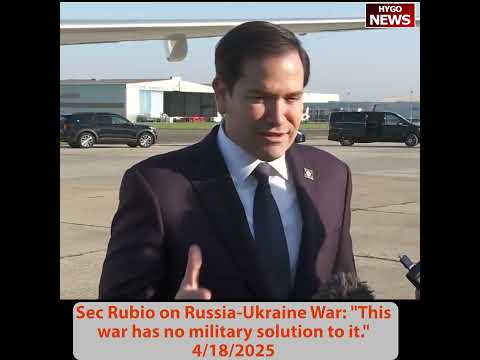
Rubio in Paris: “The Ukraine War Is Not Our War — We Need Progress in Days, Not Weeks”; Threatens U.S. Will Walk Away
Secretary of State Marco Rubio delivered a stark ultimatum from Paris in April 2025 after negotiations with Ukrainian and European officials: “This war has no military solution to it. We need to determine very quickly now — and I’m talking about a matter of days, not weeks — whether or not this is doable. If it is, we’re in. If it’s not, then we have other priorities to focus on.” Rubio emphasized: “The Ukraine war is a terrible thing, but it’s not our war. We didn’t start it.” He confirmed that Ambassador Whitcoff had held three separate meetings with Vladimir Putin and that the president had spent “87 days at the highest level of his government” trying to end the war. On security guarantees, Rubio acknowledged Ukraine’s right to defend itself but said negotiations had not reached that level of specifics.
”Not Our War”
Rubio delivered the foundational statement that reframed American engagement with the conflict.
“I think it’s important to remind everybody that the Ukraine war is a terrible thing, but it’s not our war,” Rubio said. “We didn’t start it. The United States has been helping Ukraine over the last three years, and we want it to end. But it’s not our war. I want everyone to understand that.”
He explained why this distinction mattered: “And the reason why I make that point is the president has spent 87 days at the highest level of his government repeatedly taking efforts to bring this war to an end.”
He described the investment: “We are now reaching a point where we need to decide and determine whether this is even possible or not, which is why we’re engaging both sides.”
The “not our war” declaration was the most significant reframing of American foreign policy since the end of the Cold War. For three years under Biden, the Ukraine conflict had been treated as America’s fight — with over $100 billion in aid, weapons, and intelligence support flowing to Kyiv. The framing had been that Russia’s invasion was an attack on the “rules-based international order” that America had a moral obligation to resist.
Rubio was dismantling that framework. The war was between Russia and Ukraine. America had helped, wanted it to end, and was willing to facilitate peace. But it was not America’s war, and the United States would not continue investing unlimited resources in a conflict where the parties themselves might not be ready for peace.
”No Military Solution”
Rubio delivered the military assessment that underscored the urgency of negotiations.
“This war has no military solution to it,” Rubio said. “It really doesn’t. It’s not going to be decided — neither side has some strategic capability to end this war quickly.”
He described what was at stake: “And so what we’re talking about here is avoiding thousands and thousands of people” — a reference to the continuing daily casualties on both sides.
The “no military solution” assessment was shared by virtually every serious military analyst. Russia had enough manpower and industrial capacity to sustain its current operations indefinitely, but not enough to achieve a decisive breakthrough. Ukraine, even with Western weapons, lacked the force to drive Russia from all occupied territory. The war had become a grinding attritional conflict that could continue for years, destroying a generation of young men on both sides while achieving no definitive result.
Rubio’s willingness to state this publicly was significant. Under the Biden administration, the official position had been that Ukraine could win with enough Western support — a claim that sustained the argument for continued funding but that did not reflect military reality. By acknowledging the stalemate, Rubio was providing the intellectual foundation for a negotiated settlement.
”A Matter of Days”
Rubio set a timeline that created genuine urgency.
“We’re not going to continue to fly all over the world and do meeting after meeting after meeting if no progress is being made,” Rubio said.
He offered the binary: “So if there’s serious about peace, either side or both, we want to help. If it’s not going to happen, then we’re just going to move on. We’re going to move on to other topics that are equally, if not more important in some way to the United States.”
He specified the deadline: “I’m talking about a matter of days, not a matter of weeks, whether or not this is the war that can be ended.”
He stated the consequences: “If it can, we’re prepared to do whatever we can to facilitate that and make sure that it happens, that it ends in a durable and just way.”
The alternative: “If it’s not possible, if we’re so far apart that this is not going to happen, then I think the president’s probably at a point where he’s going to say, well, we’re done. We’ll do what we can on the margins. We’ll be ready to help whenever you’re ready to have peace.”
The final formulation: “But we’re not going to continue with this endeavor for weeks and months on end. We need to determine very quickly now, and I’m talking about a matter of days, whether or not this is doable over the next few weeks. If it is, we’re in. If it’s not, then we have other priorities to focus on as well.”
The “days not weeks” deadline was negotiating leverage in its purest form. By threatening to walk away, Rubio was creating pressure on both sides. Russia would lose the prospect of a deal legitimized by American involvement. Ukraine would lose the mediator that was its best hope for a settlement that preserved its sovereignty. Both sides had incentives to accelerate — but only if they believed the threat was real.
The Diplomatic Investment
Rubio cataloged the extensive engagement the administration had already invested.
“Ambassador Whitcoff has had not one, not two, but three meetings with Vladimir Putin to determine the Russian perspective on this and understand what it would take for them to end it,” Rubio said.
He continued: “General Kellogg, myself and others have had repeated engagements with the Ukrainians.”
He described the Paris meeting: “So we came here yesterday to sort of begin to talk about more specific outlines of what it might take to end the war.”
The three Whitcoff-Putin meetings were a detail that had received less public attention than it deserved. Direct engagement with Putin — understanding Russia’s actual requirements for ending the war, as opposed to the maximalist public positions — was essential to any realistic peace framework. The Biden administration had refused such direct engagement, treating any contact with Russia as moral capitulation. The Trump administration recognized that you cannot negotiate peace without talking to both sides of the war.
Security Guarantees
When asked about security guarantees for Ukraine, Rubio was careful.
“That gets it to a level of specifics that we’re not ready to discuss publicly yet,” Rubio said.
He acknowledged the legitimacy of the concern: “Every sovereign nation on earth has a right to defend itself. Ukraine will have a right to defend itself and to enter into whatever agreements it wants to enter into on a bilateral basis with different countries.”
He stated the principle: “Ukraine, in order for there to be peace, we recognize that Ukraine has to feel like it has the ability to defend itself from a future attack from anyone. Every country in the world has that right.”
But he kept expectations realistic: “We’re not working yet on that level of specifics. I think that’s something we can fix and solve in a way that’s acceptable to everyone. I think we have bigger challenges that we need to figure out whether it’s even possible within the short term.”
The security guarantee question was the most complex element of any peace deal. Ukraine’s fundamental concern was that a ceasefire without security guarantees would simply allow Russia to rearm and attack again. Rubio’s answer — that Ukraine had a right to defend itself and to make bilateral agreements — suggested a framework in which European countries would provide security commitments to Ukraine rather than the United States taking on a NATO-style obligation.
Key Takeaways
- Rubio from Paris: “The Ukraine war is a terrible thing, but it’s not our war. We didn’t start it.”
- He set a deadline: “I’m talking about a matter of days, not weeks, whether this is doable. If it is, we’re in. If it’s not, we have other priorities.”
- Military assessment: “This war has no military solution. Neither side has the capability to end this quickly.”
- Ambassador Whitcoff held three meetings with Putin; General Kellogg and Rubio had “repeated engagements” with Ukraine.
- On security guarantees: “Ukraine has a right to defend itself. Every country has that right. But we’re not at that level of specifics yet.”