 HYGO News
 Trump Rips ABC Over Qatar Jet: 'You Should Be Embarrassed'; Brokered India-Pakistan Ceasefire 'Using Trade'; Houthis 'Ceased Firing'
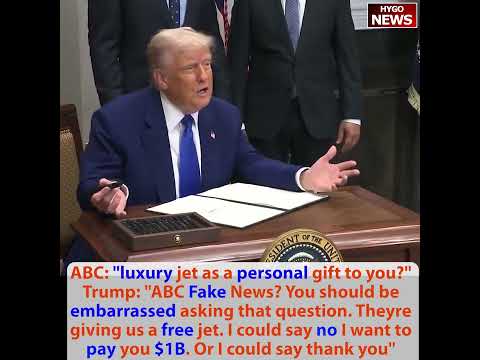
Trump Rips ABC Over Qatar Jet: “You Should Be Embarrassed”; Brokered India-Pakistan Ceasefire “Using Trade”; Houthis “Ceased Firing”
President Trump departed for Saudi Arabia on his first foreign trip of the second term in May 2025, with three major stories dominating. When an ABC reporter asked about the Qatar jet as “a personal gift,” Trump fired back: “You’re ABC Fake News right? You should be embarrassed asking that question. They’re giving us a free jet. I could pay them a billion, or I could say thank you.” He announced a historic breakthrough: “My administration helped broker a full and immediate ceasefire — I think permanent — between India and Pakistan, ending a dangerous conflict of two nations with lots of nuclear weapons.” He revealed the mechanism: “People have never really used trade the way I used it. I said, ‘If you stop, we’ll do a trade. If you don’t stop, no trade.’ They stopped.” On the Houthis: “For the first time ever they have ceased firing. Nobody was able to do what we did."
"You Should Be Embarrassed”
The ABC reporter attempted to characterize the Qatar 747 as personally enriching Trump.
“Mr. President, why don’t you say to people who view that luxury jet as a personal gift to you? Why not leave it behind?” the reporter asked.
Trump identified the outlet: “You’re ABC Fake News, right?”
He delivered the rebuke: “Let me tell you, you should be embarrassed to ask that question.”
He stated the facts: “They’re giving us a free jet. I could say, ‘No, no, no, don’t give us. I want to pay you a billion or 400 million or whatever it is.’ Or I could say, ‘Thank you very much.’”
He offered a classic Trump analogy: “You know, there was an old golfer named Sam Snead. Did you ever hear of him? He won 82 tournaments. He was a great golfer, and he had a motto: When they give you a putt, you say, ‘Thank you very much.’ You pick up your ball and you walk to the next hole.”
He applied the lesson: “A lot of people are stupid. They say, ‘No, no, I insist on putting it.’ Then they putt and they miss it, and their partner gets angry. Remember Sam Snead. When they give you a putt, you pick it up and you walk to the next hole and you say, ‘Thank you very much.’”
He addressed the reporter’s framing directly: “It’s not a gift to me. It’s a gift to the Department of Defense. And you should know better, because you’ve been embarrassed enough, and so has your network. Your network is a disaster. ABC is a disaster.”
The Sam Snead analogy was classic Trump. Snead — one of the greatest golfers in American history, with 82 PGA Tour victories — had been known for his golf wisdom as well as his playing ability. The “gimme putt” metaphor was something every golfer understood: when your opponent concedes a short putt, you accept the concession rather than insisting on attempting the shot. Refusing a gimme was not honorable — it was foolish, and often led to missing the putt entirely.
Trump was applying the lesson to diplomacy. When a partner nation offered a gift that served American interests, accepting it with gratitude was both gracious and wise. Insisting on paying for it, or refusing it out of abstract concerns about appearances, was the diplomatic equivalent of refusing a gimme — likely to generate worse outcomes than gracious acceptance.
”Using Trade” to Stop a Nuclear War
Trump announced the most significant diplomatic achievement of his second term to date.
“On Saturday, my administration helped broker a full and immediate ceasefire — I think a permanent one — between India and Pakistan,” Trump said. “Ending a dangerous conflict of two nations with lots of nuclear weapons.”
He described the stakes: “They were going at it hot and heavy, and it was seemingly not going to stop.”
He praised the leaders: “The leadership of India and Pakistan was unwavering — powerful but unwavering in both cases. They really — from the standpoint of having the strength and the wisdom and fortitude to fully know and understand the gravity of the situation.”
He revealed the key leverage: “We helped a lot, and we helped also with trade.”
He described the negotiation: “I said, ‘Come on, we’re going to do a lot of trade with you guys. Let’s stop it. Let’s stop it. If you stop it, we’ll do a trade. If you don’t stop it, we’re not going to do any trade.’”
He stated the principle: “People have never really used trade the way I used it, that I can tell you.”
He described the outcome: “All of a sudden, they said, ‘I think we’re going to stop.’ And they have.”
He elaborated: “They did it for a lot of reasons, but trade is a big one. We’re going to do a lot of trade with Pakistan. We’re going to do a lot of trade with India. We’re negotiating with India right now. We’re going to be soon negotiating with Pakistan.”
He summarized the stakes: “And we stopped the nuclear conflict. It could have been a bad nuclear war. Millions of people could have been killed. I’m very proud of that.”
He credited his team: “I also want to thank Vice President Vance and Secretary of State Rubio for their work and efforts. They worked very hard on that.”
The “using trade” revelation was historically significant. Trump had weaponized trade as a diplomatic tool in a way that no previous president had attempted. The message to both India and Pakistan was simple: peace came with economic rewards, and war came with economic isolation. Both countries needed American trade relationships; both leaders understood that continued conflict would cost them those relationships.
The nuclear dimension made the achievement extraordinary. India and Pakistan had fought multiple wars over the decades, and both now possessed nuclear arsenals. A conflict that escalated to nuclear exchange would have killed millions, potentially triggered global climate disruption from nuclear winter, and transformed the geopolitical landscape permanently. Trump’s use of trade leverage to bring both sides to accept an immediate ceasefire was diplomatic achievement of historic proportions.
”Houthis Ceased Firing”
Trump announced the Houthi capitulation in definitive terms.
“We also created a situation where the Houthis for the first time ever have ceased firing, and they’ve let it be known that they’re not going to be firing at American ships anymore,” Trump said.
He described the campaign: “This was a heavy barrage. It lasted for approximately 50 days.”
He acknowledged the history: “As you know, they’ve been in war essentially forever. But over the last 10 years, they’ve been very difficult for other countries.”
He stated the unique achievement: “Nobody was able to do what we did. But they stopped, and we take their word for it.”
He described the communication: “They, their surrogates, and them directly said, ‘We don’t want to do this anymore.’ And so we were satisfied with that.”
The 50-day military campaign against Houthi forces had demonstrated that the United States possessed both the military capability and the political will to respond decisively to attacks on international shipping. The Biden administration had conducted limited strikes that the Houthis easily absorbed; the Trump administration had conducted sustained operations that forced capitulation.
The “nobody was able to do what we did” claim was largely accurate. The Saudi-led coalition had fought the Houthis for years without achieving lasting results. The Biden strikes had produced no change in Houthi behavior. Only Trump’s combination of military pressure and diplomatic signaling had produced a clear cessation of attacks.
Key Takeaways
- Trump to ABC on Qatar jet: “You should be embarrassed. It’s not a gift to me — it’s to the Department of Defense. Your network is a disaster.”
- Sam Snead golf analogy: “When they give you a putt, you say thank you and walk to the next hole.”
- India-Pakistan ceasefire: “Using trade the way no one has before. ‘If you stop, we trade. If not, no trade.’ They stopped.”
- “We stopped the nuclear conflict. Millions could have been killed.”
- Houthis: “For the first time ever ceased firing. Nobody was able to do what we did.”