 HYGO News
 Trump: A real end. Not a ceasefire; very close to nuclear; Eric Trump & Don Jr 'Trump Mobile'
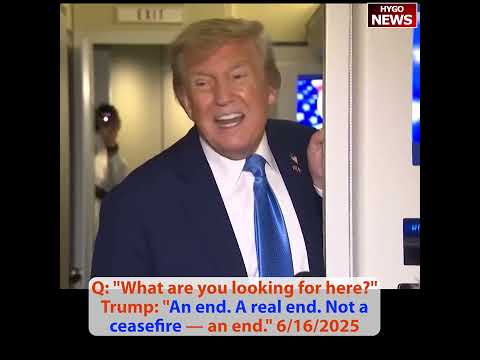
Trump: A real end. Not a ceasefire; very close to nuclear; Eric Trump & Don Jr ‘Trump Mobile’
Trump’s Iran posture hardened overnight into the clearest public statement of the administration’s desired outcome. Not a ceasefire. A real end. The press stakeout produced a series of clarifying exchanges — on the nuclear program, on the negotiation window, on what form of resolution the president is willing to accept. Separately, Eric Trump and Don Jr. announced the launch of “Trump Mobile,” a new mobile service offering that bundles phone plans with telemedicine, roadside assistance, and unlimited international texting. Treasury Secretary Scott Bessent delivered statistical vindication of the administration’s labor-market story: blue-collar wage growth under Trump’s second term is running at levels seen only once before — during Trump’s first term. And cabinet officials closed the day in Louisiana promoting the One Big Beautiful Bill, which the administration describes as “the most pro-worker, pro-blue-collar, pro-small business bill in American history."
"A Real End, Not A Ceasefire”
The most consequential statement of the day came from Trump’s exchange with reporters. “What specifically is better than a ceasefire? What are you looking for here?”
Trump: “A real end, not a ceasefire.”
“So something that will be permanent? Or giving up entirely. Is that okay too?”
Trump: “Certainly possible. Complete give up. That’s possible.”
The distinction Trump is drawing is between a temporary cessation of hostilities and a permanent resolution. A ceasefire, in the Middle Eastern context, has historically been a pause that both sides use to rearm, reposition, and prepare for the next round of conflict. An “end” means the underlying dispute is resolved — typically through dismantlement of the program that produced the dispute.
“Complete give up” is the shorthand for Iranian concession on the nuclear program. Trump is willing to accept that form of resolution. He is implicitly not willing to accept a temporary pause that allows Iran to reconstitute its capability.
The Nuclear Proximity
The reporter then pressed on the intelligence assessment. “Mr. President, you’ve always said that you don’t believe [Iran] should be able to have a nuclear weapon. But how close do you personally think that they were to getting one? Because Tulsi Gabbard testified in March that the intelligence community said Iran wasn’t building a nuclear weapon.”
Trump’s response: “I don’t care what you said. I think they were very close to having one.”
The exchange is significant for two reasons. First, it confirms that the administration is operating on a more aggressive assessment of Iran’s nuclear progress than the one that Director of National Intelligence Tulsi Gabbard presented to Congress in March. Second, it shows Trump’s willingness to publicly contradict his own DNI when the president’s assessment differs from the intelligence community’s formal product.
The Gabbard-Trump Gap
The Gabbard-Trump gap matters. The Director of National Intelligence is, by statute, the head of the intelligence community. Her testimony before Congress reflects the formal intelligence community assessment. When a president disagrees publicly with that assessment — or when he says “I don’t care what you said” — the question of what the real intelligence assessment is becomes, for observers outside the White House, uncertain.
Whether Trump has access to intelligence that is more current or more specific than what Gabbard presented is plausible. DNIs typically report the consensus of the community, and that consensus can lag rapidly changing situations. Alternatively, Trump may be operating on his own judgment about Iranian intent and capability, informed by his conversations with Israeli intelligence, with regional partners, and with his own inner circle.
”Iran Cannot Have Nuclear Weapons”
Trump then delivered the compressed version of the policy. “Remember Iran cannot have nuclear weapons. Very simple. You don’t have to go too deep into it. They just can’t have a nuclear weapon.”
The repetition — as seen in earlier statements — is the administration’s way of removing interpretive ambiguity. The policy is simple. The policy is absolute. The policy does not have exceptions.
”I Told Them To Do The Deal”
A reporter asked about the negotiating status. “Were you open to negotiating with the Iranians right now? Or do you want to wait?”
Trump: “I don’t know. I’ve been negotiating. I told them to do the deal. They should have done the deal. The cities have been blown to pieces. Lost a lot of people. They should have done the deal. I told them to do the deal. So I don’t know. I’m not too much into negotiating.”
The exhaustion in the answer is audible. “I’m not too much into negotiating” is Trump’s way of saying that the negotiating window — the 60-day window he referenced earlier — has closed. Iranian actions since then have reduced, not increased, his patience.
“The cities have been blown to pieces. Lost a lot of people” is the president’s acknowledgment of the human cost of the current escalation. He is not celebrating it. He is citing it as evidence that the deal Iran declined to make would have been preferable to the situation Iran now faces.
The Trump Mobile Launch
The video also captured Eric Trump and Don Jr.’s announcement of Trump Mobile. “We felt there was lackluster performance within the mobile industry. And so with Trump Mobile, we’re going to be introducing an entire package of products that people can come. They can get telemedicine on their phone for one flat monthly fee. Roadside assistance in their cars. Unlimited texting to 100 countries around the world. And we’ve partnered with some of the best to really bring something unique to the American people.”
The value proposition is bundled. A single monthly fee covers not just phone service but telemedicine, roadside assistance, and international texting. The bundling is an attempt to differentiate from the incumbent carriers — AT&T, Verizon, T-Mobile — who sell those services as separate add-ons.
The Family Business Dimension
The Trump Mobile launch is, in addition to being a commercial venture, a family business expansion. Eric Trump and Don Jr. are running the Trump Organization during their father’s second term. The mobile service is an extension of the brand into a consumer sector where, in their framing, American customers have been underserved by existing carriers.
”They’ve Probably Forgotten More About Mobile Technology Than I’ll Ever Know”
One of the Trump sons noted in the presentation: “So I think what I’ll do is let the team really speak for this because they’ve probably forgotten more about mobile technology than I’ll ever actually know. And with that, I’m going to introduce Pat.”
The humility in the framing is notable. The Trump family is willing to be the marketing face of the venture while deferring technical and operational questions to the mobile-industry partners who are actually building the product. That division of labor is the standard model for most celebrity-branded mobile services.
Bessent On Blue-Collar Wages
The day’s economic news came from Treasury Secretary Scott Bessent. “Blue-collar wage growth. The only other time it’s been this high, wait for it, was during President Trump’s first term. So we’ve seen real wages for hourly workers, non-supervisory workers rise almost 2% in the first five months. Why is that? No president has done that before.”
“Real wages” — meaning wages adjusted for inflation — rising 2% in five months is a significant statistic. Real wage growth has been one of the most elusive indicators in American economic data. Nominal wages rise during most periods. But once inflation is subtracted, the gains disappear or shrink. Bessent is claiming that the current period is one in which both nominal wages are rising and inflation is moderating, producing genuine real wage gains.
”It’s A President’s Emphasis On Manufacturing”
Bessent offered his analysis of the mechanism. “And why is that? It’s a president’s emphasis on manufacturing. I think there’s also likely a component of whether it’s 12 or 20 million illegal aliens coming out of the workforce. Joe Biden opened the border. It was flooded. That for working Americans, that’s a disaster because it’s pressure on their wages.”
Two mechanisms. First, manufacturing-focused policy. The tariffs, the reshoring incentives, the regulatory rollback are all designed to increase demand for American manufacturing labor. Increased demand for labor, with supply roughly constant, produces wage gains.
Second, labor-market tightening from reduced undocumented population. The administration’s removal operation, combined with reduced border inflow, reduces the supply of low-wage labor. Reduced labor supply, with demand roughly constant, produces wage gains.
Both mechanisms operate in the same direction — upward pressure on wages — and both are consistent with the administration’s preferred policy posture.
”That’s A Disaster Because It’s Pressure On Their Wages”
Bessent’s observation that Biden-era undocumented entry was “a disaster” for working Americans because of “pressure on their wages” is the policy argument underlying the immigration enforcement operation. The argument is not primarily cultural or legal. It is economic. Labor markets are subject to the laws of supply and demand. When the supply of low-wage labor increases dramatically without corresponding growth in demand, wages stagnate or fall.
The charge against Biden-era immigration policy is that it depressed blue-collar wages for years. The administration’s enforcement operation is, among other things, an attempt to reverse that pressure and restore upward wage trajectory.
The Louisiana Pitch
The video closed in Louisiana with cabinet officials promoting the One Big Beautiful Bill. “Hey everyone, it’s Kelly. I’m wrapping up the day here in Louisiana. What a great day we had talking about the one big beautiful bill. It is the most pro-worker, pro-blue-collar, pro-small business bill in American history. It’s tax cuts. It’s no tax on tips. No tax on overtime. We’re going to get this bill done. I’m grateful that President Trump is fighting for the American worker.”
The Louisiana visit was part of the administration’s ongoing effort to sell the bill in specific states where particular provisions will resonate. Louisiana, with its oil and gas industry, its service-sector workforce with significant tip income, and its manufacturing base, is a state where the bill’s provisions on energy, tips, and small business are expected to play well.
”Durable Ends” — The Trump Peacemaker Framing
The video’s closing commentary tied Trump’s Iran posture to his broader approach to conflict resolution. “That is up to the president. He is the singular guiding hand about what will be occurring from this point forward as he has been. I think that that dynamic is pretty clear. He says he wants an end. As he has said about every conflict that he has as a peacemaker worked to stop peacefully through diplomacy. That has been his commitment. He wants these things, as he said, about a number of situations. Not for a month or six months, but durable ends to this nature of forever wars. That has been his posture and that’s his posture now.”
“Durable ends” is the key phrase. The administration’s claim is that Trump’s track record is one of pursuing lasting resolutions rather than temporary pauses. Whether the current Iran situation can be brought to a “durable end” depends on whether Iran concludes that resistance is costlier than concession.
Key Takeaways
- Trump’s goal on Iran: “A real end, not a ceasefire” — with “complete give up” of the nuclear program as an acceptable outcome.
- Trump disputes DNI Gabbard’s congressional testimony: “I don’t care what you said. I think they were very close to having one.”
- Trump on the closed negotiating window: “The cities have been blown to pieces. Lost a lot of people. They should have done the deal. I’m not too much into negotiating.”
- Eric Trump and Don Jr. launch Trump Mobile with bundled telemedicine, roadside assistance, and unlimited international texting in the service.
- Bessent: “real wages for hourly workers, non-supervisory workers rise almost 2% in the first five months. No president has done that before” — attributed to manufacturing emphasis plus labor-market tightening from reduced undocumented population.