 HYGO News
Trump at the 2020 UN General Assembly: 'Hold China Accountable' and 'America First'
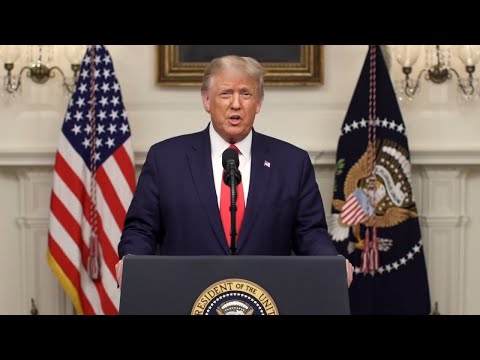
On September 22, 2020, six weeks before the presidential election, Donald Trump addressed the 75th session of the United Nations General Assembly. The pandemic had turned the annual gathering into a video conference, so his speech was pre-recorded and played in the General Assembly Hall in New York. It lasted about seven minutes, less than half the 15 minutes leaders are allowed [2]. Most of it was an indictment of China over COVID-19, delivered minutes before China’s leader, Xi Jinping, spoke. The rest was a defense of “America First” and a list of his foreign-policy record, from the Abraham Accords to the killing of Qasem Soleimani. Quotes below are from the official text [1].
Key Moments
”Hold accountable the nation which unleashed this plague”
Trump opened by calling the virus “the China virus,” which he said “has claimed countless lives in 188 countries.” Then he turned to Beijing: “We must hold accountable the nation which unleashed this plague onto the world: China.” He accused China of locking down domestic travel “while allowing flights to leave China and infect the world,” and said: “The Chinese government and the World Health Organization — which is virtually controlled by China — falsely declared that there was no evidence of human-to-human transmission.” His demand to the assembly was blunt: “The United Nations must hold China accountable for their actions.” Fox News led its coverage with that line [14].
Vaccines “in the final stage of clinical trials”
He claimed a record mobilization against the virus, including a surplus of ventilators shared abroad and treatments “reducing our fatality rate 85 percent since April.” Three vaccines, he said, were “in the final stage of clinical trials,” and “we are mass-producing them in advance so they can be delivered immediately upon arrival.” He promised: “We will distribute a vaccine, we will defeat the virus, we will end the pandemic.”
China’s pollution and the Paris accord
Trump attacked China’s environmental record, from ocean plastic to overfishing, and said: “China’s carbon emissions are nearly twice what the U.S. has, and it’s rising fast.” He set that against his own decision on climate: “By contrast, after I withdrew from the one-sided Paris Climate Accord, last year America reduced its carbon emissions by more than any country in the agreement."
"Putting America first, just as you should be putting your countries first”
The passage that drew the most attention in diplomatic circles was his argument against global governance itself: “Only when you take care of your own citizens will you find a true basis for cooperation. As President, I have rejected the failed approaches of the past, and I am proudly putting America first, just as you should be putting your countries first. That’s okay — that’s what you should be doing.”
Peace deals and “peace through strength”
He listed his record: withdrawing from “the terrible Iran Nuclear Deal,” the destruction of the ISIS caliphate, the killings of Abu Bakr al-Baghdadi and Qasem Soleimani, an economic agreement between Serbia and Kosovo, and the Abraham Accords, signed at the White House a week earlier by Israel, the United Arab Emirates and Bahrain, “with many other Middle Eastern countries to come.” He also said the United States was “working to end the war in Afghanistan, and we are bringing our troops home.”
China’s Reply
Xi Jinping spoke soon after and took a different tack. Without naming the United States, he called for global solidarity against the virus and made news of his own: China would aim to “have CO2 emissions peak before 2030 and achieve carbon neutrality before 2060” [3][4]. China’s U.N. ambassador, Zhang Jun, introduced Xi and pushed back on the call to hold China accountable. On climate he told reporters: “The United States should be the last one to talk about climate change” [5].
Fact Check
- “Falsely declared that there was no evidence of human-to-human transmission.” Partly accurate. On January 14, 2020, the WHO tweeted that “preliminary investigations conducted by the Chinese authorities” had found “no clear evidence” of human-to-human transmission. PolitiFact found the tweet accurately relayed what Chinese officials told the WHO, and a WHO official said at a briefing the same day that limited human-to-human transmission may have occurred [6]. In other words, the WHO was relaying China’s preliminary findings rather than making a finding of its own, and it raised the possibility of limited human spread the same day.
- “China’s carbon emissions are nearly twice what the U.S. has.” Accurate. In 2019 China produced 28% of the world’s carbon dioxide emissions and the United States 14.5%, according to the Global Carbon Project [15].
- “After I withdrew from the one-sided Paris Climate Accord, last year America reduced its carbon emissions…” The timeline is wrong. Trump had announced the withdrawal, but under the agreement’s rules it could not take effect until November 4, 2020, so the United States was still a party throughout 2019 [8]. The decline itself was real: U.S. energy-related carbon dioxide emissions fell 2.8% in 2019, led by a 14.6% drop in emissions from coal [7].
What Happened Next
- Vaccines: On December 11, 2020, the FDA authorized the Pfizer-BioNTech vaccine for emergency use, the first in the United States [9]. Trump’s prediction that a vaccine would come quickly proved right; it came after the election.
- Paris: The U.S. withdrawal took effect on November 4, 2020, the day after the election. Joe Biden rejoined on his first day in office, effective February 19, 2021 [8][10]. Back in office, Trump withdrew again in January 2025; that exit took effect on January 27, 2026 [11].
- The WHO: Trump had begun pulling the United States out of the WHO in 2020, and Biden reversed it. Trump ordered the withdrawal again on his first day back in office, and the U.S. completed its exit on January 22, 2026, although the WHO says its governing bodies have not formally accepted it [12].
- The Abraham Accords: “Many other Middle Eastern countries to come” proved partly right. Sudan agreed to normalize relations with Israel in October 2020 and Morocco on December 10, 2020, the fourth such agreement in recent months [13].
- Afghanistan: The troop withdrawal Trump promised was completed under his successor. The last U.S. troops left Kabul on August 30, 2021 [16].
Sources
- Archived White House: Remarks by President Trump to the 75th Session of the United Nations General Assembly
- UN News: US delivering “peace through strength,” President Trump tells UN
- UN News: “Enhance solidarity” to fight COVID-19, Chinese President urges, also pledges carbon neutrality by 2060
- Politico via Yahoo News: China’s Xi pledges to ax carbon emissions by 2060
- Philstar (AFP): In major move, China sets 2060 goal to go carbon neutral
- PolitiFact: No, the World Health Organization didn’t miss the coronavirus
- U.S. Energy Information Administration: U.S. energy-related CO2 emissions fell 2.8% in 2019
- NPR: U.S. officially leaving Paris climate agreement
- FDA: Pfizer-BioNTech COVID-19 vaccine, emergency use authorization of December 11, 2020
- NPR: U.S. officially rejoins Paris Agreement on climate change
- UN: United States withdrawal from the Paris Agreement takes effect
- CBS News: U.S. completes withdrawal from World Health Organization
- NPR: Morocco becomes latest Arab country to normalize ties with Israel
- Fox News: Trump tells the UN to hold China accountable for the pandemic
- AP via Fortune: Global carbon pollution continues to rise, but more slowly
- Military Times: One year after the Abbey Gate attack
- HYGO News video on Facebook
Full Transcript
Read the full official transcript
The White House, 9/22/2020
PRESIDENT TRUMP: It is my profound honor to address the United Nations General Assembly.
Seventy-five years after the end of World War II and the founding of the United Nations, we are once again engaged in a great global struggle. We have waged a fierce battle against the invisible enemy — the China virus — which has claimed countless lives in 188 countries.
In the United States, we launched the most aggressive mobilization since the Second World War. We rapidly produced a record supply of ventilators, creating a surplus that allowed us to share them with friends and partners all around the globe. We pioneered life-saving treatments, reducing our fatality rate 85 percent since April.
Thanks to our efforts, three vaccines are in the final stage of clinical trials. We are mass-producing them in advance so they can be delivered immediately upon arrival.
We will distribute a vaccine, we will defeat the virus, we will end the pandemic, and we will enter a new era of unprecedented prosperity, cooperation, and peace.
As we pursue this bright future, we must hold accountable the nation which unleashed this plague onto the world: China.
In the earliest days of the virus, China locked down travel domestically while allowing flights to leave China and infect the world. China condemned my travel ban on their country, even as they cancelled domestic flights and locked citizens in their homes.
The Chinese government and the World Health Organization — which is virtually controlled by China — falsely declared that there was no evidence of human-to-human transmission. Later, they falsely said people without symptoms would not spread the disease.
The United Nations must hold China accountable for their actions.
In addition, every year, China dumps millions and millions of tons of plastic and trash into the oceans, overfishes other countries’ waters, destroys vast swaths of coral reef, and emits more toxic mercury into the atmosphere than any country anywhere in the world. China’s carbon emissions are nearly twice what the U.S. has, and it’s rising fast. By contrast, after I withdrew from the one-sided Paris Climate Accord, last year America reduced its carbon emissions by more than any country in the agreement.
Those who attack America’s exceptional environmental record while ignoring China’s rampant pollution are not interested in the environment. They only want to punish America, and I will not stand for it.
If the United Nations is to be an effective organization, it must focus on the real problems of the world. This includes terrorism, the oppression of women, forced labor, drug trafficking, human and sex trafficking, religious persecution, and the ethnic cleansing of religious minorities.
America will always be a leader in human rights. My administration is advancing religious liberty, opportunity for women, the decriminalization of homosexuality, combatting human trafficking, and protecting unborn children.
We also know that American prosperity is the bedrock of freedom and security all over the world. In three short years, we built the greatest economy in history, and we are quickly doing it again. Our military has increased substantially in size. We spent $2.5 trillion over the last four years on our military. We have the most powerful military anywhere in the world, and it’s not even close.
We stood up to decades of China’s trade abuses. We revitalized the NATO Alliance, where other countries are now paying a much more fair share. We forged historic partnerships with Mexico, Guatemala, Honduras, and El Salvador to stop human smuggling. We are standing with the people of Cuba, Nicaragua, and Venezuela in their righteous struggle for freedom.
We withdrew from the terrible Iran Nuclear Deal and imposed crippling sanctions on the world’s leading state sponsor of terror. We obliterated the ISIS caliphate 100 percent; killed its founder and leader, al-Baghdadi; and eliminated the world’s top terrorist, Qasem Soleimani.
This month, we achieved a peace deal between Serbia and Kosovo. We reached a landmark breakthrough with two peace deals in the Middle East, after decades of no progress. Israel, the United Arab Emirates, and Bahrain all signed a historic peace agreement in the White House, with many other Middle Eastern countries to come. They are coming fast, and they know it’s great for them and it’s great for the world.
These groundbreaking peace deals are the dawn of the new Middle East. By taking a different approach, we have achieved different outcomes — far superior outcomes. We took an approach, and the approach worked. We intend to deliver more peace agreements shortly, and I have never been more optimistic for the future of the region. There is no blood in the sand. Those days are, hopefully, over.
As we speak, the United States is also working to end the war in Afghanistan, and we are bringing our troops home. America is fulfilling our destiny as peacemaker, but it is peace through strength. We are stronger now than ever before. Our weapons are at an advanced level like we’ve never had before — like, frankly, we’ve never even thought of having before. And I only pray to God that we never have to use them.
For decades, the same tired voices proposed the same failed solutions, pursuing global ambitions at the expense of their own people. But only when you take care of your own citizens will you find a true basis for cooperation. As President, I have rejected the failed approaches of the past, and I am proudly putting America first, just as you should be putting your countries first. That’s okay — that’s what you should be doing.
I am supremely confident that next year, when we gather in person, we will be in the midst of one of the greatest years in our history — and frankly, hopefully, in the history of the world.
Thank you. God bless you all. God bless America. And God bless the United Nations.
END