 HYGO News
 Trump: 3 hrs very extensive, now really up to Zelensky; Putin CONFIRMS war not happened under Trump
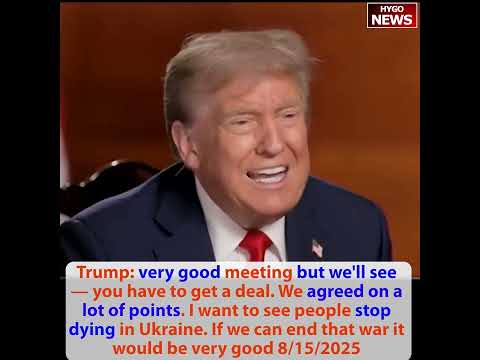
Trump: 3 hrs very extensive, now really up to Zelensky; Putin CONFIRMS war not happened under Trump
Trump’s post-Alaska-summit update describing the 3-hour meeting with Putin, the remaining negotiation handoff to Zelensky, and — most notably — Putin’s explicit on-camera confirmation that the Ukraine war would never have happened if Trump had been president. Trump: “We were together almost three hours and it was very extensive and we agreed on a lot of points … There’s not that much, there’s one or two pretty significant items, but I think they can be reached. Now it’s really up to President Zelensky to get it done.” On the next meeting format: “They’re going to set up a meeting now between President Zelensky and President Putin. And myself, I guess … Not that I want to be there, but I want to make sure it gets done.” Putin’s extraordinary confirmation: “I’d like to remind you that in 2020, during the last contact with the previous administration, I tried to convince my previous American colleague that the situation should not be brought to the point of no return when it would come to hostilities … Today, when President Trump is saying that if he was the president back then, there will be no war. And I’m quite sure that it would indeed be so. I can confirm that.” And: “Me and President Trump have built a very good business-like and trustworthy contact."
"Almost Three Hours”
Trump’s summit framing. “We were together almost three hours and it was very extensive and we agreed on a lot of points.”
Three hours of direct Putin-Trump engagement. That is a substantial meeting by modern summit standards. Earlier G7, NATO, and bilateral summits have typically been shorter for any single conversation. Three hours represents substantive engagement — not merely a protocol exchange.
“Very extensive.” The meeting covered many topics in depth. Territorial questions. Security arrangements. Economic normalization. European NATO posture. Various specific issues that require specific substantive discussion.
“We agreed on a lot of points. I mean a lot of points were agreed on.” The repetition emphasizes the specific outcome. Multiple points of agreement — not merely areas of shared concern, but specific points where U.S. and Russian positions converged.
”One or Two Pretty Significant Items”
“There’s not that much, there’s one or two pretty significant items, but I think they can be reached.”
The remaining points. One or two. Not ten. Not five. One or two. That small number suggests the negotiation is substantially complete on most dimensions.
“Pretty significant items.” These remaining points are not minor. They are the core questions that have driven the war. Likely candidates:
- Territorial status of Donbas and Crimea
- Ukraine NATO membership question
- Security guarantees for Ukraine post-war
- Sanctions relief sequencing
- Russian forces withdrawal timeline
“I think they can be reached.” Trump’s assessment. The remaining points are negotiable. Not deal-breakers. Solutions exist if both parties continue engaging.
”Now It’s Really Up to President Zelensky”
“Now it’s really up to President Zelensky to get it done. I would also say the European nations, they have to get involved a little bit, but it’s up to President Zelensky.”
Trump is handing the ball to Zelensky. The Putin-Trump portion is substantially complete. Russia’s position is understood. U.S. mediation framework is in place. Zelensky must now engage with the specific terms that have been framed.
“European nations, they have to get involved a little bit.” European participation. NATO members have specific interests in the Ukraine outcome — security guarantees, refugee resolution, economic reconstruction financing. Their “little bit” of involvement is substantial relative to the overall framework, but relative to the core Ukraine-Russia bilateral negotiation, European involvement is secondary.
“But it’s up to President Zelensky.” The specific primacy. Zelensky as Ukraine’s head of state must accept the terms. Neither Trump nor European leaders can accept terms on Zelensky’s behalf. Zelensky’s political room — Ukrainian public opinion, Ukrainian parliament approval — limits what he can accept.
”I’ll Be at That Next Meeting”
“I think, and if they’d like, I’ll be at that next meeting.”
Trump’s participation conditional on request. “If they’d like” — Zelensky and Putin need to want Trump present. Trump is not insisting. Not forcing his participation. Offering to participate if the principals find it useful.
“They’re going to set up a meeting now between President Zelensky and President Putin. And myself, I guess, you know, I didn’t even, I didn’t ask you about it. Not that I want to be there, but I want to make sure it gets done.”
Trump’s specific statement. He wants the deal done. Not his presence at the signing ceremony. Not his photo with the two leaders. The deal itself. If his presence helps, he will be there. If his absence helps, he will not insist.
That framing matters. Trump is not making this about him. He is making it about ending the war. That is a diplomatic framing that typically produces better outcomes than ego-driven participation.
”Pretty Good Chance of Getting It Done”
“We have a pretty good chance of getting it done. We have a very good meeting today, but we’ll see. I mean, it’s, you know, you have to get a deal. We agreed on a lot of points.”
Trump’s probability assessment. “Pretty good chance” — consistent with his “very good chance” from the earlier segment. Substantial probability of successful conclusion.
“You have to get a deal.” The specific transactional framing. Agreement on points is not a deal. A deal is the final resolution. Multiple diplomatic processes have “agreed on many points” without producing final deals. The distinction matters.
”I Want to See People Stop Dying”
“I want to see people stop dying in Ukraine and that’s what’s happening. We’re losing five, six, seven thousand. They’re Russians, mostly Russians and they’re Ukrainian soldiers.”
Trump’s specific casualty characterization. Five, six, seven thousand weekly. Mostly Russian soldiers. Some Ukrainian soldiers. That breakdown matters — if Russia’s casualties exceed Ukraine’s, that creates specific pressure on Putin’s political position.
Russian casualty estimates from various open-source analysts range from approximately 250,000-800,000 total killed and wounded across the war (as of late 2024 to 2025). Ukrainian casualty estimates are generally lower, though Ukrainian military secrecy makes precise estimates difficult. If Russian casualties substantially exceed Ukrainian casualties, that is the specific Russian political pressure that motivates Putin to end the war.
”People Dying in Cities and Towns”
“There’s some people dying in cities and towns where they’re trying to blow up missile manufacturers and other things and some cities, I don’t know if you know what’s going on there, but there are a lot of people dying.”
Civilian casualties. The Russian missile strikes on Ukrainian cities. Ukrainian strikes on Russian military infrastructure. Civilians die in both situations.
“Trying to blow up missile manufacturers.” That refers to both Russian strikes on Ukrainian defense facilities and Ukrainian strikes on Russian missile-production facilities. The war’s industrial dimension continues alongside the military front lines.
“Some cities, I don’t know if you know what’s going on there, but there are a lot of people dying.” That acknowledges specific civilian death tolls in cities — Kharkiv, Kyiv, Odesa, Mykolaiv on the Ukrainian side; various Russian border cities and military cities on the Russian side.
”And If We Can End That War”
“And if we can end that war, it would be very good.”
That is the core. Ending the war would be very good. For Ukrainians. For Russians. For European security. For global energy markets. For U.S. financial interests (no longer funding Ukraine aid to the same degree). For regional stability.
“Very good” is understatement. Ending a war that has killed hundreds of thousands is an extraordinary achievement regardless of the specific terms.
Putin’s Extraordinary Confirmation
“And I was very happy to hear him say if I was president, that war would have never happened.”
Putin’s specific statement. The war would not have happened if Trump had been president. That is Putin directly confirming Trump’s repeated claim.
Putin’s full statement (translated): “I’d like to remind you that in 2020, during the last contact with the previous administration, I tried to convince my previous American colleague that the situation should not be brought to the point of no return when it would come to hostilities. And I said it quite directly back then that it’s a big mistake.”
“The previous administration” — the Biden administration (which took office in January 2021, following Trump’s first term). Putin characterizes specific 2020-2021 communications where he warned Biden not to push the situation to “the point of no return.”
“It’s a big mistake.” Putin specifically told Biden that the Biden approach was a mistake. Biden proceeded anyway. The war began in February 2022.
”I Can Confirm That”
“Today, when President Trump is saying that if he was the president back then, there will be no war. And I’m quite sure that it would indeed be so. I can confirm that.”
That is direct confirmation. Putin, speaking on camera, confirms Trump’s claim. “I can confirm that” — the war would not have happened under Trump.
The political implications are substantial. Biden’s defenders have characterized Trump’s “war would not have happened” claim as retrospective boasting. Putin’s direct confirmation of that claim is not political — Putin has no interest in helping Trump domestically. Putin is making the factual assessment from his own knowledge of what would have happened.
That Putin’s confirmation aligns with Trump’s claim is significant. It does not prove the counterfactual absolutely. But it removes the Biden-defender argument that Trump is merely making political claims. Putin confirms the underlying dynamic.
”Business-like and Trustworthy Contact”
“I think that overall, me and President Trump have built a very good business-like and trustworthy contact. And I have every reason to believe that moving down this path, we can come and the sooner better to the end of the conflict in Ukraine.”
“Business-like and trustworthy contact.” Putin’s specific characterization of his relationship with Trump. Not friendship. Not alliance. Business-like — transactional, focused on specific outcomes, rational rather than emotional. Trustworthy — agreements reached are expected to be kept.
That characterization is diplomatic vocabulary. Putin is saying Trump can be trusted to follow through on specific commitments. That Putin is willing to engage substantively because Trump’s word has value.
“Moving down this path, we can come and the sooner better to the end of the conflict.” Putin’s specific endorsement of continued diplomacy. The sooner the war ends, the better. Putin is not stalling. Putin wants the war ended on acceptable terms.
Whether “acceptable terms” align with Zelensky’s “acceptable terms” is the remaining negotiation. But Putin’s expressed willingness to resolve the war — publicly, on camera, with specific endorsement of Trump’s diplomacy — is substantial.
Three Distinct Pieces
Trump’s substantive summit report (three hours, extensive, agreement on many points). Zelensky handoff (Trump’s role is setting the table; Zelensky must complete the deal). Putin’s confirmation (the war would not have happened under Trump; direct diplomacy continues to be productive).
Each piece reinforces the overall narrative. Diplomacy is working. Substantive progress is being made. Remaining questions are identifiable and addressable. The parties involved (specifically Putin) are confirming specific claims that opponents have disputed.
The political effect extends beyond Russia-Ukraine. Putin’s confirmation of Trump’s war-avoidance claim strengthens Trump’s credibility on other foreign policy claims. If Putin confirms that specific claim, perhaps other Trump claims that Democrats have disputed also have factual foundations.
Key Takeaways
- Trump on the summit length: “We were together almost three hours and it was very extensive and we agreed on a lot of points … There’s not that much, there’s one or two pretty significant items, but I think they can be reached.”
- On the Zelensky handoff: “Now it’s really up to President Zelensky to get it done. I would also say the European nations, they have to get involved a little bit, but it’s up to President Zelensky.”
- On the next meeting: “They’re going to set up a meeting now between President Zelensky and President Putin. And myself, I guess … Not that I want to be there, but I want to make sure it gets done.”
- Putin’s explicit on-camera confirmation: “I’d like to remind you that in 2020 … I tried to convince my previous American colleague that the situation should not be brought to the point of no return … Today, when President Trump is saying that if he was the president back then, there will be no war. And I’m quite sure that it would indeed be so. I can confirm that.”
- Putin’s characterization of Trump: “Me and President Trump have built a very good business-like and trustworthy contact … moving down this path, we can come and the sooner better to the end of the conflict in Ukraine.”