 HYGO News
 Trump 3 AI EOs: permitting data center, Promoting American AI models abroad, not woke DEI AI
Trump 3 AI EOs: permitting data center, Promoting American AI models abroad, not woke DEI AI
President Trump signed three AI-related executive orders, each addressing a distinct dimension of American AI policy. First: fast-track permitting for data center infrastructure, dramatically accelerating federal approvals for the physical capacity needed to host AI workloads. Second: promoting the export of American AI models abroad, using federal instrumentalities to expand U.S. AI’s global reach. Third: banning federal procurement of “woke” AI — models “infused with partisan bias or ideological agendas such as critical race theory.” “From now on the US government will deal only with AI that pursues truth, fairness and strict impartiality.” Trump also demolished what he called the Biden-era strategy to “regulate and restrict AI … so they could limit this technology to just a few large companies, allowing them to centralize it, censor it, control it, weaponize it.” On small and startup companies: “The unique strength of the American tech industry has always come from its startups and small tech … Jensen was small … started in your bedroom I think you were small right.”
Order One: Data Center Permitting
The first executive order’s topic — federal permitting for data centers — addresses the infrastructure constraint on AI buildout. “First executive order that we’ve prepared for your signature today relates to federal permitting for data center infrastructure. As you mentioned during your speech, this is a crucial issue affecting the entire AI industry is established fast track permitting and ensure that the federal government is working to get data centers proved and through the permitting pipeline as quickly as possible.”
The problem is real and acute. Major AI data centers require enormous amounts of electricity — gigawatts in the largest cases. That power needs transmission infrastructure, substations, generating capacity, and approvals from FERC, state utility commissions, and sometimes federal permitting for natural gas pipelines, transmission lines, and related support infrastructure. Those approvals have been the binding constraint on AI capacity growth. Companies can design the AI models and buy the chips. They cannot build the data centers without the permits.
“Fast track permitting” — shortening the permitting timeline from years to months — would dramatically increase U.S. AI capacity. It would also trigger environmental and community-impact concerns that environmental groups have been pressing. The executive order is a specific administration choice to prioritize AI buildout over those slower permitting processes.
Order Two: Export of American AI Models
The second order addresses international positioning. “As you said before, sir, it’s absolutely essential that American AI models in the American AI industry dominates the future of this industry around the world. What this next executive order will do is promote through various instrumentalities of the federal government the export abroad of American AI models to ensure American AI dominance in the future.”
“American AI dominance” is the framing. The administration is not aiming for American AI parity or competitive positioning. It is aiming for dominance — the U.S. as the global center for AI development, deployment, and use.
“Through various instrumentalities of the federal government” — that phrase encompasses a wide range of tools. Commerce Department export promotion. State Department diplomacy aligning allies around American AI stack deployment. Commerce and Treasury tools that make it easier for American AI firms to serve foreign customers. Federal research and procurement that signals preference for American AI.
The policy stakes are large. Chinese AI models — from firms like DeepSeek, Alibaba, Baidu, and others — have been making rapid technical progress and have active deployment across emerging markets. If the U.S. does not actively support American AI exports, Chinese models may win global market share by default.
Order Three: No Woke AI
The third order — banning federal procurement of “woke” AI — generated the most immediate political coverage. “And lastly, sir, as you said in your speech, we don’t want woke AI. We want AI models based on accurate information that give accurate information and accurate answers.”
“This executive order will ensure that when the federal government procures or promotes different AI models that those AI models are ideologically neutral that they don’t embrace woke ism and critical race theory and all of these terrible theories that have done so much damage to our country.”
The problem the order addresses is well-documented. Major AI models — particularly those from the largest Western AI labs — have been caught producing outputs that reflect specific ideological framings on topics including race, gender, history, and contemporary politics. Google’s Gemini famously produced images of racially diverse Nazi soldiers in an early version of its image generation. Claude has refused to answer certain categories of questions or offered responses reflecting specific ideological framings. Various other models have been documented providing politically skewed responses to controversial prompts.
Whether that “wokeness” reflects deliberate training choices by AI labs, unintentional artifacts of the training data, or emergent behaviors from the models’ learned patterns is a debated technical question. The administration’s response is policy-level: if a model produces woke outputs, the federal government will not procure it.
Biden’s Worst AI Executive Order
Trump escalated with characteristic directness. “One of Biden’s worst executive orders established toxic diversity, equity and inclusion ideology as a guiding principle of American AI development. So you immediately knew that was the end of your development.”
Biden’s October 2023 AI executive order — “Safe, Secure, and Trustworthy Development and Use of Artificial Intelligence” — did establish certain equity-related requirements for federal AI development. Whether those requirements constituted “the end of your development” is Trump’s characterization, not a neutral description. The requirements did add compliance burdens that some AI developers found onerous.
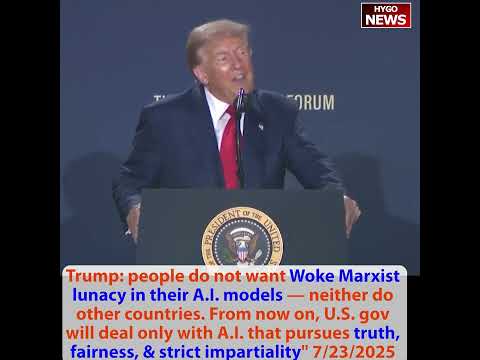
“But the American people do not want woke Marxist lunacy in the AI models and neither do other countries. They don’t want it. They don’t want anything to do with it.”
“Neither do other countries” is the global framing. Trump is arguing that woke AI is an American progressive preoccupation, not a global preference. Countries that will be adopting AI — India, Brazil, Indonesia, Nigeria, most of Europe, most of the Middle East — do not have the same woke cultural preoccupations that dominate certain U.S. institutional spaces.
“That’s why on day one I very proudly terminated Joe Biden’s order on woke AI effective immediately. You don’t have any of those crazy rules. Crazy."
"Truth, Fairness, Strict Impartiality”
“And in just a moment I will be signing an order banning the federal government for procuring AI technology that has been infused with partisan bias or ideological agendas such as critical race theory, which is ridiculous. And from now on the US government will deal only with AI that pursues truth, fairness and strict impartiality.”
“Truth, fairness, and strict impartiality” is the standard. The specific implementation of that standard will be the subject of considerable debate. How does a federal procurement officer assess whether an AI model “pursues truth”? The determination methodology matters as much as the standard.
”It’s So Uncool to Be Woke”
A moment of Trump’s characteristic rhetorical wander. “We’re not going to go through the craziness that we’ve gone through for the last four years. And then we skip for and then you go back and it started then but it hung around a little while now it’s not hanging around there all now it’s actually very uncool as somebody told me the other day it’s so uncool to be woke.”
“It’s so uncool to be woke” — that is Trump’s read of the cultural trajectory. The political-cultural formation called “woke” that dominated institutional spaces across higher education, corporate DEI, media, and many public-sector activities from roughly 2015 to 2023 has, in Trump’s read, lost its cultural cachet. Being woke is no longer fashionable.
That cultural read aligns with measurable data. DEI department staffing has been reduced across major corporations. The most visible woke rhetoric has receded from mainstream political discourse. Public opinion polling on various social issues has shifted away from the progressive framings that defined the 2018-2022 period.
“I encourage all American companies to join us in rejecting poison is Marxism and our technology.”
The Biden Strategy: “Centralize, Censor, Control, Weaponize”
Trump’s clearest articulation of his theory of the previous administration’s AI approach. “The reason the last administration was so eager to regulate and restrict AI was so they could limit this technology to just a few large companies, allowing them to centralize it, censor it, control it, weaponize it, and they would weaponize a very dishonest group of people you probably saw that because we caught them in the act.”
That is the deep critique. The Biden administration’s AI regulation, in Trump’s framing, was not primarily about safety or ethics. It was about concentrating AI capabilities in a small number of companies (Google, Microsoft, OpenAI’s partnership with Microsoft, Meta, etc.) that could be easily regulated — and through that regulation, could be leveraged by the government for specific political purposes (censorship, ideological enforcement, surveillance).
“We really caught them we had it before but now we really have them. We have it where it counts.”
Trump’s confidence that the pattern has been documented is notable. Whether the documentation he is referencing is the recent Gabbard document releases or separate revelations about AI-government coordination is ambiguous.
”Jensen Was Small”
The startup framing is the alternative vision. “But this is the exact opposite of my approach. The unique strength of the American tech industry has always come from its startups and small tech it comes through small. Jensen was small we have a small I think so when you started in your bedroom I think you were small right. He started as very small and now he’s really become very amazing.”
“Jensen” is Jensen Huang, the NVIDIA CEO whose company has become the dominant supplier of AI-training chips. NVIDIA’s market capitalization has exceeded $3 trillion at various points. Huang started the company small — “in your bedroom” is likely overstated but directionally correct about the early days.
Trump’s point: American tech dominance has historically come from startups that grew — Apple in the garage, NVIDIA in the small office, Facebook in the dorm room, Google in the research lab. Regulation designed to protect large incumbents against the startup competition kills the source of American tech leadership.
“If you regulate them too much you kill the source of American genius and technological power."
"Biden Had a Plan to Lose the AI Race”
The closing accusation is direct. “I believe that Joe Biden had a plan to lose the AI race. I think he wanted to lose it because his plan would never have worked it would have never been successful and you would have spent a lot of money and you wouldn’t have been able to win. They didn’t allow you to win.”
“Plan to lose” is the accusation. Trump is arguing that the Biden administration’s AI policies were not incompetent — they were designed to prevent American AI leadership, not merely failing to achieve it. Whether that characterization fits the actual policy objectives of the previous administration is contested. The policy outcomes — slow permitting, DEI requirements, regulatory uncertainty — were the operational results regardless of intent.
Three Orders, One AI Strategy
The three orders together constitute a coherent AI policy: build the physical infrastructure, export the American models, and strip out the ideological baggage. Each addresses a specific barrier to American AI dominance. Each reflects the administration’s consistent theory: lighter regulation, faster buildout, preserve startup culture, win the global competition.
Whether the strategy works will be judged over the full term. The immediate tests: data center permit approval timelines, American AI market share in key international markets, and measurable changes in the ideological posture of federally procured AI systems.
Key Takeaways
- Trump signed three AI executive orders: fast-track permitting for data centers, promoting export of American AI models abroad, and banning federal procurement of “woke” AI.
- On anti-woke AI: “Ideologically neutral … don’t embrace woke ism and critical race theory … from now on the US government will deal only with AI that pursues truth, fairness and strict impartiality.”
- Trump’s critique of Biden-era AI regulation: “to limit this technology to just a few large companies, allowing them to centralize it, censor it, control it, weaponize it.”
- On startups: “The unique strength of the American tech industry has always come from its startups and small tech … Jensen was small … started in your bedroom.”
- Trump’s direct accusation: “I believe that Joe Biden had a plan to lose the AI race. I think he wanted to lose it.”