 HYGO News
 Trump: 2nd more important meeting Putin, Zelensky & myself; 275K illegal removed Social Security
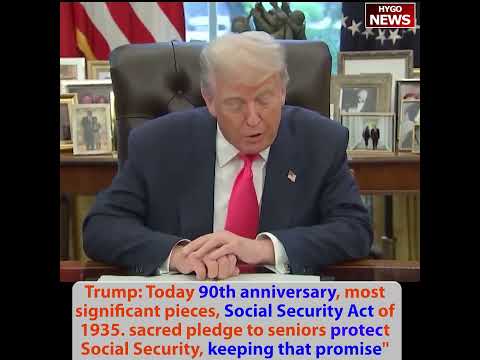
Trump: 2nd more important meeting Putin, Zelensky & myself; 275K illegal removed Social Security
Trump covered the Russia-Ukraine diplomatic architecture, Social Security’s 90th anniversary, the removal of 275,000 illegal aliens from Social Security, and contrasted against Rep. Delia Ramirez’s renewed call to abolish ICE as a “terrorist organization.” On the upcoming summit: “We have a meeting with President Putin tomorrow. I think it’s going to be a good meeting, but the more important meeting will be the second meeting that we’re having. We’re going to have a meeting with President Putin, President Zelensky, myself.” On his record: “I’ve solved six wars in the last six months, a little more than six months now. I’m very proud of it. I thought the easiest one would be this one. It’s actually the most difficult.” On Social Security’s anniversary: “Today we celebrate that 90th anniversary of one of the most significant pieces of legislation ever signed into law, the Social Security Act of 1935.” On the illegal alien removal: “We’ve already kicked nearly 275,000 illegal aliens off of the Social Security system.” And on the database absurdities: “We cleared 12.4 million names listed in the Social Security database over 120 years of age … there were nearly 135,000 people listed who were over 160 years old."
"Meeting with President Putin Tomorrow”
Trump’s opening framing for the Russia summit. “We have a meeting with President Putin tomorrow. I think it’s going to be a good meeting, but the more important meeting will be the second meeting that we’re having.”
That is the specific architecture. Tomorrow’s Trump-Putin bilateral is the first step. The more important meeting follows — trilateral with Zelensky included, and potentially European leaders depending on format.
“I think it’s going to be a good meeting.” Trump’s expectation. Not transformative on its own. But productive enough to establish the framework for the follow-up trilateral.
”More Important Meeting Will Be the Second”
“We’re going to have a meeting with President Putin, President Zelensky, myself, and maybe we’ll bring some of the European leaders along, maybe not. I don’t know that it’s going to be very important.”
That is the trilateral structure. Putin. Zelensky. Trump. Three principals at the same table. European leaders optional — Trump indicates he has not decided whether European inclusion would add value.
“Maybe we’ll bring some of the European leaders along, maybe not.” Trump’s flexibility. The European leaders — Macron, Scholz/Merz, Starmer, Meloni, etc. — have been active in Ukraine diplomacy. Their inclusion at the trilateral would represent Western unity. Their exclusion would focus the negotiation on the specific warring parties.
“I don’t know that it’s going to be very important” — Trump’s hedge on European participation. The core negotiation is between Ukraine and Russia. European participation matters for the security guarantees and economic reconstruction dimensions but is less central to the immediate ceasefire and territorial decisions.
”I Think President Putin Will Make Peace”
“We’re going to see what happens. I think President Putin will make peace. I think President Zelensky will make peace. We’ll see if they can get along. If they can, it’ll be great.”
That is Trump’s specific belief. Both principals want peace. The obstacle is not fundamental rejection by either side but rather the specific terms that produce acceptable peace for both.
“We’ll see if they can get along.” That acknowledges the personal dynamics matter. Putin and Zelensky have not met directly since the invasion. Their respective positions — Putin claiming territorial gains, Zelensky claiming territorial integrity — are not easily reconciled. Personal dynamics at the trilateral will influence whether substantive compromises emerge.
”I’ve Solved Six Wars in Six Months”
“You know, I’ve solved six wars in the last six months, a little more than six months now. I’m very proud of it. I thought the easiest one would be this one. It’s actually the most difficult.”
Six wars resolved in six months. The specific list (per administration enumeration across multiple statements):
- India-Pakistan (May 2025 ceasefire after brief military exchange)
- Democratic Republic of Congo-Rwanda (peace agreement)
- Armenia-Azerbaijan (normalization with corridor deal)
- Cambodia-Thailand (border agreement)
- Israel-Iran (de-escalation after brief conflict)
- Multiple other regional resolutions
“I thought the easiest one would be this one.” That is Trump’s candid admission. Russia-Ukraine seemed easier from the outside. The countries share cultural and economic ties. The war serves neither country’s long-term interests. The specific territorial questions are negotiable in principle.
“It’s actually the most difficult.” That is the empirical reality Trump has encountered. Three years of war. Entrenched positions. Specific red lines on both sides that resist compromise. The war has become politically necessary for both leaders in different ways — Putin cannot easily accept anything perceived as defeat; Zelensky cannot easily accept territorial concessions that Ukrainian public opinion rejects.
”90th Anniversary of Social Security”
Trump’s pivot to Social Security. “We had it’s the 90th anniversary right now of Social Security. So today we celebrate that 90th anniversary of one of the most significant pieces of legislation ever signed into law, the Social Security Act of 1935.”
August 14, 1935. FDR signed the Social Security Act. 2025 is the 90th anniversary. Social Security provides retirement benefits, disability benefits, and survivor benefits to approximately 70 million Americans.
“One of the most significant pieces of legislation ever signed into law.” That characterization is historically widely shared. Social Security transformed American retirement. It moved elderly poverty from a common condition to a relatively rare one. It established federal social insurance as an ongoing feature of American government.
”Make It Stronger, Bigger, and Better”
“And we’re going to make it stronger, bigger, and better. Really doing a job.”
Trump’s framing. Social Security enhanced. Not cut. Not privatized. Made “stronger, bigger, and better.”
“Really doing a job.” That is Trump’s casual characterization of administration work on Social Security. The specific interventions include the illegal-alien removal (below), fraud database cleanup, and the no-tax-on-Social-Security provision in the One Big Beautiful Bill.
”Sacred Pledge to Our Seniors”
“In the campaign, I made a sacred pledge to our seniors that I would always protect Social Security. And under this administration, we’re keeping that promise and strengthening Social Security for generations to come.”
“Sacred pledge.” That is specific vocabulary. Not merely a campaign promise. A sacred commitment. Trump’s political brand includes protection of Social Security and Medicare — distinguishing him from the traditional Republican posture that has sometimes proposed benefit reductions or privatization.
“Strengthening Social Security for generations to come.” That is the long-term framing. Social Security will be available for current seniors and future retirees. The program’s viability is being extended through the specific reforms.
”Social Security Will Be Gone If Democrats Get Involved”
“You keep hearing stories that in six years, seven years, Social Security will be gone, and it will be if the Democrats ever get involved, because they don’t know what they’re doing. But it’s going to be around a long time with us.”
That is Trump’s political framing. Social Security trustees have projected insolvency in the early 2030s — before which the trust fund runs out and benefits would be reduced to what incoming payroll taxes can support.
“Democrats ever get involved, because they don’t know what they’re doing.” Trump’s attribution. Democratic policies contribute to Social Security’s fiscal pressure. Specifically, Democratic support for extending benefits to additional populations without corresponding revenue reforms.
The more technical argument: Democratic expansions of eligibility (various proposals to extend Social Security to additional groups) without corresponding revenue raises the insolvency risk. Reducing the imbalance requires either benefit changes (unpopular) or revenue increases (also unpopular) or administrative reforms (less directly visible but potentially substantial).
“275,000 Illegal Aliens Off Social Security”
“And to protect our benefits, we’ve already kicked nearly 275,000 illegal aliens off of the Social Security system. These are people. Many of them have already left the country. And yet we were sending them checks all the time.”
That is the specific administrative reform. 275,000 illegal aliens identified and removed from Social Security benefit rolls. Many had already left the country. Yet checks were continuing to be issued.
275,000 × average monthly benefit (~$1,800 for retired workers, $1,500 for disabled workers) × 12 months = approximately $5-6 billion per year in improper benefit payments. That is substantial savings.
“275,000, and that number is now even larger than that, Frank. It’s an unbelievable job.”
Trump addressing “Frank” (unclear referent). The number continues to grow as the administrative review continues. The total savings from the illegal alien removal is in the billions annually.
”Biden Never Kicked Anybody Off”
“And what that’s doing is making the system strong. It’s making it strong. Biden never kicked anybody off. Everybody joined. We’re carrying out historic deportations to remove many more illegals committing Social Security fraud.”
The Biden-era comparison. Under Biden, illegal aliens were not being removed from Social Security systematically. The beneficiary rolls grew without the corresponding eligibility verification.
“We’re carrying out historic deportations to remove many more illegals committing Social Security fraud.”
The deportation tempo produces an operational side effect. Deported individuals are identified for Social Security database removal. The deportation and benefit-removal operations reinforce each other.
“Social Security fraud that was taking place at levels that nobody’s ever seen.” That is Trump’s characterization. Fraud levels unprecedented. The magnitude — 275,000 identified already — supports that framing. The underlying question is how those numbers compare to historical enforcement patterns.
”12.4 Million Names Over 120 Years of Age”
“We cleared 12.4 million names listed in the Social Security database over 120 years of age. Think of that. So we had 12.4 million names where they were over 120 years old.”
12.4 million Social Security database entries for individuals listed as over 120 years old. The oldest verified human in history lived to 122 years (Jeanne Calment, France, died 1997). Anyone listed as alive over 120 years old is, with very few exceptions, a database error or fraud.
“Is that right? That’s a hell of a statement. I have a feeling, Dan, that really didn’t happen, did it?”
Trump’s rhetorical question. Of course no one is actually 120+ years old and collecting Social Security. The database entries reflect either:
- Database errors (real person never flagged as deceased)
- Deliberate fraud (deceased person’s benefits continuing to be collected)
- Identity fraud (multiple individuals using the same Social Security number, with the oldest version still listed as active)
12.4 million entries is an enormous database integrity problem. Even if only a small percentage represented active fraud, the dollar value of continued payments to these “individuals” is substantial.
”135,000 People Over 160 Years Old”
“There were nearly 135,000 people listed who were over 160 years old. And in some cases, getting payments. So somebody’s getting those payments, and we’re after that.”
135,000 database entries for individuals over 160 years old. No one in recorded human history has lived to 160. Every one of these entries represents either database error or fraud.
“In some cases, getting payments.” That is the specific finding. Some of these “160-year-old” entries were receiving Social Security payments. Someone was collecting those benefits. Criminal investigation and prosecution are appropriate responses.
“Somebody’s getting those payments, and we’re after that.” Active enforcement. Not just database cleanup. Investigation into who was collecting fraudulent benefits. Prosecution of fraud cases. Recovery of improperly paid amounts where possible.
Ramirez: “ICE Is a Terrorist Organization”
The segment ends with Rep. Delia Ramirez repeating her ICE characterization. “You have called to abolish ICE. How do we achieve a future that’s post-ICE? How do we achieve a future free of terrorism by abolishing ICE? ICE is a terrorist organization. It needs to be defunded. It needs to be abolished.”
Ramirez, Illinois Democrat, continuing to frame ICE as a terrorist organization. This is the second video segment featuring Ramirez’s ICE-as-terrorist framing (the earlier segment in article 6602 showed the same language).
The consistency of the rhetoric matters. Ramirez is not moderating her language after the initial pushback. She continues to frame federal law enforcement as terrorism. The rhetorical escalation — “defund,” “abolish” — is not softening.
That framing is what produces the ongoing ICE officer assault wave. When a sitting member of Congress characterizes federal law enforcement as terrorist, supporters who internalize the framing view violence against those officers as justified resistance rather than criminal assault.
Three Distinct Threads
The Russia-Ukraine diplomatic architecture (Putin tomorrow, trilateral follow-up). The Social Security anniversary and reforms (275,000 removed, 12.4 million database errors, 135,000 aged over 160). Ramirez’s continued ICE-abolition rhetoric (contrast against the administration’s operational success).
Each thread reinforces a specific administration narrative. Active foreign policy producing results. Administrative reform eliminating fraud. Democratic rhetoric contributing to ongoing problems despite evidence of successful enforcement.
The cumulative effect documents administration activity across multiple domains while Democrats continue rhetorical patterns that produce political costs without producing constituent benefits.
Key Takeaways
- Trump on the Putin summit: “We have a meeting with President Putin tomorrow … but the more important meeting will be the second meeting that we’re having. We’re going to have a meeting with President Putin, President Zelensky, myself.”
- On his diplomatic record: “I’ve solved six wars in the last six months … I thought the easiest one would be this one. It’s actually the most difficult.”
- On Social Security’s 90th anniversary: “One of the most significant pieces of legislation ever signed into law, the Social Security Act of 1935, and we’re going to make it stronger, bigger, and better.”
- On illegal alien removal: “We’ve already kicked nearly 275,000 illegal aliens off of the Social Security system … Many of them have already left the country. And yet we were sending them checks all the time.”
- On database absurdities: “We cleared 12.4 million names listed in the Social Security database over 120 years of age … There were nearly 135,000 people listed who were over 160 years old.”