 HYGO News
 Liberation Day Speech: Trump Signs Reciprocal Tariffs -- '1789 to 1913, America Was Wealthiest'; UAW: 'We Support 100 Percent'
Liberation Day Speech: Trump Signs Reciprocal Tariffs — “1789 to 1913, America Was Wealthiest”; UAW: “We Support 100 Percent”
President Trump delivered the Liberation Day address from the Rose Garden on April 2, 2025, declaring that “April 2, 2025, will forever be remembered as the day American industry was reborn.” A UAW representative from Macomb County, Michigan, opened by telling Trump the union’s 20 members present “support Donald Trump’s policies on tariffs 100 percent.” Trump then signed the reciprocal tariff executive order, citing trade abuses by Canada (250-300% dairy tariffs), Australia (banning American beef while exporting $3B of its own), and the EU (banning most American poultry). He placed the action in historical context: “From 1789 to 1913, we were a tariff-backed nation, and America was proportionally the wealthiest it has ever been."
"The Day American Industry Was Reborn”
Trump opened the Rose Garden event with the declaration that established the day’s place in history.
“My fellow Americans, this is Liberation Day,” he said. “We’ve been waiting for a long time. April 2, 2025, will forever be remembered as the day American industry was reborn, the day America’s destiny was reclaimed, and the day that we began to make America wealthy again.”
The framing elevated the tariff announcement from an economic policy decision to a civilizational turning point. Liberation Day was not about trade tables and tariff schedules; it was about the rebirth of American industry, the reclamation of national destiny, and the restoration of national wealth.
UAW: “100 Percent”
Before Trump spoke, a UAW representative from Michigan delivered remarks that provided the working-class validation the administration sought.
“I grew up just north of Detroit, Michigan, in Macomb County, known as the home of the Reagan Democrats,” the speaker said. “My first vote for president was for Ronald Reagan. I thought that was going to be the best president I ever saw in my lifetime until Donald J. Trump came along.”
He described what he had witnessed: “I have watched my entire life. I have watched plant after plant in Detroit and in the Metro Detroit area close. There are now plants sitting idle. There are now plants that are underutilized.”
He predicted the effect: “Donald Trump’s policies are going to bring product back into those underutilized plants. There’s going to be new investment. There’s going to be new plants built.”
Then the endorsement: “And the UAW members — and I brought 20 of them with me, they’re sitting right over here — we support Donald Trump’s policies on tariffs 100 percent.”
He concluded: “Mr. President, we can’t thank you enough. And in six months or a year, we’re going to begin to see the benefits. I can’t wait to see what’s happening three or four years down the road.”
Having UAW members at the Rose Garden for the tariff signing was a powerful political image. The UAW had endorsed the Democratic ticket in 2024. Now its members were standing behind the Republican president as he signed the trade policy they had waited decades to see.
”Looted, Pillaged, Raped, and Plundered”
Trump delivered the most forceful language of any presidential trade speech in modern history.
“For decades, our country has been looted, pillaged, raped, and plundered by nations near and far, both friend and foe alike,” he said. “American steelworkers, auto workers, farmers, and skilled craftsmen — we have a lot of them here with us today — they really suffered gravely.”
He described the process: “They watched and anguished as foreign leaders have stolen our jobs, foreign cheaters have ransacked our factories, and foreign scavengers have torn apart our once beautiful American dream.”
Trump noted the American dream’s decline: “We had an American dream that you don’t hear so much about. You did four years ago, and you are now. But for many years and decades even, you didn’t hear too much about it.”
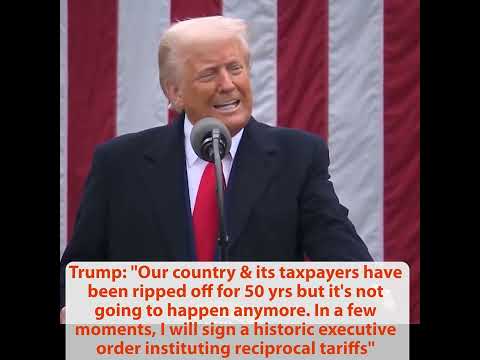
The bottom line: “Our country and its taxpayers have been ripped off for more than 50 years. But it is not going to happen anymore.”
The Executive Order: “Reciprocal”
Trump described the order in the simplest possible terms.
“In a few moments, I will sign a historic executive order instituting reciprocal tariffs on countries throughout the world,” he said. “Reciprocal. That means they do it to us, and we do it to them. Very simple. Can’t get any simpler than that.”
The word “reciprocal” was the moral foundation of the entire policy. Trump was not asking for advantageous terms; he was asking for equal terms. If Canada charged 300% on American dairy, America would respond in kind. If Australia banned American beef, America would impose equivalent barriers on Australian beef. The principle was fairness, not protectionism.
The Trade Abuse Catalog
Trump provided specific examples that made the abstract policy concrete.
Canada: “Canada, by the way, imposes a 250 to 300 percent tariff on many of our dairy products. They do the first can of milk, the first little carton of milk at a very low price. But after that it gets bad, and then it gets up to 275 to 300 percent.”
He exposed how the averages hid the reality: “So when they are figuring what is Canada charging, they say, ‘Oh, about 2 percent, 3 percent.’ But take a look at what happens down the road when you look a little bit. It’s not a pretty picture.”
Trump cited the subsidies: “In the case of Mexico, it’s $300 billion a year. In the case of Canada, it’s close to $200 billion a year. And I say, why are we doing this?”
European Union: “Through non-tariff barriers, the European Union bans imports of most American poultry. You understand? They say, ‘We want to send you our cars. We want to send you everything. But we’re not going to take anything that you have.’”
Australia: “Australia bans American beef, yet we imported $3 billion of Australian beef from them just last year alone. They won’t take any of our beef. They don’t want it because they don’t want it to affect their farmers.”
Trump offered a remarkably fair assessment: “And you know what? I don’t blame them. But we’re doing the same thing right now — starting about midnight tonight, I would say.”
The “I don’t blame them” was consistent with Trump’s broader argument. Foreign nations had acted rationally by protecting their industries and exploiting American openness. The fault lay with the American presidents who had accepted asymmetric arrangements for decades.
The Historical Argument
Trump placed the tariff policy in the longest possible historical context.
“From 1789 to 1913, we were a tariff-backed nation, and the United States was proportionally the wealthiest it has ever been,” he said. “Then in 1913, for reasons unknown to mankind, they established the income tax.”
The historical argument was that America’s greatest period of wealth creation — from the founding through the Gilded Age — had been powered by tariff revenue rather than income taxes. The nation that had built the transcontinental railroad, industrialized at a pace that astonished the world, and attracted millions of immigrants with the promise of economic opportunity had done so under a tariff-funded government. The income tax, established by the 16th Amendment in 1913, marked the beginning of a shift from tariff-based to tax-based federal revenue — a shift that, in Trump’s telling, had gradually impoverished the country.
Key Takeaways
- Trump signed the Liberation Day reciprocal tariff EO from the Rose Garden: “April 2, 2025, will forever be remembered as the day American industry was reborn.”
- A UAW representative with 20 union members declared: “We support Donald Trump’s policies on tariffs 100 percent.”
- Trade abuses cited: Canada 250-300% on dairy, EU bans American poultry, Australia bans American beef while exporting $3B to the U.S.
- Trump’s historical argument: “From 1789 to 1913, we were tariff-backed and proportionally the wealthiest ever. Then they established the income tax.”
- On foreign abuses: “I don’t blame them. But we’re doing the same thing right now — starting about midnight tonight.”