 HYGO News
 "True story": 'Biden: Poorest Man in Congress' Newspaper headline, front page, top of the fold
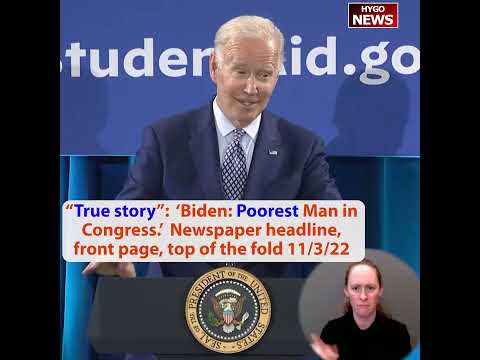
Biden Tells “True Story” About Being Named “Poorest Man in Congress” — a Tale He’s Told Dozens of Times With Varying Details
On 11/3/2022, President Biden traveled to Albuquerque, New Mexico to rally young voters on student debt relief ahead of the midterms. During his remarks, Biden told one of his most frequently recycled personal stories — about his wife calling him to report a newspaper headline: “Biden: Poorest Man in Congress.” He prefaced the anecdote with “true story” and “I shouldn’t say this, but I’m going to tell you anyway,” then delivered the tale with practiced timing about calling his wife from Vermont while campaigning for Pat Leahy, her reading the headline from the Wilmington paper — “front page, top of the fold” — and his punchline: “I didn’t think you were supposed to make money when you’re in Congress.”
The “Poorest Man” Story
Biden set up the anecdote by connecting it to his son Beau’s student debt. “My son, Beau Biden — he went to two universities. He went to the University of Pennsylvania and Syracuse Law School. He ended up with a debt, because I had the dubious distinction of being listed as the ‘poorest man in Congress,’” Biden said.
He then launched into the full narrative. “I got a call when — you know, when I’d be away campaigning for somebody, I’d call my wife in the morning before she took off to school, see how things were,” Biden said. “And I called her one morning, and I was up in the state of Vermont campaigning for Pat Leahy.”
“And I said, ‘Hi, honey. How are you?’ She said, ‘Fine.’ Well, you know, that’s a good start,” Biden said, drawing laughter. “And she said, ‘Did you read today’s paper?’ True story. ‘Did you read today’s paper?’ — meaning the local Wilmington paper — Wilmington, Delaware.”
“I said, ‘No, honey. I didn’t see it.’ She said, ‘Headline, front page, top of the fold: Biden: Poorest Man in Congress. Is that true?’” Biden continued.
“Well, I didn’t think you were supposed to make money when you’re in Congress,” Biden delivered as the punchline. “But I didn’t feel poor. No, no.”
A Story Told Dozens of Times
The “poorest man in Congress” story was one of Biden’s most frequently deployed personal anecdotes — appearing in speeches, interviews, debates, and campaign events across multiple decades. Like his “I married up” line, his sister’s age joke, and his “not a joke” emphasis, the poorest man story had become part of Biden’s standard rotation of pre-loaded narratives that he inserted into speeches regardless of the specific topic or venue.
The story served multiple rhetorical purposes simultaneously. It established Biden’s working-class credentials (he wasn’t wealthy). It differentiated him from politicians who enriched themselves through public service (he “didn’t think you were supposed to make money”). It humanized him through the domestic scene of calling his wife. And it provided humor through the wife’s reaction and the self-deprecating punchline.
But the frequency of the telling — with “true story” as the introducer — raised the question of whether the story’s details were themselves embellished through decades of retelling. Biden’s personal narratives had a documented history of evolving over time, with details added, locations changed, and contexts shifted to fit different audiences.
The Financial Record
Biden’s claim of being the “poorest man in Congress” was based on financial disclosure data that did show him among the least wealthy senators for most of his 36-year tenure. His Senate salary was his primary income, and he did not accumulate significant wealth during his time in Congress — a distinction from many colleagues who entered or left the Senate with substantial personal fortunes.
However, Biden’s financial picture changed dramatically after leaving the vice presidency in 2017. Between 2017 and 2019, Biden and Jill Biden earned more than $15 million — primarily from book deals and speaking fees, plus his compensation from the University of Pennsylvania ($900,000 for an honorary professorship where he never taught a class).
The Bidens purchased a $2.7 million vacation home in Rehoboth Beach, Delaware in 2017 and already owned a home in the Wilmington suburbs valued at over $1 million. By the time Biden ran for president in 2020, his net worth was estimated at approximately $8 million — far from poor by any standard, though modest by presidential candidate norms.
The “poorest man in Congress” narrative worked because it referenced a period that had ended years earlier. Biden was no longer the relatively modest senator he described; he was a multimillionaire former vice president. But the story’s rhetorical power depended on the listener associating Biden with the humble past rather than the affluent present.
The Student Debt Connection
Biden used the “poorest man” story to connect with the student loan forgiveness audience. By framing Beau Biden’s student debt as a consequence of the family’s modest finances, Biden positioned himself as someone who personally understood the burden of educational debt.
“He ended up with a debt, because I had the dubious distinction of being listed as the ‘poorest man in Congress,’” Biden said — implying that Beau’s student loans were necessary because the family couldn’t afford to pay tuition out of pocket.
The connection between Biden’s congressional salary and his son’s need for student loans was plausible but incomplete. Biden’s Senate salary — roughly $174,000 in his later years — placed him in the top 5% of American earners. While this was modest by Senate standards, it was substantially above the median household income. Many families earning far less than a senator’s salary found ways to fund education without the debt levels Biden described.
”I Got Elected When I Was 29”
Biden added biographical context. “By the way, I got elected when I was 29. I had no income. I mean, I had a little. I was just starting my law practice,” Biden said. “But I had a good salary as a senator. I thought that was just fine.”
The reference to his age at election — Biden was elected to the Senate in 1972 at age 29, turning 30 before he was sworn in — was another standard Biden biographical detail that appeared in most of his speeches. The early election age, combined with his modest financial background, created a narrative of a young man who entered public service before accumulating wealth and chose to serve rather than enrich himself.
The “I thought that was just fine” closer was the humility punchline — a senator’s salary was enough, he didn’t need more, money wasn’t why he was in politics. The sentiment may have been genuine during his Senate years, but it contrasted with the $15 million in post-vice-presidential earnings that suggested the financial modesty was situational rather than philosophical.
The “True Story” Qualifier
Biden’s use of “true story” as a preface had become, like “not a joke,” a verbal tic that appeared so frequently it had lost its authenticating function. If Biden felt the need to assure audiences that a story was true, it invited the question of why that assurance was necessary. Politicians who told straightforwardly true stories didn’t typically feel compelled to label them as such.
The “true story” qualifier appeared in Biden’s speeches dozens of times per month — attached to stories that ranged from verifiable (he was indeed listed among the least wealthy senators) to questionable (his claims about civil rights marching, his law school record, and his athletic career). The blanket use of “true story” for both accurate and embellished anecdotes diluted its credibility for all of them.
Key Takeaways
- Biden told his frequently recycled “poorest man in Congress” story — one of a small rotation of personal anecdotes he deployed across decades of speeches.
- He prefaced it with “true story” — a verbal qualifier he used so often it had lost its authenticating function.
- Biden was indeed among the least wealthy senators during his 36-year tenure, but earned over $15 million after leaving the vice presidency.
- He used the story to connect with student loan borrowers, framing Beau’s educational debt as a consequence of the family’s modest congressional income.
- The story’s power depended on associating Biden with his past modesty rather than his present multimillionaire status.
Transcript Highlights
The following is transcribed from the video audio (unverified — AI-generated from audio).
- I had the dubious distinction of being listed as the poorest man in Congress.
- I shouldn’t say this, but I’m going to tell you anyway.
- I called her one morning. I was up in Vermont campaigning for Pat Leahy. She said, did you read today’s paper?
- Headline, front page, top of the fold: Biden, poorest man in Congress. Is that true?
- I didn’t think you were supposed to make money when you were in Congress.
- I didn’t feel poor. No, no.
Full transcript: 159 words transcribed via Whisper AI.