 HYGO News
 Trump Surprises Xhaferi Family for Make-A-Wish: 'Can I Give Him a Little Coin? Don't Lose It, Bud'; RFK Urges Nations to Leave WHO: 'Straitjacket of Pharma Influence'; Interior Sec Burgum: 'Turn Clock Back on 50 Years of Over-Regulation'; 'AI Arms Race with China'
Trump Surprises Xhaferi Family for Make-A-Wish: “Can I Give Him a Little Coin? Don’t Lose It, Bud”; RFK Urges Nations to Leave WHO: “Straitjacket of Pharma Influence”; Interior Sec Burgum: “Turn Clock Back on 50 Years of Over-Regulation”; “AI Arms Race with China”
Three May 2025 stories captured Trump administration priorities. In a touching Make-A-Wish Foundation moment, President Trump met the Xhaferi family and gave the young son a presidential coin: “Can I give him a little coin? Don’t lose it, bud.” HHS Secretary Robert F. Kennedy Jr. urged other nations to join the United States in leaving the World Health Organization: “I urge the world’s health ministers and the WHO to take our withdrawal as a wake-up call. It isn’t that President Trump and I have lost interest in international cooperation — we just want it to happen in a way that’s fair and efficient and transparent. We want international health cooperation free from the straitjacket of political interference by corrupting influences of pharmaceutical companies of adversarial nations and their NGO proxies.” Interior Secretary Doug Burgum on the nuclear executive orders: “This is a huge day for the nuclear industry. This is going to turn the clock back on over 50 years of over-regulation of the industry… We need enough electricity to win the AI arms race with China. What we do in the next five years related to electricity is going to determine the next 50.”
The Xhaferi Family Moment
The Make-A-Wish Foundation interaction was documented briefly but movingly.
The mother introduced her daughter: “This is my daughter, Ella.”
Trump engaged warmly: “Oh, you love your brother, right?”
The response confirmed: “Yes, very much. He’s the best.”
Trump offered a gift: “Can I give him a little coin?”
The mother agreed: “Yep, he would love that. Thank you.”
Trump presented the coin: “Okay, what? Why do you see this? Oh, wow.”
The mother: “That’s a really special coin.”
Trump’s final instruction: “Don’t lose it, bud.”
The Make-A-Wish Foundation had been granting wishes to seriously ill children for over 40 years. Meetings with the President of the United States were among the most requested experiences. Trump’s warm engagement with the Xhaferi family — presumably including a child facing serious illness — reflected the tradition of presidential participation in such events.
The “presidential coin” was a specific artifact. Military challenge coins had been a longstanding American military tradition, with various units issuing coins that service members kept and exchanged. Presidents had developed their own variations, often featuring the presidential seal. Trump’s coin featured his name prominently in the design Trump had used during his first term.
The coin gift was more than a token. For a seriously ill child, receiving a presidential coin during a Make-A-Wish visit created a tangible memento of the experience. The “don’t lose it, bud” instruction acknowledged the significance the coin would have for the recipient throughout whatever life remained to him.
The Hygo framing captured the broader significance: “This is what a TRUE Leader looks like.” The contrast with Biden-era interactions (where interactions with disabled or ill Americans had sometimes been awkward) was implicit. Trump’s genuine engagement with the family, combined with the meaningful gift of the coin, reflected authentic leadership in a personal moment.
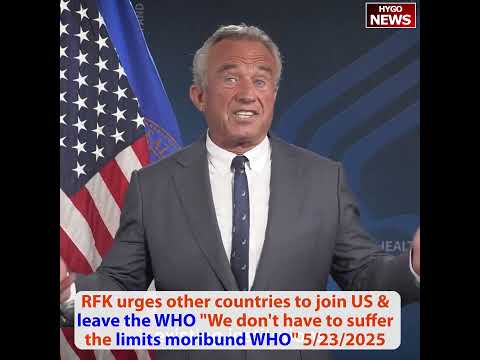
RFK’s WHO Appeal
Kennedy made a substantive international policy statement.
“I urge the world’s health ministers and the WHO to take our withdrawal from the organization as a wake-up call,” Kennedy said.
He stated the framing: “It isn’t that President Trump and I have lost interest in international cooperation, not at all.”
He described the American preference: “We just want it to happen in a way that’s fair and efficient and transparent for all the member states.”
He cited existing coordination: “We’ve already been in contact with like-minded countries, and we encourage others to consider joining us.”
He laid out the critique: “We want a free international health cooperation from the straight jacket of political interference by corrupting influences of the pharmaceutical companies of adversarial nations and their NGO proxies."
"Corrupting Influences”
The “corrupting influences” framing was specific and significant. Kennedy was alleging that the WHO had been captured by:
Pharmaceutical companies: Major pharmaceutical manufacturers had substantial influence over WHO through:
- Direct funding (Bill Gates’ foundation being a major donor)
- Technical advisory relationships
- Revolving door between industry and WHO positions
- Industry influence over WHO research priorities
- Industry relationships with national health delegations
Adversarial nations: Countries whose interests diverged from American values had substantial WHO influence:
- China’s increasing influence over WHO leadership
- Chinese coordination with WHO during COVID origins investigation
- Russia’s continued WHO membership despite various violations
- Other authoritarian states shaping WHO priorities
NGO proxies: Non-governmental organizations that appeared independent but operated as proxies for specific interests:
- Foundations funded by pharmaceutical companies
- NGOs with financial ties to Chinese government or Chinese companies
- Advocacy organizations pursuing specific political agendas through health framing
- Research institutions dependent on industry funding
Each of these influences had distorted WHO decision-making during the COVID pandemic. The WHO had initially echoed Chinese talking points about COVID origins, had downplayed evidence of human-to-human transmission, had been slow to call a pandemic, and had generally functioned more as a political organization than as an independent public health authority.
”New Era of Cooperation”
Kennedy issued an invitation to other countries.
“I would like to take this opportunity to invite my fellow health ministers around the world into a new era of cooperation,” Kennedy said.
He stated the affirmative vision: “We don’t have to suffer the limits of a more abundant WHO.”
He proposed alternatives: “Let’s create new institutions or revisit existing institutions that are lean, efficient, transparent, and accountable.”
He described the scope: “Whether it’s an emergency outbreak of an infectious disease or the pervasive rot of chronic conditions that have been overtaking not just America but the whole world, we’re ready to work with you.”
He closed with religious reference: “Thank you, and may God bless you, and let’s all pray for the health of our children and our grandchildren.”
Kennedy’s invitation was substantive rather than merely rhetorical. The Trump administration had been developing alternative international health cooperation mechanisms. Potential approaches included:
Bilateral agreements: Direct country-to-country cooperation on specific health issues, bypassing multilateral WHO mechanisms.
Regional arrangements: Geographic groupings (Americas, Pacific, Atlantic) that could pursue common health interests without global WHO bureaucracy.
Issue-specific coalitions: Groupings of countries sharing specific concerns (chronic disease, food safety, environmental health) rather than comprehensive health governance.
Alternative multilateral institution: A new global health body with cleaner governance, transparency requirements, and lean operations.
Hybrid approach: Combinations of the above, with different mechanisms for different types of health cooperation.
The “pervasive rot of chronic conditions” framing extended MAHA’s domestic concerns to international public health. Chronic disease was not uniquely American; obesity, diabetes, cardiovascular disease, autoimmune conditions, and mental health problems were increasing globally. Countries that shared concern about these trends could cooperate without going through the WHO’s politicized structure.
Burgum: “Huge Day for the Nuclear Industry”
Interior Secretary Doug Burgum introduced the nuclear executive orders.
“Thank you, President Trump. This is a huge day for the nuclear industry,” Burgum said. “Mark this day on your calendar.”
He made the historical claim: “This is going to turn the clock back on over 50 years of over-regulation of the industry.”
He described the American history: “American Greatness has always come from innovation, and we were very innovative. We led post-World War II in all things nuclear, but then we’ve been stagnated. We’ve choked it with over-regulation.”
The “50 years” reference placed the regulatory ossification at roughly 1975, shortly after the 1973 oil crisis and in the same era as Three Mile Island (1979). This framed nuclear regulation as a specific ideological-political choice rather than technical necessity.
The post-WWII American nuclear leadership Burgum referenced was substantial. From 1945 through the 1970s, American nuclear technology had been globally dominant. The United States had:
- Pioneered commercial nuclear reactors
- Built the world’s first nuclear-powered submarine
- Developed reactor designs used worldwide
- Led uranium enrichment technology
- Coordinated international nuclear peaceful applications
This leadership had eroded over subsequent decades. By 2025:
- France led Europe in nuclear deployment
- South Korea had become a major nuclear exporter
- Russia dominated international reactor sales
- China was building more reactors than the rest of the world combined
- American new construction had effectively halted
The Executive Orders Sequence
Burgum described the overall package: “Today, Will is going to walk us through a series of four executive orders. Each of these help attack separate issues that have held back this industry.”
He noted the industry presence: “And with us today, we’ve got a number of CEOs from the industry, representing some of our largest nuclear providers.”
He described the capital shift: “But also a big change. This is a time when capital and competition has finally come to this industry. We’ve got venture capital, we’ve got startups coming into all aspects of small-modern nuclear.”
The venture capital and startup wave in nuclear was recent and significant. For decades, nuclear had been dominated by a few large utilities and established suppliers (Westinghouse, GE, AREVA). The capital requirements had been prohibitive for new entrants, and regulatory complexity had deterred venture investment.
By 2025, this had changed dramatically. Multiple nuclear startups had attracted substantial venture capital:
- X-energy (high-temperature gas-cooled reactors)
- Oklo (liquid metal-cooled reactors)
- Kairos Power (fluoride salt-cooled reactors)
- TerraPower (Natrium sodium-cooled reactors with molten salt energy storage)
- Commonwealth Fusion Systems (fusion)
- Helion Energy (fusion)
- Various SMR developers
The combination of:
- Climate policy concerns making carbon-free baseload power valuable
- AI data center demand requiring gigawatts of reliable power
- Grid stability concerns as renewables increased
- National security concerns about Russian and Chinese nuclear dominance
had made nuclear investable in ways it had not been for decades.
”AI Arms Race with China”
Burgum framed the strategic stakes.
“This has impacts on national security, on our defense, and again, President Trump here today has committed to energy dominance,” Burgum said.
He articulated the connection: “And part of that energy dominance is that we’ve got enough electricity to win the AI arms race with China.”
He stated the generational framing: “What we do in the next five years related to electricity is going to determine the next 50.”
He made the key insight: “Because it’s the first time in history where electricity can be translated into intelligence, and we need that intelligence for every aspect of our economy, but also for defense.”
The “electricity translated into intelligence” framing was crucial to understanding why AI was reshaping energy politics. Traditional industrial uses of electricity required relatively fixed amounts of power for specific processes. AI training, in contrast, could consume essentially unlimited electricity if the models could be scaled.
The implications were:
- Countries with abundant cheap electricity would develop better AI
- Countries with expensive or unreliable electricity would fall behind
- AI capability could determine military effectiveness across multiple domains
- National security would increasingly depend on electricity abundance
China had been building approximately 100 GW of new power generation per year for years, much of it coal but also substantial nuclear. The United States had been building far less, with regulatory and political barriers to large-scale new generation. If this continued, China’s electricity advantage would translate into AI advantage, and then into military and economic advantage.
The Trump nuclear executive orders addressed this directly. Small Modular Reactors could be deployed at AI data centers rapidly, providing dedicated reliable power without requiring new grid infrastructure. This would allow American AI development to scale electricity supply alongside computational requirements.
The Hegseth Connection
Burgum connected the nuclear initiative to defense needs.
“Pete Hegseth in the Department of Defense has been a key part of this,” Burgum said.
He described the defense applications: “This is going to help us make sure that we’re providing the defense we need, where we need that AI and the electricity, but also to secure our bases here at home and around the world.”
Defense Department AI needs were significant and growing:
- Autonomous systems requiring sophisticated AI
- Intelligence analysis requiring machine learning at scale
- Logistics optimization requiring continuous computation
- Cybersecurity requiring AI-based defense
- Command and control requiring real-time AI support
Military base power requirements had also been increasing. Traditional commercial power grids were vulnerable to both physical attack and cyber disruption. Dedicated nuclear power at critical military installations would provide:
- Reliable power independent of grid conditions
- Immunity to commercial power outages
- Security from external cyber attacks on power infrastructure
- Reduced fuel convoy requirements in conflict zones
- Long-term operational independence
SMRs deployed at American bases globally would fundamentally transform military logistics and resilience. Rather than depending on vulnerable power supplies, critical installations would have their own continuous power generation.
Key Takeaways
- Trump’s Make-A-Wish moment with Xhaferi family: “Can I give him a little coin? Don’t lose it, bud.”
- RFK on WHO: “Take our withdrawal as a wake-up call. Straitjacket of pharma, adversarial nations, NGO proxies.”
- RFK invites other countries to “new era of cooperation” outside WHO framework.
- Burgum: “Huge day for nuclear industry. Turn clock back on 50 years of over-regulation.”
- Strategic stakes: “AI arms race with China. Next 5 years of electricity determine the next 50. Electricity translated into intelligence.”