 HYGO News
 Top Biden Econ Advisor Jared Bernstein Squirms When Confronted With Biden's Own Words On Debt Limit
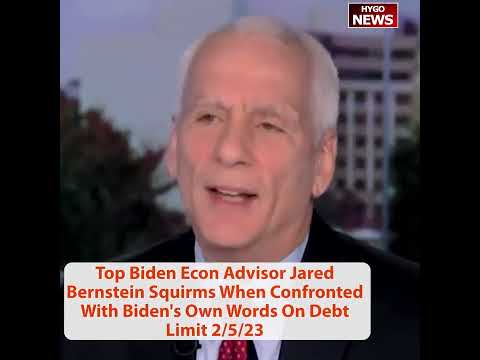
Interviewer Reads Senator Biden’s 2006 Anti-Debt Vote Speech — Bernstein Squirms On Biden’s Own Words
In February 2023, an interviewer confronted Council of Economic Advisers member Jared Bernstein with Senator Joe Biden’s own 2006 words explaining why he voted against raising the debt ceiling. The interviewer set up the trap: “Here’s one member explaining his intention to vote no on raising the debt ceiling. Because this massive accumulation of debt was predicted because it was foreseeable, because it was unnecessary, because it was the result of willful and reckless disregard for the warnings that were given and for the fundamentals of economic management. So I don’t know who that lawmaker is.” Bernstein said he didn’t know. The interviewer revealed: “Well, let me tell you, it was President Joe Biden… Back in 2006.” Bernstein responded: “Oh, okay. So look. But does he have a point? Because Republicans say that’s their position now.” Bernstein tried to distinguish: “No, the Republicans’ position is that they are threatening to default in order to get what they want. And the debt ceiling should never be used as that kind of a threat. Is just antithetical to anything that President stands for.” When pressed on whether Biden was doing that in 2006, Bernstein deflected: “In 2006, do you remember a debt ceiling debate that was anywhere close to as heated as this one?”
The Interviewer’s Trap
Trap:
Quote — Read first.
Lawmaker unnamed — Initially.
Bernstein reaction — Assessed.
Revelation delayed — Effective.
Professional technique — Classic.
The interviewer’s trap was classic professional technique. Reading quote first without naming author allowed Bernstein’s reaction to be genuine. Revealing Biden was source made point that Biden once held opposite position.
Biden’s 2006 Rhetoric
Biden’s words:
“Massive accumulation” — Strong.
“Willful and reckless” — Characterization.
“Disregard for warnings” — Attack.
“Fundamentals of economic management” — Principle.
Against raising — Explicit.
Senator Biden’s 2006 words were substantive attack on debt accumulation and those responsible. “Willful and reckless disregard for warnings” was strong characterization. His vote against raising ceiling was explicit position based on these concerns.
The “Willful and Reckless” Framing
Framing:
Moral characterization — Strong.
Intentional — Irresponsibility.
Accountability — Through vote.
Position — Clear.
Political — Message.
Biden’s “willful and reckless” framing was strong moral characterization of debt accumulation as intentional irresponsibility. Accountability was sought through vote against raising. Position was clear and political message was delivered.
The Current Biden Position Contradiction
Contradiction:
2006 — Voted no.
Now — Demands clean raise.
Framework shift — Complete.
Rhetoric opposite — Of past.
Hypocrisy claim — Real.
The contradiction with current Biden position was stark. In 2006 he voted no on debt ceiling raise while giving speech about reckless debt accumulation. Now as president he demanded clean raise with no discussion. Framework was completely shifted.
”I Don’t Know Who That Lawmaker Is”
Bernstein response:
Genuine ignorance — Perhaps.
Feigned — Possible.
Awkward moment — Created.
Setup for reveal — Worked.
Squirm beginning — Visible.
Bernstein’s “I don’t know who that lawmaker is” response was likely genuine momentarily. Revealing Biden as author created awkward moment. Setup for trap worked. Squirm from political confrontation began.
”Oh, Okay”
The reaction:
“Oh, okay” — Deflated.
Small response — To big reveal.
Processing — Visible.
Retreat — Defensive.
Political awkwardness — Peak.
Bernstein’s “Oh, okay” response was deflated acknowledgment of the reveal. Small response to big revelation. Processing what had just been revealed. Political awkwardness was at peak moment.
”Does He Have a Point”
The challenge:
Direct — Question.
“A point” — Admission.
Republicans’ position — Parallel.
Present parallel — Made.
Accountability — Demanded.
The interviewer’s “does he have a point” was direct challenge. Asking Bernstein to acknowledge Biden’s 2006 point had merit — implicitly acknowledging Republicans’ current parallel position also had merit. Accountability was demanded.
”Threatening to Default”
Bernstein distinction:
Republicans threatening — Claim.
Biden 2006 — Different?
Distinction attempted — Weak.
Logical problem — Evident.
Spin — Visible.
Bernstein’s attempted distinction was that Republicans were “threatening to default” while Biden in 2006 was doing something different. But Biden had also voted against raising debt ceiling — creating same default possibility. Distinction was weak.
”Never Be Used As Threat”
The principle:
Debt ceiling principle — Stated.
Current Biden — Position.
2006 Biden — Did the same.
Principle contradiction — Clear.
Argument weakness — Visible.
“The debt ceiling should never be used as that kind of a threat” principle was Bernstein’s argument. But 2006 Biden voting no was precisely using debt ceiling as political statement. Principle contradiction was clear.
”Antithetical to Anything President Stands For”
Claim:
“Antithetical” — Strong.
“Anything he stands for” — Absolute.
But 2006 — Contradicts.
Position evolution — Unacknowledged.
Integrity — Questioned.
Bernstein’s “antithetical to anything the President stands for” claim was strong but contradicted by 2006 Biden’s own actions. Position evolution was unacknowledged. Integrity of claim was questioned by historical record.
”Was That What Biden Was Doing in 2006”
The follow-up:
Direct parallel — Drawn.
Force acknowledgment — Sought.
Consistency — Challenged.
Response required — Substantive.
Pressure maintained — Professional.
The interviewer’s direct parallel between Biden’s 2006 actions and current Republican position forced acknowledgment. Consistency of Bernstein’s argument was challenged. Pressure maintained professionally.
”2004” “Let Me Make This Point”
Bernstein stumbling:
Date confusion — 2006 vs. 2004.
Recovery — Attempted.
“Let me make this point” — Reset.
Squirm visible — In response.
Awkward — Moment.
Bernstein’s date confusion between 2006 and 2004, recovery attempt, and “let me make this point” reset all showed visible squirming. Awkward moment captured on video. Under pressure performance.
”Do You Remember a Debate This Heated”
The deflection:
Heat level — Different.
Then vs. now — Distinction.
Context — Different.
Principle — Still same.
Deflection — Weak.
Bernstein’s “do you remember a debt ceiling debate that was anywhere close to as heated as this one” was deflection attempt. Heat level was different but principle was same. Biden voted no; the vote existed; no amount of current heat changed the record.
The 2006 Context Actual
2006 context:
Iraq war — Costs.
Bush tax cuts — Deficit impact.
Debt accumulation — Real.
Biden vote — Against ceiling.
Speech delivered — Critical.
The actual 2006 context was Bush administration with Iraq war costs, Bush tax cuts, real debt accumulation. Biden voted against raising debt ceiling while giving critical speech. Historical record was clear.
The Political Posture Evolution
Evolution:
Opposition position — 2006.
Executive position — 2023.
Framework different — Yes.
Principle — Same.
Convenient — Evolution.
Biden’s political posture evolution from opposition position (2006) to executive position (2023) showed typical convenient principle evolution. Framework was different (senator vs. president) but principle about debt ceiling use remained same ideologically.
Jared Bernstein the Role
Bernstein:
CEA member — Appointed.
Progressive economist — Known.
Administration spokesperson — Role.
Economic messaging — Function.
Professional — Track record.
Jared Bernstein was Council of Economic Advisers member, known progressive economist, administration spokesperson, economic messaging function. Professional track record with generally respected analysis.
The “Squirms” Title Characterization
Title:
“Squirms” — Characterization.
Physical reaction — Implied.
Video visible — Element.
Partisan framing — Perhaps.
But — Pressure evident.
“Squirms” title characterization referred to Bernstein’s visible physical reaction. Video element made this visible. Partisan framing element perhaps, but pressure was evidently real in captured moments.
The Republican Use of This Material
Political use:
Campaign ads — Possible.
Social media — Sharing.
Partisan amplification — Expected.
Fact basis — Real.
Political weapon — Created.
The Republican use of this material through campaign ads, social media sharing, partisan amplification was expected. Fact basis was real — Biden’s 2006 vote and speech existed. Political weapon was created through the revelation.
The Hypocrisy Charge
Hypocrisy:
Previous position — Against.
Current position — For clean raise.
Rationale shift — Complete.
Convenience — Evident.
Charge — Stands.
The hypocrisy charge was substantively grounded. Previous position (against raising) contradicted current position (for clean raise with no negotiation). Rationale shift was complete. Convenience was evident. Charge stood on historical record.
The Democratic Evolution Pattern
Pattern:
Obama 2006 — Also voted no.
Senate Democrats — Similar pattern.
Party position — Shifts with power.
Standard — Political behavior.
Not unique — To Biden.
Democratic evolution pattern wasn’t unique to Biden. Obama in 2006 also voted no on debt ceiling raise. Many Senate Democrats followed similar pattern. Party position shifted with power — out of power voted no, in power demanded clean raise. Standard political behavior.
The Republican Parallel Position
Parallel:
Current GOP — Uses ceiling.
Past Democrats — Did same.
Symmetric behavior — Over time.
Standard bipartisan — Hypocrisy.
Political theater — Recurring.
The Republican parallel position now mirrored past Democratic behavior. Current GOP uses debt ceiling for leverage as past Democrats did. Symmetric behavior over time showed standard bipartisan hypocrisy. Political theater recurring.
The Interview Format Value
Format:
One-on-one — Intimate.
Evidence showing — Direct.
Pressure application — Focused.
Response capture — Good video.
Accountability — Achieved.
The interview format allowed intimate one-on-one engagement with direct evidence showing, focused pressure application, good video response capture. Accountability was achieved through format’s affordances.
The Administration Response Challenges
Challenges:
Historical record — Can’t change.
Biden’s own words — Used.
Counter-argument — Weak.
Credibility cost — Real.
Pattern — Continuing.
The administration response challenges were substantial. Historical record couldn’t be changed. Biden’s own words were used against current position. Counter-arguments were weak. Credibility cost was real. Pattern of these confrontations continuing.
The Debt Ceiling Inconsistency Pattern
Inconsistency:
Both parties — Have done it.
Opposition — Uses ceiling.
Governing — Demands clean.
Rhetoric — Changes with position.
Principle — Partial.
The debt ceiling inconsistency pattern was bipartisan. Both parties when in opposition used ceiling; when governing demanded clean raise. Rhetoric changed with position. Principle was partial rather than consistent. This was well-established political dynamic.
The 2011 Context Relevant
2011:
Obama — Negotiated.
Bad outcome — Sequester.
Democratic learning — Applied.
Current strategy — Derived.
Memory — Influential.
The 2011 context was relevant to current Democratic strategy. Obama’s negotiation led to problematic sequester outcomes. Democratic learning from that experience drove current no-negotiation strategy. Memory was influential.
The 2023 Resolution Context
2023 context:
Brinksmanship — Ongoing.
Eventually negotiated — June.
Fiscal Responsibility Act — Result.
Compromise — Made.
Irony — Present.
2023 resolution context would involve brinksmanship continuing through June then negotiation producing Fiscal Responsibility Act. Compromise was made. Irony of earlier no-negotiation stance was present in retrospect.
The Press Accountability Function
Function:
Archive research — Deep.
Historical quotes — Retrieved.
Current position — Contrasted.
Hypocrisy exposed — Through research.
Quality journalism — Displayed.
The press accountability function through deep archive research, historical quote retrieval, current position contrast, hypocrisy exposure through research demonstrated quality journalism. This was substantive accountability work.
The Long-Term Political Lessons
Lessons:
Positions shift — With power.
Historical record — Matters.
Video evidence — Lasts.
Consistency claims — Risky.
Accountability — Persistent.
Long-term political lessons from exchanges like this included positions shifting with power being exposed through historical record, video evidence lasting, consistency claims being risky when contradicted by past positions, persistent accountability through documentation.
Key Takeaways
- An interviewer read Senator Biden’s 2006 speech attacking debt accumulation as “willful and reckless disregard” then revealed Biden as the author.
- Bernstein’s reaction: “Oh, okay.” He had initially said “I don’t know who that lawmaker is.”
- The interviewer asked: “Does he have a point? Because Republicans say that’s their position now.”
- Bernstein tried to distinguish: “The Republicans’ position is that they are threatening to default in order to get what they want.”
- He claimed: “The debt ceiling should never be used as that kind of a threat. Is just antithetical to anything that President stands for.”
- When pressed on 2006 parallel, Bernstein deflected: “In 2006, do you remember a debt ceiling debate that was anywhere close to as heated as this one?”
Transcript Highlights
The following is transcribed from the video audio (unverified — AI-generated from audio).
- Here’s one member explaining his intention to vote no on raising the debt ceiling. Because this massive accumulation of debt was predicted because it was foreseeable, because it was unnecessary, because it was the result of willful and reckless disregard for the warnings that were given and for the fundamentals of economic management.
- So I don’t know who that lawmaker is. Well, let me tell you, it was President Joe Biden.
- Oh, okay. Back in 2006. So look. But does he have a point? Because Republicans say that’s their position now.
- No, the Republicans’ position is that they are threatening to default in order to get what they want. And the debt ceiling should never be used as that kind of a threat.
- Is just antithetical to anything that President stands for.
- In 2006, do you remember a debt ceiling debate that was anywhere close to as heated as this one?
Full transcript: 185 words transcribed via Whisper AI.