 HYGO News
 TikTok: Last Month vs Now, What Changed?
By HYGO News
Published
· Updated
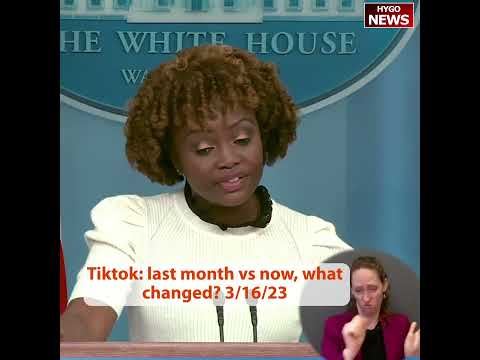
TikTok: Last Month vs Now, What Changed?
A reporter pressed White House Press Secretary Karine Jean-Pierre at a March 2023 briefing to explain why the Biden administration’s TikTok stance appeared to have hardened from President Biden’s earlier uncertainty about a ban to the current warning of a potential prohibition. The journalist also asked about Beijing’s claim that Washington had not presented evidence of national security harm, framing the question around whether the U.S. was targeting foreign companies without substantive proof.
The Shifting Position
- Last month’s framing: Biden had publicly said he “wasn’t sure” whether the U.S. should ban TikTok when pressed a month before the briefing.
- New posture: The administration had since backed the RESTRICT Act and reportedly pushed ByteDance to divest or face a ban.
- Reporter’s point: The public shift from uncertainty to aggressive posture demanded explanation.
- KJP’s answer: Jean-Pierre offered no specifics on what intelligence or analysis had driven the shift.
- Bottom-line framing: She simply said when it comes to “potential threats” the administration “will speak out.”
The RESTRICT Act Context
- Sponsors: Sens. Mark Warner (D-Va.) and John Thune (R-S.D.) led the bipartisan RESTRICT Act effort.
- Broader scope: The legislation would authorize the Commerce Department to take action on any foreign-controlled technology posing security risks.
- Process requirements: The bill established procedural requirements for any ban to survive legal challenge.
- Administration endorsement: The White House formally backed the legislation days before this briefing.
- Legal exposure: Without legislative authorization, any TikTok ban would face elevated risk of being struck down in court.
KJP’s Non-Answer
- Bottom line frame: Jean-Pierre used “the bottom line is” to package a general statement as the answer.
- Triple refrain: She cited “national security,” “safety,” and “privacy” as three-pillar framing.
- Speak-out commitment: The press secretary committed only to “speak out” on threats, not to specific actions.
- No change explanation: She offered nothing about what specifically changed between Biden’s uncertainty and the new stance.
- Evidence question deflected: When asked about China’s demand for evidence, KJP pointed to the CFIUS (“Saphirs”) review process.
China’s Evidence Challenge
- Beijing’s claim: Chinese officials said the U.S. had not presented evidence of national security threats.
- Suppression framing: China argued the U.S. action was “simply about suppressing foreign companies.”
- Evidence burden: The U.S. had not publicly documented specific instances of TikTok harm to American security.
- Classified intelligence: Officials suggested classified assessments existed but could not be discussed publicly.
- Theoretical vs. actual: Much of the public case rested on what could happen rather than what has happened.
The CFIUS Review Framing
- Committee role: The Committee on Foreign Investment in the United States had been reviewing TikTok for years.
- Confidentiality: CFIUS deliberations are statutorily confidential, preventing public disclosure of specifics.
- Negotiation leverage: The ongoing review created pressure on ByteDance to propose concessions.
- Project Texas: TikTok had offered to house U.S. data with Oracle under monitored access.
- Divestiture demand: Reports indicated the administration was demanding ByteDance divest TikTok or face a ban.
What Potentially Changed
- NSA Director comments: Gen. Paul Nakasone’s “loaded gun” characterization days before the briefing elevated the threat framing.
- Balloon incident: February’s Chinese surveillance balloon had intensified public concern about Chinese surveillance.
- Congressional pressure: Both House and Senate committees had accelerated TikTok-focused hearings.
- Public opinion: Polling showed growing American support for restricting TikTok on national security grounds.
- Project Texas inadequacy: Reported administration conclusions that TikTok’s proposed remedies were insufficient.
The Political Evolution
- State momentum: More than 30 states had imposed their own TikTok device bans in the preceding months.
- Federal device ban: Biden signed legislation banning TikTok on federal government devices in December 2022.
- International alignment: UK, Canadian, EU partners had taken parallel actions against TikTok.
- Bipartisan cover: The RESTRICT Act’s bipartisan sponsors provided political cover for aggressive action.
- 2024 calculus: Election-year concerns about Chinese election interference elevated TikTok as a policy priority.
The Administration’s Dilemma
- Evidence gap: Without publicly presentable evidence, U.S. action looks arbitrary to international observers.
- Classified source protection: Releasing evidence would compromise intelligence sources and methods.
- First Amendment exposure: Banning a platform based on foreign ownership raised constitutional concerns.
- User backlash: 150 million American users represented a massive political constituency to alienate.
- Creator economy: Small businesses and creators reliant on TikTok faced existential economic threat.
ByteDance’s Corporate Structure
- Chinese parent: ByteDance is headquartered in Beijing with Chinese and foreign investors.
- Global operations: TikTok operates globally under various regulatory structures outside Chinese jurisdiction.
- U.S. subsidiary: TikTok’s U.S. operations are technically incorporated in California.
- CCP law exposure: Chinese national intelligence law could theoretically compel ByteDance to cooperate with state intelligence.
- Independence claims: ByteDance maintained TikTok operated independently with data outside China’s legal reach.
Key Takeaways
- Jean-Pierre declined to explain what changed between Biden’s “not sure” position last month and the administration’s hardened ban threat.
- The press secretary relied on general national security, safety, and privacy framing rather than specific new evidence or analysis.
- China’s demand for presented evidence was deflected to the CFIUS review process, which is statutorily confidential.
- The administration endorsed the RESTRICT Act to provide legislative authority for broader action on foreign-owned tech.
- Recent developments including the Chinese balloon incident and congressional pressure had elevated the TikTok threat framing.
- The White House faced a dilemma between classified evidence protection and public demands for specific harm documentation.
Transcript Highlights
The following quotations are drawn from an AI-generated Whisper transcript of the briefing and should be considered unverified pending official transcript release.
- “The bottom line is that when it comes to potential threats to our national security, when it comes to the safety of Americans, when it comes to their privacy, we’re going to speak out.” — Karine Jean-Pierre
- “Last month, the President said he wasn’t sure if the U.S. should ban TikTok when he was asked about this.” — Reporter framing
- “Now the administration seems to be hardening its stance.” — Reporter framing
- “China says that the U.S. hasn’t presented evidence that this threatens U.S. national security.” — Reporter question
- “They say that this is simply about suppressing foreign companies. Is there evidence that the U.S. has that has been presented?” — Reporter follow-up
- “What I can say is that Saphirs has a process that they’re going through.” — Karine Jean-Pierre
Full transcript: 148 words transcribed via Whisper AI.