 HYGO News
 This month Biden said No more drilling; Spox Kirby Defends Easing Oil Sanctions On Venezuela
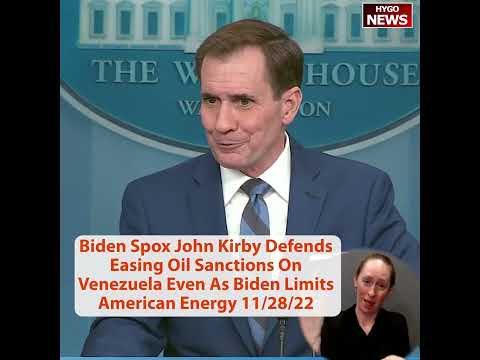
Doocy: Why Would Biden Rather Let U.S. Companies Drill for Oil in Venezuela Than in the U.S.? Kirby Defends Chevron Sanctions Relief
On 11/28/2022, Fox News reporter Peter Doocy confronted NSC Coordinator John Kirby with a devastating contradiction. The Biden administration had just announced sanctions relief allowing Chevron to resume oil production in Venezuela — a country under Nicolás Maduro’s authoritarian rule. But earlier that month, Biden had publicly declared “no more drilling. There is no more drilling” in the United States. Doocy asked the obvious question: “Why is it the President Biden would rather let U.S. companies drill for oil in Venezuela than here in the U.S.?” Kirby’s response deflected by pointing to “9,000 unused permits” for drilling on federal lands — the same talking point KJP had used repeatedly to avoid questions about the administration’s anti-fossil-fuel posture. When Doocy asked whether the climate was better protected by drilling in Venezuela than in the U.S., Kirby said “it has nothing to do with the benefit to the climate.”
The Chevron Sanctions Decision
On November 26, 2022, the Biden administration announced that the Treasury Department had issued a license allowing Chevron to resume limited oil production operations in Venezuela. The decision modified sanctions that had been imposed against the Maduro regime, which the U.S. did not recognize as Venezuela’s legitimate government.
The sanctions relief was politically complicated for several reasons:
Authoritarian regime: Maduro had consolidated power through fraudulent elections, persecution of opposition figures, and destruction of democratic institutions. The Biden administration had continued supporting opposition leader Juan Guaidó as Venezuela’s legitimate interim president, though this support had eroded over time.
Human rights concerns: The Maduro regime had been accused of human rights violations including extrajudicial killings, political imprisonment, and suppression of dissent. Relaxing sanctions provided the regime with financial resources.
Oil industry implications: Allowing U.S. companies to drill in Venezuela while restricting drilling in the U.S. created the appearance that the administration preferred foreign oil production to domestic production.
Climate contradiction: The administration’s stated climate goals required reducing oil production and consumption. Enabling new drilling anywhere — domestic or foreign — contradicted those goals.
Doocy’s Question
Doocy’s question went directly to the contradiction. “Why is it the President Biden would rather let U.S. companies drill for oil in Venezuela than here in the U.S.?” Doocy asked.
The question was structured to force Kirby to explain the administration’s preference for foreign oil production. There were really only two possible explanations:
- The administration genuinely preferred Venezuelan oil production to domestic production for some specific reason (climate, geopolitics, etc.)
- The administration didn’t actually oppose domestic drilling and the contradiction was only apparent
Doocy’s question was asking Kirby to pick one of these explanations. The answer would reveal the administration’s actual position on domestic oil production.
Kirby’s Denial
Kirby pushed back on the premise. “That’s not an accurate take on the President’s view,” Kirby said.
The denial was important because it implicitly acknowledged that Doocy’s characterization was a legitimate interpretation of administration policy. If Biden’s position was that Venezuelan drilling was preferable to American drilling, that would indeed be the view Doocy described. Kirby was saying the administration didn’t hold that view — even as its actions suggested otherwise.
But the denial also required Kirby to explain what Biden’s actual view was. If Biden wasn’t preferring Venezuelan drilling to American drilling, what explained the sanctions relief combined with the “no more drilling” statements?
”The President Has Issued 9,000 Permits”
Kirby then pivoted to the standard administration talking point. “The President has issued 9,000 permits for drilling on U.S. federal lands, Peter. 9,000 of them being unused. There are plenty of opportunities for oil and gas companies to drill here in the United States,” Kirby said.
The “9,000 unused permits” claim was the Biden administration’s preferred response to any question about domestic oil production. The idea was that since oil companies already had permits they weren’t using, the administration couldn’t be accused of restricting domestic production. If oil companies wanted to drill more, they could — they had the permits.
But the “9,000 unused permits” claim was misleading. Oil permits are preliminary steps in a long development process. A permit authorizes drilling but doesn’t guarantee that drilling will be economically or technically feasible. Companies evaluate many factors before drilling — geological surveys, infrastructure requirements, market prices, regulatory outlook, and investor demands for capital discipline.
By November 2022, oil and gas companies were responding to two signals. First, the Biden administration’s anti-fossil-fuel rhetoric and regulatory posture made long-term investment in new production risky. Second, investor pressure for capital discipline (rather than aggressive expansion) was limiting oil company spending on new drilling. Both factors constrained production regardless of how many permits existed on paper.
The “9,000 unused permits” talking point allowed the administration to blame oil companies for not drilling while taking no responsibility for the policy environment that discouraged drilling.
”It Has Nothing to Do With the Climate”
Doocy pressed on the climate implications. “Does the President think there’s some benefit to the climate to drill oil in Venezuela and not here?” Doocy asked.
Kirby’s response was telling. “It has nothing to do with the benefit to the climate. Again, there are 9,000 unused permits here in the United States on federal land that oil and gas companies can and should take advantage of,” Kirby said.
“It has nothing to do with the benefit to the climate” was an extraordinary admission. The Biden administration’s justification for restricting domestic oil drilling had consistently been climate-related. Biden’s entire anti-fossil-fuel agenda was framed as necessary to address climate change. Pipeline cancellations, lease moratoriums, and the “no more drilling” declarations were all presented as climate policy.
If enabling Venezuelan oil production wasn’t about climate, what was it about? Kirby didn’t say. But the implicit answer was that the administration was willing to enable oil production when politically convenient (addressing gas prices, helping U.S. companies, extracting concessions from Maduro) while opposing oil production when politically inconvenient (honoring climate commitments to progressive base voters).
The contradiction revealed the administration’s actual priorities. Climate policy was a political posture applied selectively rather than a consistent commitment. When oil production was useful, climate concerns were set aside. When oil production was politically awkward, climate concerns were invoked.
The Broader Pattern
The Chevron sanctions relief fit a broader pattern of Biden administration energy policy contradictions:
- “Pariah” Saudi Arabia visited to request more oil production (July 2022)
- SPR releases to lower gas prices before midterms despite climate commitments
- Chevron Venezuela sanctions relief to increase oil supply
- “No more drilling” rhetoric about domestic production
- Keystone XL cancellation on day one, blocking North American pipeline infrastructure
- Federal lease moratorium restricting new domestic drilling
The pattern showed an administration that publicly opposed oil production for climate reasons while privately enabling oil production when politically useful. The inconsistency undermined both the climate messaging (which looked like posturing) and the energy security messaging (which looked like desperation).
Key Takeaways
- Fox News’s Peter Doocy asked NSC Coordinator John Kirby why Biden would rather let U.S. companies drill for oil in Venezuela than in the United States.
- Kirby denied the premise and deflected to the “9,000 unused permits” talking point.
- When asked if there was a climate benefit to drilling in Venezuela rather than the U.S., Kirby said “it has nothing to do with the benefit to the climate.”
- The admission contradicted the administration’s consistent framing of anti-drilling policy as climate-motivated.
- The exchange exposed a broader pattern of Biden administration energy contradictions — opposing domestic drilling for climate reasons while enabling foreign drilling for political convenience.
Transcript Highlights
The following is transcribed from the video audio (unverified — AI-generated from audio).
- On the sanctions relief for Venezuela, why is it the President Biden would rather let U.S. companies drill for oil in Venezuela than here in the U.S.?
- That’s not an accurate take on the President’s view.
- The President has issued 9,000 permits for drilling on U.S. federal lands, Peter. 9,000 of them being unused.
- I’ll let Chevron speak for this particular issue of sanctions relief.
- Does the President think there’s some benefit to the climate to drill oil in Venezuela and not here?
- It has nothing to do with the benefit to the climate.
Full transcript: 184 words transcribed via Whisper AI.