 HYGO News
 These 10 questions are really going quickly, Biden Calls on Preapproved List of 10 Reporters
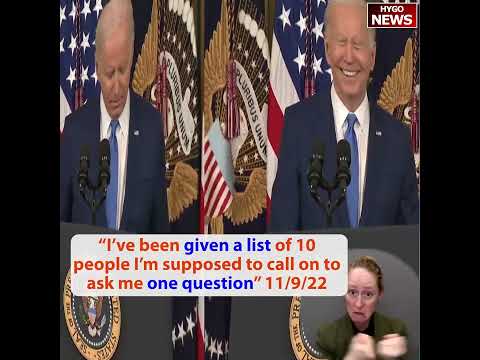
Biden’s Post-Midterm Press Conference: Calls From Preapproved List of 10 Reporters, Says “These 10 Questions Are Really Going Quickly”
On 11/9/2022, President Biden held his first formal White House press conference in 10 months — the day after the midterm elections. The event immediately revealed that Biden was working from a preapproved list of reporters, calling on them by name in sequence: “Nancy, CBS, Nancy Cordes… Phil, Phil Mattingly, CNN…” At one point Biden said, “These 10 questions are really going quickly. Well, I’ve got to meet with some of my talks of some” — inadvertently revealing that the press conference was pre-scripted to include exactly 10 questions. The format stripped away any pretense of spontaneous questioning: Biden knew who would be called, in what order, and how many questions there would be before he walked in.
”10 Questions Are Really Going Quickly”
The most revealing moment of the post-midterm press conference came when Biden said “these 10 questions are really going quickly.” The sentence confirmed what the pre-selected reporter pattern had already suggested: Biden had been told in advance there would be 10 questions, knew which 10 reporters he would call on, and was tracking the progression through his planned list.
A typical presidential press conference involves the reporter corps raising hands, the president picking who to call on based on visible enthusiasm or strategic balance, and the event continuing until the president decides to end it. The format allows for genuine back-and-forth because neither the president nor the reporters know exactly which questions will be asked until the moment of asking.
Biden’s press conference operated on the opposite model. The 10 questions were allocated to 10 specific reporters in advance. Biden had the list. The reporters presumably knew they were on the list and prepared accordingly. The “press conference” was closer to a scripted performance than a genuine news conference — a format Biden had used repeatedly throughout his presidency.
Calling Reporters by Name
The transcript showed Biden calling reporters in a specific sequence. “Nancy, CBS, Nancy Cordes,” Biden said, identifying the reporter by first name, network, and full name — indicating he was reading from a list rather than spotting someone in the audience.
“Phil, Phil Mattingly, CNN,” Biden continued — another named call with the same format.
The pattern continued throughout the event. Each reporter was identified by name before being called, and the calls followed a predetermined order. Biden’s comment “I’ve been saving them up” — made to one of the preselected reporters — acknowledged the relationship between him and the chosen correspondents that the format depended on.
The Journalistic Problem
The preapproved list approach created several journalistic problems. First, it eliminated the element of surprise that made genuine press conferences useful as accountability mechanisms. If Biden knew in advance which reporters he would face, his team could prepare for each specific reporter’s known interests and likely questions. The advantage that open press questioning typically provided — testing a politician’s unscripted reactions to tough questions — was lost.
Second, the format raised questions about which reporters were included and which were excluded. Fox News’s Peter Doocy was frequently combative with the administration; was he on the list? Reporters from conservative outlets with difficult questions; were they called on? The White House could structure the list to favor friendly outlets while marginalizing adversarial ones, and no transparency existed about how the list was determined.
Third, the preapproved format gave reporters on the list an incentive to ask questions the White House could answer comfortably, in exchange for being included in future lists. The implicit quid pro quo — call on me, and I’ll ask questions that don’t embarrass the president — corrupted the adversarial dynamic that made press conferences valuable.
”As You Mentioned, How Come We Never Hold You Guys”
The transcript also captured a reporter asking Biden about accountability. “As you mentioned, how come we never hold you guys in the same stand that you hold us to?” the reporter asked — a question that suggested concerns about whether the Biden administration was held to the same standards it applied to others.
Biden’s response was dismissive: “But anyway, go ahead” — moving immediately to the next reporter without engaging with the question. The deflection was consistent with Biden’s broader pattern: accept questions he could answer comfortably, deflect or cut off questions that were uncomfortable, and rely on the controlled format to prevent sustained challenges.
The 10-Month Gap
The November 9 press conference was Biden’s first formal White House press conference in approximately 10 months. The gap — from January 2022 to November 2022 — was historically unusual. Previous presidents had held formal press conferences at roughly monthly intervals, allowing the press corps multiple opportunities to press on policy decisions, respond to news events, and test presidential positions on emerging issues.
Biden’s avoidance of the format was widely attributed to his communications team’s concern about unscripted performance. The verbal stumbles, confused statements, and off-message remarks that characterized Biden’s public appearances were magnified in press conference settings, where sustained questioning gave reporters multiple opportunities to surface problematic responses.
The cost-benefit analysis inside the White House apparently concluded that the political damage from limited press conferences was less than the risk of damaging moments at sustained press events. The calculation was rational from a narrow communications perspective but corrosive to the democratic accountability function press conferences served.
”I’ve Been Saving Them Up”
A CBS reporter told Biden “I have a few questions. I’ve been saving them up” — an acknowledgment that the 10-month gap had created a backlog of questions the press corps couldn’t ask through routine briefings or shouted exchanges.
The “saving them up” comment highlighted the dysfunction of the Biden press relations strategy. When press conferences are regular, reporters can pursue timely questions as news events unfold. When press conferences are rare, reporters have to prioritize which accumulated questions to ask in limited opportunities, often missing follow-up opportunities because the next chance might be months away.
”Last Question. OK, Excuse Me”
Biden’s attempt to end the press conference was itself revealing. “Last question,” Biden said, then corrected himself: “OK, excuse me. These 10 questions are really going quickly.” The stumble suggested Biden was tracking his preapproved list of 10 reporters and realized he hadn’t completed the full list when he tried to wrap up.
“Well, I’ve got to meet with some of my talks of some” — Biden’s final, garbled sentence before ending the press conference — was characteristic of his speech patterns in late 2022. The phrase appeared to be trying to say “meet with some of my staff” or “meet with some of my talks,” but collapsed into incoherence before reaching a clear meaning.
Key Takeaways
- Biden’s first press conference in 10 months was built around a preapproved list of 10 reporters called by name in sequence.
- He said “these 10 questions are really going quickly” — revealing that the number of questions was predetermined before the event began.
- A CBS reporter acknowledged the 10-month gap: “I have a few questions. I’ve been saving them up.”
- The preapproved format eliminated the accountability value of press conferences by allowing White House preparation for each specific reporter.
- Biden’s attempt to end the press conference included a garbled sentence: “Well, I’ve got to meet with some of my talks of some.”
Transcript Highlights
The following is transcribed from the video audio (unverified — AI-generated from audio).
- As you mentioned, how come we never hold you guys in the same stand that you hold us to? But anyway, go ahead.
- Nancy, CBS, Nancy Cordes. — Thank you, Mr. President. I have a few questions. I’ve been saving them up.
- Phil, Phil Mattingly, CNN.
- Mr. President, last question is on humanity. Everybody else got some?
- These 10 questions are really going quickly.
- Well, I’ve got to meet with some of my talks of some.
Full transcript: 109 words transcribed via Whisper AI.