 HYGO News
 Texas Trooper: if no secure border, not recovery; FLOTUS: deepest sympathy; Trump: they loved God
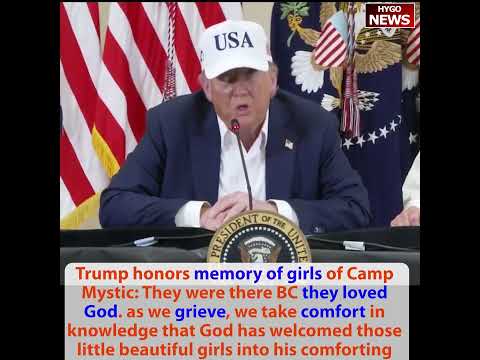
Texas Trooper: if no secure border, not recovery; FLOTUS: deepest sympathy; Trump: they loved God
President Trump and First Lady Melania Trump traveled to Kerrville, Texas in the aftermath of catastrophic flooding along the Guadalupe River — a disaster that claimed at least 135 to 140 lives, with more still missing, and that devastated Camp Mystic, a legendary girls’ Christian summer camp. Greeted by Governor Greg Abbott and lines of Texans along the highway, the Trumps met with grieving families, first responders, and law enforcement. A Texas state trooper thanked the president personally, linking the ability to surge recovery assets to the administration’s border security posture. FLOTUS offered her “deepest sympathy” to the parents of “beautiful young souls,” while POTUS honored the Camp Mystic girls, saying they “loved God” and were now in “his comforting arms in heaven.” The visit fused raw grief with the administration’s broader argument: that a secured southern border is not a separate issue from domestic emergency response, but a prerequisite for it.
Texas State Trooper Thanks Trump: Secure Border Made Recovery Possible
A Texas state trooper, speaking directly to the president during the Kerrville visit, tied the flood recovery operation to the administration’s border posture. In remarks captured on video, the trooper told Trump: “I want to thank you, too, sir — because if we didn’t have a secure border, we wouldn’t have this many assets to move. I wanted to say that to you personally.”
The comment reframes a debate often kept in separate policy silos. Border security and domestic disaster response are typically argued as distinct budget lines and distinct agencies. The trooper’s framing — coming from an operator inside the recovery itself, not a politician — collapses that distinction. His argument is operational, not ideological: if federal and state law enforcement are not tied down managing a porous border, they are available to surge to a flood zone and move assets where lives are at stake.
That is not a marginal claim. Disaster recovery at the scale of the Kerr County floods — with 135 to 140 confirmed dead and more missing, with Camp Mystic destroyed, with the Guadalupe River having risen 26 feet in under 45 minutes — depends on a very specific kind of capacity: staging areas, convoys, rescue teams, communication equipment, and the trained personnel who move all of it. When those personnel and that equipment are consumed elsewhere, recovery slows. When they are freed, recovery accelerates.
FLOTUS Melania Trump: “Our Nation Is Grieving With You”
The First Lady’s remarks centered on the parents. “My deepest sympathy to all of the parents who lost beautiful young souls,” Melania Trump said. “Deeper sympathy from all of us, to the community, to everybody who lost the loved one. We are grieving with you. Our nation is grieving with you.”
There is a reason first ladies are often tasked with this role. It is the part of the presidency that cannot be delegated to a press statement. It requires physical presence, eye contact, and the willingness to sit with grief that has no policy solution. Melania Trump’s language — “beautiful young souls,” “lost the loved one,” “we are grieving with you” — is deliberately simple. It does not reach for eloquence. It reaches for solidarity.
“We just met with the wonderful families,” she continued. “We pray with them. We hug. We hold hands. They share the stories.” That cadence — pray, hug, hold hands, listen — is the script for bereavement ministry, not political speechmaking. It is what parents of dead children actually need from a public figure: not analysis, but presence.
The Bracelet From Camp Mystic
One detail from the First Lady’s remarks cut through more sharply than any policy framing. “I met beautiful young ladies,” she said. “They gave me this special bracelet from the camp in honor of all of the little girls that they lost their lives.”
A bracelet. Handed across a line by a girl who lived, placed on the wrist of a First Lady, in honor of the friends who didn’t. It is the kind of moment that defines a presidential visit in memory more than any speech. The surviving campers were not asking for anything. They were making sure the dead were remembered.
“We are here to honor them and also to give the support, help,” Melania Trump said. “I will be back. I promise to them and I just pray for them and giving them my strength and love.” The promise to return is not a throwaway line. In disaster communities, the first visit is expected. The second, months later after the cameras have left, is the one that gets noticed.
The Scale of the Water: “A Giant, Giant Wave in the Pacific Ocean”
President Trump, speaking to reporters, tried to convey the sheer hydraulic force of what hit the Guadalupe River valley. “Anyone’s ever seen Guadalupe River rose 26 feet in less than 45 minutes,” he said. “And I’ve even heard it went well over 30 feet. There’s one story that one person said it had to be 60 feet at one moment.”
Then the comparison: “This is like a giant, giant wave in the Pacific Ocean. That the best surfers in the world would be afraid to surf.”
The president’s analogy is meant to do something specific for an audience that has never seen an inland flash flood of that magnitude. Most Americans understand ocean waves. Most do not understand what happens when a relatively narrow river channel receives the runoff from a stalled storm cell dumping biblical amounts of rain onto hill country. A 26-foot rise in 45 minutes is not a flood in the way most people picture floods. It is a wall.
“A catastrophic flooding,” Trump said, “as the most residents were asleep in their beds. A very dark evening.” That is the detail that matters most for understanding the death toll. The water came at night. The water came fast. The victims, in many cases, never had the chance to be warned, to hear a siren, to reach higher ground. They were in cabins, in beds, in the dark.
”The Waters Claimed at Least 135, 140 Lives”
Trump delivered the grim arithmetic directly. “The waters claimed at least 135, 140 lives,” he said. “They’re getting that count, but the count that they don’t have is how many are still missing with a lot of lives, a lot of young angels.”
The gap between confirmed dead and missing is the gap families are living inside. For every body recovered, there is a family that now knows. For every name on the missing list, there is a family that does not. Search operations in flash-flood debris are slow and brutal — crews work through tangled brush, collapsed structures, and mud deposits that can be ten feet deep — and the missing can remain missing for weeks.
“A lot of young angels” was Trump’s chosen phrase. It is a phrase that belongs to a specific American Christian register of mourning, and in Kerr County — in a county that grieves Camp Mystic — it is the right register.
Camp Mystic: “A Legendary Camp”
The president lingered on what Camp Mystic was, and what its destruction means. “At the girls Christian summer camp, known as Camp Mystic,” he said, “a legendary camp, a camp that people would want to go to from all over the country. People, parents, they come and they would stay with their children. They’d stay in other cabins just to be with their children, but a legendary place.”
For anyone unfamiliar: Camp Mystic is not a generic summer camp. It is a multi-generational institution in Texas — the kind of place mothers attended as girls and then sent their own daughters to, the kind of place where family names recur on cabin rosters across decades. Parents coming to stay in other cabins just to be near their children is a detail that only makes sense in the culture of that specific camp.
“They were there because they loved God,” Trump said. That sentence is the hinge. It is where the president moved from describing what the camp was to describing why the loss cuts the way it does. These girls were not accidentally at Mystic. Their families sent them there for a reason rooted in faith.
”God Has Welcomed Those Little Beautiful Girls Into His Comforting Arms”
Trump’s closing framing was explicitly theological. “We grieve this unthinkable tragedy,” he said. “We take comfort in the knowledge that God has welcomed those little beautiful girls into his comforting arms in heaven. And we believe that, have to believe that, and we do.”
The repetition — “we believe that, have to believe that, and we do” — is unusual for a president speaking on camera. It is the cadence of someone articulating, in real time, the reason the grief is survivable. The theology is not academic. For the families at Camp Mystic, belief that their daughters are in heaven is not a comfort added on top of the loss. It is the only structure holding the loss inside a life that must continue.
Trump’s decision to voice that theology on behalf of the nation — “we believe that, have to believe that” — is the most specifically religious framing he has offered in a disaster response. It is calibrated for Kerr County and for the camp’s community of faith. In a different disaster, in a different place, that framing would not fit. Here, it does.
The Welcome Along the Highway
Before the remarks, before the families, before the bracelet, there was the drive in. Texans lined the highways in Kerr County to welcome POTUS and FLOTUS. Flags, hand-painted signs, farm trucks parked on shoulders — the iconography of rural Texas greeting a presidential motorcade during a moment of shared mourning.
That welcome carries a message too. It is the community telling the president: come, we want you here, we are not too broken for this. Disaster-struck communities sometimes greet presidential visits with ambivalence or even hostility, especially if the federal response is perceived as late or inadequate. The Kerr County welcome was the opposite — a community leaning in, wanting the president’s presence on its soil.
Governor Greg Abbott greeted the Trumps on arrival. The governor’s coordination with the federal government on the flood response has been visible and consistent, and his presence at the greeting was a signal of cooperative state-federal operations rather than the friction that sometimes accompanies disaster politics.
The Border-Recovery Link, Revisited
It is worth returning to the trooper’s comment, because it is the unusual political artifact of this visit. Most presidential disaster visits do not produce a direct line from a uniformed state trooper thanking the commander in chief for a policy decision unrelated to the disaster itself.
The trooper’s logic, stated plainly: fewer border crises means more troopers, more National Guard, more ICE and DHS personnel available to move to Kerr County. More assets means faster recovery. Faster recovery means more lives saved and more bodies recovered for families who need to bury their dead.
Whether one accepts that framing or disputes it as a stretch, the fact that a Texas state trooper chose to make that argument on camera, to the president’s face, in the middle of a flood recovery, is itself the news. It tells you something about how state law enforcement in Texas is thinking about the relationship between border posture and domestic capacity. It is not a think-tank paper. It is an operator’s view, delivered with a handshake.
What Kerrville Asked of the Visit
Disaster visits by presidents are judged by the communities that receive them. The test is not national polling. The test is: did the president listen, did the First Lady hold a hand, did the survivors feel seen, did the dead feel honored, did the promises feel credible.
By the artifacts that emerged — the bracelet, the theology, the families who “share the stories,” the First Lady’s promise to return, the governor’s coordinated welcome, the trooper’s thanks — Kerrville appears to have received what it asked for. The national conversation will move on. The families of Camp Mystic will not. What remains is the promise, implicit and explicit, that the federal government and the state of Texas will keep moving assets as long as there are still girls to find and families to rebuild.
Key Takeaways
- A Texas state trooper personally thanked Trump during the Kerrville visit, arguing that a secure border freed up the law enforcement and logistical assets needed to mount the flood recovery: “if we didn’t have a secure border, we wouldn’t have this many assets to move.”
- First Lady Melania Trump delivered her condolences in the cadence of bereavement ministry, offering her “deepest sympathy” to parents of “beautiful young souls” and pledging: “I will be back. I promise to them.”
- Surviving Camp Mystic girls gave the First Lady a bracelet “in honor of all of the little girls that they lost their lives” — a detail that crystallized the visit’s meaning more than any official remarks.
- President Trump described the Guadalupe River’s 26-foot rise in under 45 minutes as “like a giant, giant wave in the Pacific Ocean” that “the best surfers in the world would be afraid to surf,” and confirmed at least 135 to 140 dead with more still missing.
- Honoring the Camp Mystic girls, Trump offered explicitly theological framing: “They were there because they loved God … God has welcomed those little beautiful girls into his comforting arms in heaven” — repeating “we believe that, have to believe that, and we do.”