 HYGO News
 Terrible man: KJP Defends Release Violent Russian Arms Dealer Saying Negotiations 'Very Difficult'
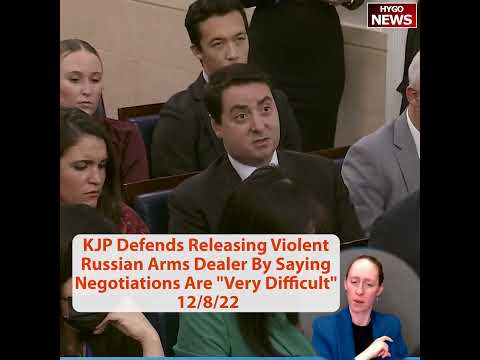
KJP Defends Release of Viktor Bout — Man Who Conspired to Kill American DEA Agents: “Immediate Results Can Feel Unfair or Arbitrary”
On 12/8/2022, a reporter pressed White House Press Secretary Karine Jean-Pierre on criticism of the Biden administration’s release of Viktor Bout — the Russian arms dealer convicted of conspiring to sell weapons that would have been used to kill American DEA agents. The reporter noted that Preet Bharara, who had been the top federal prosecutor in New York when Bout was sentenced to 25 years, had called Bout someone who “had conspired to sell AK-47s that he knew would have been used to kill Americans, American drug agents.” The reporter asked what Biden’s message was to law enforcement officials unhappy with Bout’s release and to “others who say, essentially, that this was a bad deal, that this is a terrible man who has not fully paid his debt.” KJP’s response acknowledged that “immediate results can feel unfair or arbitrary” but defended the trade as necessary for securing Griner’s release.
The Viktor Bout Criminal History
The reporter’s question was grounded in Bout’s documented criminal history. “We are talking about a man who, when he was sentenced to 25 years, Pripyat Baraha, who at the time was the top federal prosecutor in New York, said that this was someone who had conspired to sell AK-47s that he knew would have been used to kill Americans, American drug agents,” the reporter said.
“Pripyat Baraha” was a transcription error for Preet Bharara, the former U.S. Attorney for the Southern District of New York who had overseen Bout’s prosecution. Bharara’s characterization of Bout was well-documented from the 2012 sentencing:
Conspiracy to kill Americans — Bout had agreed to sell weapons to people he believed were planning to kill American DEA agents.
AK-47 sale conspiracy — Specific weapons were to be used against U.S. personnel.
International arms trafficking — Bout had supplied weapons to conflict zones globally.
Sting operation conviction — The specific case was based on a DEA sting operation that caught Bout agreeing to the sale.
Bout was commonly called “the Merchant of Death” — a nickname reflecting his role as one of the most prolific arms traffickers in modern history. He was believed to have supplied weapons to:
- Various African conflict zones
- Middle Eastern militant groups
- Latin American drug cartels
- Multiple African dictators
- The Taliban
- Various terrorist organizations
His release after serving only 11 years of a 25-year sentence — and specifically in exchange for a WNBA player — generated significant controversy even among some Democrats.
The Law Enforcement Perspective
The reporter specifically raised law enforcement concerns. “Law enforcement officials may not be happy with his release. What’s the president’s message to them and to others who say, essentially, that this was a bad deal, that this is a terrible man who has not fully paid his debt?” the reporter asked.
The law enforcement framing was important because:
DEA agents had been directly threatened — The specific case involved agents Bout had agreed to have killed.
Significant law enforcement resources — Had been devoted to capturing and prosecuting Bout.
International cooperation — Bout’s capture had involved extensive international law enforcement work.
Precedent concerns — Releasing Bout created incentives for future hostage-taking to secure releases of other criminals.
Agent safety implications — Message sent to agents who risk their lives.
The reporter was asking Biden to address these legitimate law enforcement perspectives. What would the President tell agents whose colleagues had been targets of Bout’s conspiracy? What would he tell families of agents who had served in the DEA during the period when Bout was providing weapons to drug trafficking operations?
”Terrible Man Who Has Not Fully Paid His Debt”
The reporter’s phrasing was pointed. “Terrible man who has not fully paid his debt” was a reference to both the moral character issue (terrible man) and the legal issue (incomplete sentence).
Bout had served only 11 years of his 25-year sentence. The “debt to society” framing implied that criminal sentences represent societal debts that convicted criminals must pay. Early release — especially for such a serious criminal — was effectively forgiving an unpaid portion of that debt.
The “terrible man” characterization aligned with multiple assessments:
- Federal prosecutors’ characterizations
- Various foreign governments’ assessments
- United Nations reports on his activities
- Journalistic investigations
- Victims’ families’ descriptions
There was little disagreement about whether Bout was indeed a terrible person. The question was whether trading a terrible person to secure an American’s release was the right choice.
”Negotiations for Release Are Often Very Difficult”
KJP’s opening response emphasized negotiation difficulty. “So look, negotiations for release of wrongful detainees are often very difficult. That’s just a reality,” KJP said.
The framing of “very difficult” negotiations acknowledged what was fundamentally true about hostage situations. The United States often faced bad choices:
Refuse to negotiate — Leaving Americans in foreign prisons, sometimes for years.
Pay high prices — Releasing dangerous criminals or paying cash for releases.
Military intervention — Rarely feasible and often counterproductive.
Wait for regime change — May never come, leaving Americans indefinitely detained.
None of these options were attractive. Any administration facing a hostage situation had to weigh competing bad outcomes against each other.
”The Price That Must Be Paid”
KJP elaborated on the trade-off framing. “In part because of the price that must be paid to bring Americans home to their loved ones,” KJP said.
The “price that must be paid” language was interesting. It acknowledged that securing American releases came at a cost — in this case, releasing Viktor Bout. But the framing treated this cost as necessary rather than chosen.
This framing had political advantages:
- It made the decision seem forced rather than discretionary
- It shifted responsibility to the situation rather than to the administration
- It made alternatives seem non-existent
But the framing also had limitations. The choice had actually been discretionary. The administration could have:
Refused the Bout trade — Leaving Griner detained.
Insisted on including Fogel and Whelan — Other detained Americans.
Waited for better terms — Russia might have offered different options.
Negotiated different Russian detainees — Other prisoners might have satisfied Russia.
The “price that must be paid” framing obscured that the administration had chosen among various options. The specific choice to release Bout for Griner alone had been an administration decision, not a forced necessity.
”Can Feel Unfair or Arbitrary”
KJP acknowledged the fairness concerns. “In part because of immediate results can feel unfair or arbitrary, right, to your poor,” KJP said.
The final phrase “to your poor” seemed incomplete — possibly “to your point” or similar — another of KJP’s typical verbal fragments. But the substantive acknowledgment was important.
KJP was acknowledging that:
- Results might feel unfair
- Results might feel arbitrary
- These feelings were understandable
- They reflected reality of negotiation outcomes
But she didn’t address the specific unfairness the reporter had raised. The reporter wasn’t asking a general question about fairness — the reporter was asking about the specific unfairness of trading a convicted would-be killer of Americans for a WNBA player who had brought hashish oil into Russia.
The specific unfairness concern went beyond general difficulty:
Asymmetric severity — Bout’s crimes were violent; Griner’s was possession.
Targeting Americans — Bout specifically conspired against U.S. personnel.
Still-serving sentence — Bout had served less than half his sentence.
No Griner-side reciprocity — Griner hadn’t committed crimes against Russians.
These specific asymmetries produced the “unfair or arbitrary” feeling KJP acknowledged. But acknowledgment wasn’t explanation. The reporter was asking the administration to justify the asymmetry, not just to acknowledge that it existed.
The Missing Law Enforcement Response
KJP’s response notably didn’t address the law enforcement component of the question. The reporter had specifically asked about Biden’s message to law enforcement officials. KJP’s answer was about general negotiation challenges, not about law enforcement concerns.
What might law enforcement officials have wanted to hear from the administration?
Acknowledgment of their sacrifices — Recognition that agents had risked their lives.
Commitment to future accountability — Promise to monitor Bout and prevent further crimes.
Consultation commitment — Pledge to involve law enforcement in future similar decisions.
Alternative strategies — Approaches to preventing future hostage situations.
Apology for insufficient consideration — If that was accurate.
KJP’s response offered none of these specifically. The law enforcement community would have to infer what Biden’s message to them was from generic statements about negotiation difficulty.
The Other Detained Americans
The Bout-Griner trade also implicitly raised questions about other Americans detained by Russia:
Paul Whelan — A former Marine arrested in Russia in 2018 on espionage charges, still detained.
Marc Fogel — The teacher arrested on marijuana charges, still detained.
Other American citizens — Various Americans in Russian custody for various reasons.
The Bout trade had secured only Griner’s release. Whelan and Fogel remained detained. This outcome raised questions about:
- Why Bout was only worth one American release
- Why Russia agreed to release Griner but not others
- Whether the administration had negotiated hard enough for others
- What criteria determined which Americans got priority attention
KJP’s “very difficult” framing didn’t address these questions. The negotiations had produced a specific outcome. That outcome had specific implications for other Americans who remained detained. The administration’s explanations didn’t address those implications.
Key Takeaways
- A reporter raised criticism of Viktor Bout’s release, citing prosecutor Preet Bharara’s description of Bout as conspiring to sell AK-47s “knowing they would be used to kill Americans, American drug agents.”
- The reporter asked Biden’s message to law enforcement officials unhappy with the release and to others calling it a “bad deal.”
- KJP defended negotiations for detainee release as “often very difficult.”
- She framed Bout’s release as “the price that must be paid to bring Americans home.”
- KJP acknowledged results “can feel unfair or arbitrary” but didn’t specifically address law enforcement concerns about releasing a man who had targeted DEA agents.
Transcript Highlights
The following is transcribed from the video audio (unverified — AI-generated from audio).
- There’s some criticism of the release of Victor Bout.
- This was someone who had conspired to sell AK-47s that he knew would have been used to kill Americans, American drug agents.
- Law enforcement officials may not be happy with his release. What’s the president’s message to them and to others who say this was a bad deal, that this is a terrible man who has not fully paid his debt?
- Negotiations for release of wrongful detainees are often very difficult. That’s just a reality.
- In part because of the price that must be paid to bring Americans home to their loved ones.
- Immediate results can feel unfair or arbitrary.
Full transcript: 171 words transcribed via Whisper AI.