 HYGO News
 Supreme Court on forcing designer to create expressive wedding designs for a same-sex couple
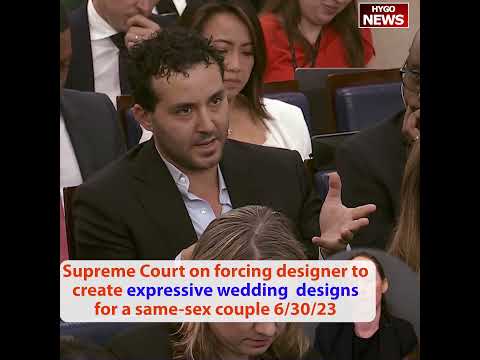
Supreme Court Rules Designer Cannot Be Forced to Create Expressive Wedding Designs for Same-Sex Couples — White House Responds
On June 30, 2023, the same day the Supreme Court struck down President Biden’s student loan forgiveness program, the Court also issued its ruling in 303 Creative LLC v. Elenis, holding that a Colorado web designer could not be compelled under the state’s anti-discrimination law to create custom wedding websites for same-sex couples. During the White House press briefing, a reporter pressed Press Secretary Karine Jean-Pierre on the practical implications of the ruling, revealing the administration’s inability to articulate what the decision actually meant beyond calling it “the wrong decision.”
KJP Struggles to Explain the Ruling’s Impact
The exchange between the reporter and Jean-Pierre was notable for the press secretary’s visible difficulty engaging with the substance of the Court’s decision. The reporter began by asking about a core concept in Justice Gorsuch’s majority opinion: the distinction between a routine service and an “expressive original design.”
The reporter asked: “What is an ‘expressive original design’?”
KJP responded: “Say that one more time.”
After the reporter repeated the question and reframed it to ask whether the administration had a clearer sense of who the decision would actually impact, KJP offered only a general statement of disapproval.
“I mean, I don’t have like a number or a list of who — of who this is going to impact,” KJP said. “What we know and understand is this was — this was a — the wrong decision. This was incredibly disappointing that decision was made.”
The reporter pressed further, noting that the Court’s opinion specifically tried to draw a line between providing a service (which could still be subject to anti-discrimination laws) and creating an expressive design (which the Court held was protected speech under the First Amendment).
“The Court tries to distinguish in its decision — the Gorsuch’s decision — between a service and an expressive design. And I’m just trying to get a sense of if you feel like you understand that distinction?” the reporter asked.
KJP declined to engage: “So, I hear you. I’m just not going to get into specifics.”
The White House Pivots to Broader Messaging
Rather than addressing the legal nuances of the ruling, Jean-Pierre pivoted to the administration’s standard messaging on LGBTQ discrimination.
“More broadly, this is a problem. Right? This is clear discrimina- — this is going to — clearly opened another avenue, another door to discriminating against a vulnerable community,” KJP said. “And so, the President is going to continue to enforce federal anti-discrimination protections, and he’s going to call on Congress to move forward with the Equality Act.”
The reference to the Equality Act — a bill that would amend federal civil rights law to explicitly prohibit discrimination based on sexual orientation and gender identity — was the administration’s default policy response on LGBTQ issues. The bill had passed the House in 2021 but stalled in the Senate, and there was no realistic prospect of it advancing in the Republican-controlled House in 2023.
The gap between the reporter’s substantive question and KJP’s messaging-driven response highlighted a recurring dynamic in White House press briefings. The reporter wanted to understand the practical scope of the ruling — specifically, what kinds of businesses and services would now be able to invoke First Amendment protections to decline work related to same-sex weddings. The White House either had not prepared a detailed analysis of the ruling’s implications or chose not to share one, defaulting instead to broad disapproval.
The 303 Creative Ruling Explained
The Supreme Court’s 6-3 decision in 303 Creative LLC v. Elenis was one of the most significant First Amendment cases in years. Lorie Smith, a Colorado web designer, challenged the state’s Anti-Discrimination Act, which prohibited businesses from refusing service based on sexual orientation. Smith wanted to expand her business to include custom wedding websites but said her religious beliefs prevented her from creating sites celebrating same-sex marriages.
Justice Gorsuch, writing for the majority, ruled that the First Amendment’s free speech protections prohibited Colorado from compelling Smith to create expressive content that conveyed messages she disagreed with. The decision turned on the distinction between commercial services that are offered to all customers equally (such as selling a pre-made product) and custom expressive work that involves the creator’s artistic judgment and voice.
The majority held that the wedding websites Smith would create were a form of “pure speech” because each one would be a unique, custom-designed expression celebrating a specific couple’s relationship. Forcing her to create such speech for same-sex weddings would violate the First Amendment regardless of the state’s interest in preventing discrimination.
Justice Sotomayor wrote a forceful dissent, arguing that the ruling “for the first time in its history, grants a business open to the public a constitutional right to refuse to serve members of a protected class.” The dissent warned that the logic of the decision could extend far beyond web design to any business that claimed its work involved expressive content.
The Distinction the White House Would Not Discuss
The reporter’s question about the difference between a “service” and an “expressive original design” went to the heart of the ruling’s practical impact. The Court explicitly stated that its decision did not give businesses a blanket right to discriminate. Rather, it applied specifically to situations where a business was being asked to create custom expressive work — speech — that conveyed a message the business owner disagreed with.
Under the ruling, a web designer who sold pre-made templates could not refuse to sell one to a same-sex couple. But a designer who created custom, bespoke wedding websites involving personal messages and artistic expression could decline to create one that celebrated a same-sex marriage. The line between these two categories — routine services versus expressive designs — was exactly what the reporter was trying to get the White House to address.
The administration’s refusal to engage with this distinction meant that the public received no guidance from the White House on the practical scope of the ruling. Instead, they got a general statement that the decision “opened another avenue, another door to discriminating against a vulnerable community,” which, while reflecting the administration’s genuine concerns, did not help clarify what the ruling did and did not permit.
A Day of Two Major Supreme Court Decisions
The 303 Creative ruling landed on the same day as the student loan forgiveness decision, creating a one-two punch for the Biden administration from the conservative-majority Court. Both decisions were 6-3, with the same justices in the majority and dissent, and both represented setbacks for the administration’s policy agenda.
The coincidence of timing meant the 303 Creative ruling received less attention than it might have on its own. The student loan decision directly affected tens of millions of borrowers and dominated the news cycle. The 303 Creative case, while legally significant, affected a narrower set of circumstances and was easier for the administration to address with general messaging about discrimination rather than detailed policy responses.
Key Takeaways
- The Supreme Court ruled 6-3 in 303 Creative LLC v. Elenis that a web designer could not be compelled to create custom wedding websites for same-sex couples, holding that the First Amendment protects against compelled expressive speech.
- White House Press Secretary Karine Jean-Pierre was unable to explain the Court’s distinction between a routine service and an “expressive original design,” declining to engage with the legal substance and calling the ruling “the wrong decision.”
- KJP said the ruling “opened another avenue, another door to discriminating against a vulnerable community” and called on Congress to pass the Equality Act, a bill that had stalled in the Senate.
- Justice Gorsuch’s majority opinion held that custom wedding websites constituted “pure speech” that could not be compelled by anti-discrimination laws, while Justice Sotomayor’s dissent warned the ruling could extend to any business claiming its work involved expressive content.
- The ruling landed on the same day as the student loan forgiveness decision, creating a double setback for the Biden administration from the conservative-majority Court.